
In This Article
If you’ve ever settled into your office chair at 9 a.m. only to find yourself perched on what feels like a medieval torture device by lunchtime, you already know the problem. Standard office chairs simply aren’t built for the punishment that shift workers, call centre staff, control room operators, and intensive-use environments dish out day after day—or rather, shift after shift.
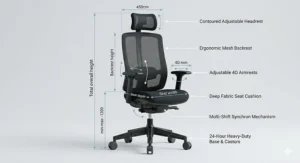
A 24 hour office chair is specifically engineered to withstand continuous use across multiple shifts without collapsing into a sad pile of broken dreams and dodgy pneumatic cylinders. Unlike regular desk chairs tested for eight-hour use by someone weighing up to 110 kg (under BS EN 1335-2), these industrial-strength pieces are certified to BS 5459-2:2000, meaning they’re rated for round-the-clock operation by individuals weighing up to 150 kg or more. What this translates to in the real world: your chair won’t give up the ghost halfway through a night shift, leaving the next person to inherit a wobbly disaster.
The British climate adds another layer to the equation—our damp, drizzly weather means moisture can seep into cheaper materials, accelerating wear on everything from fabric upholstery to foam padding. Couple that with the compact office spaces typical in UK workplaces (think cramped call centres in Manchester or tight control rooms in London’s financial district), and you need seating that’s not just durable but also properly engineered for both comfort and longevity. According to the UK Health and Safety Executive, poor seating contributes significantly to workplace musculoskeletal disorders, costing British businesses millions in lost productivity each year.
In this guide, we’ve researched the best 24 hour office chairs available on Amazon.co.uk in 2026, focusing on models that actually deliver on their promises. We’ll cover everything from budget-friendly options around £100 to premium commercial-grade seating in the £400-£600 range, all available for delivery across the UK.
Quick Comparison: Top 24 Hour Office Chairs at a Glance
| Product | Weight Capacity | Key Feature | Price Range | Best For |
|---|---|---|---|---|
| MELOKEA ReliefBack Max | 200 kg | Auto-chasing lumbar | £180-£220 | Heavy-duty users |
| HOMCOM Ergonomic Mesh | 120 kg | 4-level back adjustment | £130-£160 | Mid-range comfort |
| ELFORDSON Maxon Series | 150 kg | Dynamic lumbar support | £140-£170 | Office professionals |
| MELOKEA F064 Wide Seat | 200 kg | Extra-wide design | £150-£190 | Larger users |
| ELFORDSON Executive Dual Padding | 180 kg | Dual-layer foam | £110-£140 | Budget premium |
| HOMCOM High Back Fabric | 120 kg | Silent swivel wheels | £80-£110 | Budget choice |
| PZDO Heavy Duty Fabric | 159 kg (350 lbs) | Ultra-thick spring seat | £120-£150 | Long-shift workers |
From the comparison above, the MELOKEA ReliefBack Max offers the best weight capacity and innovative features for users who need serious support, though you’re paying a premium in the £180-£220 range. If you’re working with a tighter budget but still need proper 24-hour durability, the ELFORDSON Executive at £110-£140 provides excellent value—just be aware you’re sacrificing some of the advanced ergonomic adjustability. For call centres or environments where multiple users of varying sizes share equipment, the wider models like the MELOKEA F064 justify their cost by accommodating everyone comfortably without constant readjustment.
💬 Just one click — help others make better buying decisions too!😊
Top 7 24 Hour Office Chairs: Expert Analysis
1. MELOKEA ReliefBack Max Ergonomic Office Chair (200kg Capacity)
The standout feature here is the auto-chasing lumbar support system—rather than fiddling with knobs mid-shift, the chair intelligently adjusts to your lower back’s position and movement. It’s powered by a weight-activated mechanism that detects your body weight and automatically calibrates tilt resistance, which means lighter and heavier users can share the same chair without anyone feeling like they’re fighting against the mechanism or getting catapulted backwards.
Built with a sturdy steel frame, SGS-certified gas lift, and durable PU castors, this chair genuinely supports up to 200 kg. The seat height adjusts from 47 to 56 cm, making it suitable for users between 1.6 and 2.05 metres tall—covering most of the UK population comfortably. The breathable mesh fabric is particularly useful during British summer heatwaves (all three days of them) and prevents that sticky, sweaty feeling you get with cheap PU leather. UK buyers report that the 8 cm thick seat cushion provides proper support even during 10-12 hour shifts, though a handful mention needing a few days to break it in.
This chair meets EN 12520 testing standards, and MELOKEA’s 5-year warranty suggests they’re confident it’ll last. What most buyers overlook is that the mesh construction handles our damp climate rather well—unlike fabric chairs that can develop that musty smell in poorly ventilated offices. Worth noting: assembly takes about 20-30 minutes, and a few UK reviewers mentioned the instructions could be clearer, though the process is fairly straightforward if you’ve built flatpack furniture before.
Pros:
✅ 200 kg weight capacity with auto-adjusting tilt mechanism
✅ Dynamic lumbar support that follows your movements
✅ Breathable mesh stays cool during long shifts
Cons:
❌ Premium price point (£180-£220 range)
❌ Assembly instructions could be more detailed
Price & Value: At around £180-£220, it sits in the upper-mid range but delivers commercial-grade durability that cheaper chairs simply can’t match. For intensive-use environments, the cost per year works out favourably.
2. HOMCOM Ergonomic Mesh Office Chair (120kg Capacity)
HOMCOM’s offering brings 4-level back adjustment and a separated backrest design that cradles your spine’s natural curve more effectively than single-piece backs. The dual-zone backrest combined with independent lumbar support means you can dial in support exactly where your lower back needs it, which is particularly useful if you’re one of those people who shifts position frequently during long conference calls or data entry marathons.
The 3D flip-up armrests are cleverer than they first appear—they adjust up and down, swivel left and right, and flip completely out of the way when you need to tuck close to your desk or slide under it. For UK offices with those narrow desks common in older buildings, this feature genuinely matters. The chair reclines up to 135° with a retractable footrest, transforming it into a semi-horizontal rest position during breaks—though this is more useful for home offices than shared workspaces where colleagues might judge you for looking too comfortable.
UK reviewers generally praise the breathable mesh and robust metal base, though some mention the 120 kg weight limit feels conservative compared to the 200 kg heavy-duty models. The chair performs well for average-sized users doing standard 8-10 hour shifts, but it’s not quite the bulletproof option needed for round-the-clock multi-user environments. The silent swivel wheels are a genuine benefit in open-plan offices where noise discipline matters.
Pros:
✅ Excellent adjustability with separated backrest design
✅ 135° recline with footrest for break-time comfort
✅ 3D armrests that flip up and out of the way
Cons:
❌ 120 kg capacity lower than true heavy-duty models
❌ Mesh seat may sag over time for heavier users
Price & Value: In the £130-£160 range, it’s a solid mid-market choice for single-user home offices or lighter commercial use, though not quite robust enough for intensive 24-hour shift environments.
3. ELFORDSON Maxon Series Ergonomic Mesh Chair (150kg Capacity)
ELFORDSON’s Maxon series features what they call “divisional lumbar support”—an innovative system where the lumbar cushion adjusts automatically based on your posture rather than requiring manual fiddling. In practice, this means you can shift from typing to leaning back to read documents without the lumbar support poking you in the wrong spot. The support and movement balance instantly and automatically, which saves considerable time over a week of shifts.
The high-standard A1-class mesh fabric is genuinely breathable, allowing air circulation even during those sweltering July afternoons when British offices turn into ovens because no one anticipated actually needing air conditioning. The waterfall-edge seat design at the front prevents the common problem of circulation being cut off at the back of your thighs—something standard flat-edge seats often cause during extended sitting.
UK buyers appreciate that ELFORDSON positions itself as a professional-grade manufacturer, though some reviewers note the chair feels slightly less substantial than the 200 kg-rated models. The 150 kg capacity puts it squarely in the “heavy-duty but not extreme” category, suitable for most users in typical office environments. The 90° flip-up armrests are particularly useful in compact UK workspaces where you need to tuck chairs fully under desks to preserve walking space.
Pros:
✅ Automatic divisional lumbar support system
✅ Breathable A1-class mesh for year-round comfort
✅ Waterfall-edge seat improves circulation
Cons:
❌ 150 kg capacity middle-ground for heavy-duty claims
❌ Some users report armrests feel slightly plasticky
Price & Value: At £140-£170, it occupies the sweet spot between budget and premium, offering strong value for office professionals who need reliable all-day support without breaking the bank.
4. MELOKEA F064 Wide Seat Ergonomic Chair (200kg Capacity)
Specifically designed for larger users and European body types, the F064 features an extra-wide seat that doesn’t make you feel like you’re being squeezed into a sardine tin. The high-density shaping foam maintains its structure even after months of intensive use—none of that sad collapse you get with cheap foam that bottoms out after three months. UK buyers particularly appreciate that the foam reduces hip pain during extended sitting, a common complaint with narrower chairs.
The chair’s 200 kg capacity isn’t just marketing bluster—it’s built with reinforced components throughout, from the base to the gas lift to the frame. MELOKEA designed this with over 10 million users in mind (according to their claims), and the engineering shows in details like the robust caster wheels that glide smoothly on both carpet and hard floors without developing that annoying squeak or sticking.
What the spec sheet won’t tell you: this chair performs exceptionally well in the damp British climate. The materials resist moisture absorption better than fabric alternatives, preventing that musty smell that develops in poorly ventilated offices. A handful of UK reviewers mention a slight chemical odour upon first unboxing—standard for new products—which dissipates after a few days in a well-ventilated space.
Pros:
✅ Extra-wide seat accommodates larger users comfortably
✅ High-density foam maintains structure over time
✅ 200 kg capacity with reinforced construction
Cons:
❌ Wider footprint may not suit very compact workspaces
❌ Initial chemical smell (dissipates within 2-3 days)
Price & Value: Around £150-£190 positions this as excellent value for users who need genuine heavy-duty support without venturing into the £400+ premium territory. The wider seat justifies the cost for comfort over standard-width alternatives.
5. ELFORDSON Executive Dual Padding Chair (180kg Capacity)
The dual-layer back padding in this executive-style chair makes a noticeable difference compared to single-layer alternatives—you’re getting luxurious foam padding that maintains support without feeling like you’re sitting on a park bench by hour six. The breathable linen fabric is particularly well-suited to UK offices, handling our climate’s humidity better than synthetic materials whilst still being durable enough for multi-user environments.
The 150° recline with built-in footrest transforms this from a task chair into something approaching a recliner during breaks, though this feature works better for home offices than shared workspaces. The high back design provides full spinal support from your lower back up to your shoulder blades, addressing the common complaint of mid-back fatigue that plagues desk workers.
UK reviewers consistently mention the chair’s 180 kg capacity feels genuine—there’s no flexing or creaking under load. The fabric linen upholstery adds a touch of sophistication that PU leather and mesh alternatives can’t match, making this suitable for client-facing offices or executive spaces. Assembly is relatively straightforward, taking around 25 minutes with the included tools.
Pros:
✅ Dual-layer foam padding for genuine comfort
✅ Breathable linen fabric suits UK climate
✅ 180 kg capacity with solid construction
Cons:
❌ Linen fabric may show stains more readily than PU leather
❌ 150° recline angle excessive for some work environments
Price & Value: In the £110-£140 range, this delivers premium features at a mid-market price point. Excellent value for those wanting executive styling with genuine heavy-duty construction.
6. HOMCOM High Back Fabric Office Chair (120kg Capacity)
HOMCOM’s budget offering proves you don’t need to spend £200+ to get decent ergonomic support for standard office work. The dual-layer padding provides adequate comfort for 6-8 hour shifts, though it’s not quite engineered for the round-the-clock punishment that true 24-hour chairs handle. The silent swivel wheels are a standout feature at this price point—genuinely quiet on both carpet and hard floors, which matters considerably in shared offices.
The high back design with padded lumbar support addresses the basics well, offering height adjustment, tilt function, and fixed padded arms. It’s not packed with the advanced features of pricier models (no 4-way adjustable arms, no reclining back, no footrest), but for straightforward desk work, it ticks the essential boxes. UK buyers working from spare bedrooms or small home offices appreciate the relatively compact footprint.
What most reviewers note: this chair performs admirably for single-user home office scenarios but shows wear more quickly in intensive commercial environments. The 120 kg weight limit is honest—right at the threshold where EN 1335-2 standard chairs typically max out. For budget-conscious buyers who need something better than a £40 disaster but can’t justify £150+, this occupies a useful niche.
Pros:
✅ Budget-friendly pricing (£80-£110)
✅ Silent swivel wheels for quiet operation
✅ Dual-layer padding adequate for standard shifts
Cons:
❌ 120 kg limit not suitable for heavier users
❌ Lacks advanced adjustability of premium models
Price & Value: At £80-£110, this is the best budget option for home offices or light commercial use, though not robust enough for genuine 24-hour shift environments.
7. PZDO Heavy Duty Fabric Office Chair (159kg/350lbs Capacity)
PZDO’s offering brings an ultra-thick spring seat that maintains its bounce even after months of use—none of that sad compression where you eventually feel the base plate through exhausted foam. The 159 kg (350 lbs) capacity puts this firmly in heavy-duty territory, with reinforced construction throughout that handles the punishment of multi-user shift work.
The extra-wide seat design accommodates larger users without the arms digging into your sides, a common complaint with narrower chairs. UK reviewers working long shifts in call centres and control rooms praise the chair’s ability to maintain comfort hour after hour. The adjustable height and tilt function provide basic ergonomic customisation, though you’re not getting the advanced features of the £200+ models.
What sets this apart from cheaper alternatives: the spring seat system genuinely works. Rather than relying purely on foam compression, the springs provide dynamic support that adapts as you shift position. This reduces pressure points during extended sitting, which translates to less fidgeting and better focus during those tedious afternoon hours when concentration typically wanes.
Pros:
✅ Ultra-thick spring seat system for lasting comfort
✅ 159 kg capacity handles intensive use
✅ Extra-wide seat suits larger users
Cons:
❌ Basic adjustment options compared to premium models
❌ Fabric upholstery may require more cleaning maintenance
Price & Value: Around £120-£150 delivers solid heavy-duty performance at a reasonable price. Excellent for shift work environments where multiple users need reliable support.
Setting Up Your 24 Hour Chair for Maximum Longevity
Here’s what most furniture assembly instructions won’t tell you: the first hour you spend properly setting up and adjusting your chair will add months—possibly years—to its usable life. Start by assembling on a clean, flat surface (your living room floor works perfectly), and don’t overtighten the bolts initially. Snug them finger-tight first, then do a final tightening pass once everything’s aligned. This prevents stripped threads and cracked plastic components that plague rushed assemblies.
For UK offices dealing with our perpetually damp climate, position your chair away from radiators and exterior walls where condensation forms. The moisture accelerates fabric degradation and can cause metal components to rust prematurely—particularly important for mesh-backed chairs where airflow naturally draws in ambient humidity. If your office sits empty over weekends, crack a window slightly to maintain air circulation rather than letting moisture accumulate.
The pneumatic cylinder (that bit that makes the chair go up and down) benefits enormously from monthly maintenance. Wipe down the chrome shaft with a slightly damp cloth to remove dust and debris, which acts like sandpaper on the seals every time you adjust height. This simple 30-second task can extend cylinder life from 2-3 years to 5-6 years. Check all bolts and screws quarterly—vibration from daily use gradually loosens them, and a wobbly chair accelerates wear on every component.
For castors and wheels, flip the chair over every few months and remove accumulated hair, thread, and carpet fibres wound around the axles. British office carpets are notorious for shedding fibres that bind up wheels, causing that annoying dragging sensation and putting extra stress on the base. A quick clean with scissors or a seam ripper takes five minutes and dramatically improves mobility. If you’re on hard floors, consider using a chair mat to reduce rolling resistance and protect your flooring—cheaper than refinishing scratched laminate.
Real-World Scenarios: Matching Chairs to UK Work Environments
The Central London Call Centre Supervisor: Sarah manages a 50-seat operation in Zone 2 where staff work rotating 8-hour shifts covering 24 hours daily. She needs chairs that multiple users of varying sizes can adjust quickly without engineering degrees. The MELOKEA ReliefBack Max with its auto-adjusting lumbar system eliminates the “last person left it wrong” complaints common with manual adjustment chairs. At £180-£220 each, the upfront cost stings, but Sarah’s calculated that extending chair life from 18 months (typical with cheap models) to 4+ years justifies the investment. Factor in reduced staff complaints about back pain and the associated sick days, and the business case writes itself.
The Manchester Manufacturing Office Administrator: James works solo in a compact office space attached to a factory floor, spending 7-9 hours daily managing paperwork and coordinating logistics. He’s a larger chap (around 95 kg) and previous chairs have lasted barely a year before the gas cylinder gives up or the seat foam collapses. The MELOKEA F064 Wide Seat at £150-£190 provides the width and 200 kg capacity he needs without requiring a commercial furniture budget. The high-density foam has maintained its shape through six months of intensive use, and the breathable design prevents the sweaty-back syndrome that plagued his previous PU leather chair during summer.
The Edinburgh Home Office Consultant: Claire runs a consulting business from her converted spare bedroom, working variable hours that sometimes stretch to 12+ hour days during busy periods. She’s budget-conscious but learned the hard way that £50 chairs are false economy. The ELFORDSON Maxon Series at £140-£170 hits her sweet spot—professional enough for video calls with clients, comfortable enough for marathon working sessions, and compact enough for her modest home office. The automatic lumbar adjustment means she’s not constantly fiddling with knobs mid-call, and the 150 kg capacity provides peace of mind despite her being well below that threshold.
Common Mistakes When Buying 24 Hour Office Chairs
The single biggest error UK buyers make: trusting weight capacity claims without verifying certifications. A chair claiming “200 kg capacity” means nothing unless it’s backed by EN 12520 or BS 5459-2 testing. Marketing departments love throwing around impressive numbers, but without independent verification, you’re gambling. Look for specific mentions of British Standards or European testing protocols in the product description, not just vague claims of “heavy duty” or “industrial strength.”
Another frequent mistake: prioritising short-term price over long-term cost. That £60 chair from an unknown brand might seem like brilliant value compared to the £150 model, but if it needs replacing after 9 months whilst the pricier chair lasts 4+ years, you’ve actually spent more money for inferior comfort. UK buyers should calculate cost per year of expected use rather than focusing purely on upfront price. A £180 chair lasting 5 years costs £36 annually; a £70 chair lasting 15 months costs £56 annually and creates hassle with returns and disposal.
Ignoring the British climate is surprisingly common. Chairs with solid PU leather or dense foam upholstery might look premium, but they trap moisture and develop that musty smell in poorly ventilated UK offices. Mesh or breathable fabric options perform better in our damp climate, particularly in older buildings without modern HVAC systems. If your office is in a Victorian building in Birmingham or a converted warehouse in Bristol, prioritise breathability over executive styling.
Many buyers also underestimate the importance of proper castors for their flooring type. Hard plastic wheels on carpet create excessive drag, wearing out the chair’s swivel mechanism prematurely. Conversely, soft rubber wheels on hard floors can leave scuff marks. UK offices typically have carpet tiles, which work best with dual-wheel carpet castors—single wheels sink into the pile and create uneven pressure. Check what castors come with your chair and whether you’ll need to purchase flooring-specific replacements.
Finally, UK buyers frequently overlook UKCA marking requirements post-Brexit. Whilst enforcement has been somewhat relaxed, chairs sold in Great Britain should carry UKCA certification rather than just CE marking (Northern Ireland still uses CE). This isn’t just bureaucratic box-ticking—it confirms the chair meets UK safety standards as outlined in the UK government’s product safety regulations. For products shipped from EU warehouses or imported directly from manufacturers, verify the certification matches UK requirements to avoid potential warranty complications.
Understanding Weight Capacity: What the Numbers Actually Mean
When a chair claims a 200 kg weight capacity, it’s not suggesting you should test that limit daily. The rating indicates the maximum load the chair can handle during safety testing without catastrophic failure—typically tested with sudden drops onto the seat to simulate a person throwing themselves down heavily. In real-world use, you want significant headroom between your weight and the stated capacity.
The British Standard BS 5459-2:2000 specifies testing protocols for chairs rated up to 150 kg for 24-hour use, involving thousands of cycles simulating years of intensive operation. Chairs exceeding this often follow EN 12520 testing, which subjects components to forces well beyond normal use. What this means practically: a 200 kg-rated chair should comfortably support a 100 kg user for many years without developing the wobbles or losing adjustment functionality.
However, weight capacity alone doesn’t tell the full story. A 200 kg chair with cheap foam will still bottom out and become uncomfortable, whilst a 120 kg chair with proper high-density foam might provide better long-term comfort for average-weight users. Consider the entire construction: frame material (steel better than aluminium for heavy-duty use), gas lift certification (Class 4 is the safety standard in Europe), and base construction (five-point aluminium or steel bases distribute weight more effectively than plastic).
UK buyers should also account for how weight distributes during use. When you recline, forces shift dramatically—a 90 kg person leaning back at 135° creates significantly more stress on the mechanism than the same person sitting upright. This is why recline mechanisms on genuine heavy-duty chairs feel stiffer and more robust than budget alternatives. If you’re a larger user or plan to use recline features frequently, add at least 30-40 kg buffer to your weight when selecting capacity.
24 Hour Chairs vs Standard Office Chairs: The Real Differences
The fundamental distinction comes down to certification and testing protocols. Standard office chairs are tested to EN 1335-2, which simulates 8 hours daily use by someone up to 110 kg. That’s perfectly adequate for typical office work—most people aren’t actually sitting for full 8-hour stretches anyway once you factor in meetings, lunch breaks, and nipping off to make tea. But for shift work environments, call centres, or control rooms where the chair genuinely sees near-continuous use across 24 hours with multiple users, those standard specifications fall short. The British Standards Institution (BSI) establishes these testing protocols to ensure workplace furniture meets safety and durability requirements.
True 24-hour chairs must meet BS 5459-2:2000, which subjects them to significantly more rigorous testing cycles. Where a standard chair might be tested for 60,000 cycles, a 24-hour chair faces 200,000+ cycles. The materials differ too—thicker gauge steel in frames, higher-grade hydraulic cylinders, denser foam rated for longer compression cycles, and more robust fabric or mesh that resists wear from multiple daily users with varying body types.
The cost difference reflects this engineering gulf. Standard chairs on Amazon.co.uk typically range £40-£120, whilst genuine 24-hour chairs start around £110 and climb to £300-£600 for commercial-grade models. UK buyers sometimes baulk at the price jump, but the mathematics favour quality: replacing a £60 standard chair every 12-18 months in a shift environment versus buying a £180 24-hour chair that lasts 4-5 years makes the premium option cheaper over time, never mind the productivity lost to staff discomfort and sick days from poor posture support. Research by The Guardian highlights how investing in proper ergonomic seating reduces workplace absence and improves employee wellbeing.
Visually, you might struggle to tell the difference at first glance. Marketing photos make every chair look robust and comfortable. The real tells are in the specifications: look for explicit 24-hour certification, weight capacities above 120 kg, materials specifications (5mm steel frame vs 3mm, Class 4 gas lifts, high-density foam density ratings), and warranty length. UK sellers operating in good faith will clearly state BS 5459-2 compliance; if that certification is absent or buried in fine print, you’re probably looking at a standard chair with marketing spin.
Features That Actually Matter (And Those That Don’t)
Lumbar support that you can adjust matters enormously. Fixed lumbar support is next to useless because everyone’s spine curves differently. What feels perfect for your colleague might jab you in exactly the wrong spot. The NHS recommends adjustable lumbar support for maintaining proper posture during extended sitting, as it allows you to match the support to your spine’s natural curvature. Look for height-adjustable lumbar, or better yet, depth-adjustable so you can control how far it pushes into your lower back. The auto-adjusting systems in higher-end models like the MELOKEA ReliefBack Max eliminate fiddling but add cost—only worth it if you’re genuinely bothered by constant manual adjustment.
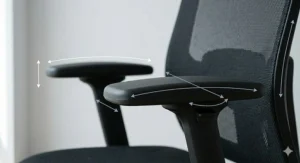
Armrest adjustability sounds fancy but check what actually adjusts. 1D armrests (height only) provide basic support. 2D adds width adjustment, useful for broader or narrower builds. 3D incorporates forward/backward movement, genuinely helpful for typing versus mouse work. 4D adds angle rotation, which is overkill for most users—nice to have but rarely justifies significant price premiums. The flip-up feature on models like the ELFORDSON Maxon proves more practical in compact UK offices than 17-position micro-adjustments you’ll never use.
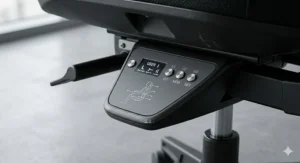
Recline angle matters less than recline mechanism quality. A chair advertising “170° recline!” sounds impressive until you realise you’ll never use more than 120-130° in a work environment. What actually matters: does the mechanism lock at useful positions (90°, 110°, 120°), and does it handle your weight smoothly? Cheap mechanisms feel spongy or require wrestling to engage the lock. Quality mechanisms click firmly into position and release with a gentle push.
Breathable mesh versus fabric versus leather: choose based on your climate, not aesthetics. In British offices with marginal heating and damp problems, mesh outperforms fabric for year-round comfort. PU leather looks executive but turns into a sweat trap during warm weather and can crack in poorly heated spaces where humidity fluctuates. Real leather (rare at consumer price points) performs better but requires maintenance. If your office is consistently climate-controlled, these concerns diminish; if you’re in a draughty Victorian conversion in Glasgow or an overheated portacabin in Kent, prioritise breathability.
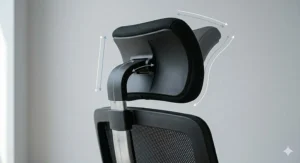
Headrests are overrated for task chairs, essential for executive chairs. If you’re typing, reading, or doing focused desk work, you rarely lean back far enough for a headrest to contact your head—it just becomes something to bang against when you reach for items behind you. Headrests make sense for recline-and-relax breaks or for people who spend significant time on phone calls leaning back. Don’t pay a premium for this feature unless you’ll genuinely use it.
Wheel quality is consistently underestimated. Cheap single wheels bind up on carpet and leave scuff marks on hard floors. Quality dual-wheel castors (two small wheels per caster for five castors total) roll smoothly on carpet without digging in, distribute weight better, and last longer. UK offices with carpet tiles benefit enormously from proper castors—the difference between gliding effortlessly and feeling like you’re dragging a shopping trolley with a dodgy wheel.
Long-Term Cost & Maintenance in the UK
Over a 5-year period, a quality 24-hour chair typically costs less than half what you’ll spend on cheap replacements. Consider this calculation: a budget £70 chair lasting 15 months means buying four chairs over five years (£280 total), plus the hassle of disposal and setup. A £180 heavy-duty chair lasting the full five years costs £180 with zero replacement hassle. Factor in the hidden costs—time spent researching replacements, arranging disposal of broken chairs (UK councils charge for bulky waste collection in many areas), and reduced productivity from working on uncomfortable or wobbly seating as chairs deteriorate.
Maintenance costs for quality chairs remain minimal if you follow basic care protocols. The pneumatic gas lift is typically the first component to fail, usually after 3-5 years depending on usage intensity. Replacement gas lifts cost £15-£30 on Amazon.co.uk and require about 10 minutes to swap (remove chair from base, slide out old cylinder, slide in new one, reassemble). This simple repair can extend a chair’s life by another 2-3 years. Compare this to budget chairs where gas lift failure effectively means total replacement because the cost of repair approaches the cost of buying new.
Castors are the second most common replacement item. A set of five premium carpet castors runs £12-£18 on Amazon.co.uk and dramatically improves mobility once original wheels wear down. Many UK buyers never realise you can replace castors—they just tolerate increasingly stiff rolling until the chair becomes stationary furniture. Ten minutes with pliers to pop out old castors and push in new ones transforms a frustrating chair back to smooth operation.
For fabric or mesh upholstery, regular vacuuming (monthly) and spot cleaning (as needed) prevents dirt buildup that accelerates wear. UK offices dealing with our damp climate should occasionally run a dehumidifier in storage areas to prevent mould developing on chairs during extended closures (Christmas holidays, summer shutdowns). This is particularly important for foam-padded chairs stored in basements or ground-floor offices prone to rising damp.
Replacement parts availability varies significantly by brand. Mainstream brands like HOMCOM and established manufacturers typically stock spare parts for 5-7 years after discontinuation. Unknown import brands might vanish entirely, leaving you unable to source replacements for specific components. Before purchasing, check whether the manufacturer or UK retailer offers spare parts service—this single factor can determine whether a £150 chair becomes a 6-year investment or landfill after 3 years when one component fails.
How to Choose a 24 Hour Office Chair for Your Specific Needs
Start with an honest assessment of your actual usage pattern. “24-hour chair” doesn’t mean you personally sit for 24 hours—it means the chair is engineered for intensive multi-user shift environments. If you’re a single user working standard office hours (even long ones), you might be overspecifying. A quality standard chair tested to EN 1335-2 will serve you perfectly well and save £50-£100 compared to heavy-duty models. Reserve true 24-hour chairs for environments where they’ll genuinely face continuous use.
Measure your workspace before ordering. This sounds obvious, but UK offices often feature tight spaces where oversized executive chairs create navigation problems. Measure from your desk edge to the wall behind—you need at least 85-90 cm for recline functionality to work. If you’re working in a compact home office or shared workspace, prioritise chairs with flip-up armrests and compact footprints. The ELFORDSON Maxon occupies less floor space than the wider MELOKEA F064, which matters considerably in a 2.5m × 3m spare bedroom office.
Consider who else uses the chair. Multi-user environments (call centres, shift work, hot-desking) require quick-adjust features and robust construction. The MELOKEA ReliefBack Max with auto-adjusting lumbar eliminates the “previous person set it wrong” problem. For single-user home offices, you can optimise settings once and leave them, making extensive adjustability less critical. Save money by choosing simpler adjustment mechanisms that you’ll set once rather than paying premiums for features you’ll rarely touch.
Factor in your climate and office environment. Modern UK office buildings with HVAC can accommodate any upholstery type. Older buildings with erratic heating and poor ventilation strongly favour mesh or breathable fabric over PU leather. If your office sits in a converted Victorian warehouse in Liverpool or a Georgian townhouse in Edinburgh, breathability trumps executive styling. Conversely, if you’re in a modern office park in Reading with consistent climate control, choose based on preference and durability rather than temperature regulation.
Budget sensibly for your usage level. £80-£110 budget chairs suit light home office use (3-5 hours daily, single user). £130-£180 mid-range models handle standard office work (6-8 hours daily, occasional heavy use). £180-£250 heavy-duty chairs are appropriate for intensive single-user environments or light multi-user shift work. £250-£400+ commercial-grade models justify their cost only in genuine 24-hour operations with multiple daily users. According to Which? magazine, the most common UK buyer mistake is underbuying for genuine intensive use, not overbuying for light use.
FAQ: Your Questions About 24 Hour Office Chairs Answered
❓ What makes a chair suitable for 24 hour use in the UK?
❓ How long should a 24 hour office chair last in a UK office environment?
❓ Can I buy 24 hour office chairs on Amazon.co.uk with Prime delivery?
❓ What's the difference between 150kg and 200kg weight capacity office chairs?
❓ Are mesh or fabric office chairs better for UK climate?
Conclusion: Investing in Proper Seating Pays Dividends
The mathematics of office chair investment are remarkably straightforward once you strip away the marketing noise. A quality 24-hour chair at £150-£220 that lasts 5+ years costs less per year than cycling through £60-£80 budget models every 15-18 months. But the real value transcends mere pounds and pence—it manifests in reduced back pain, fewer fidgety adjustments during concentration-critical work, and the simple dignity of equipment that doesn’t betray you halfway through a busy shift.
UK work environments demand chairs that handle our specific challenges: damp climate that accelerates material degradation, compact office spaces that require efficient design, and the robust construction needed for intensive use. The models we’ve reviewed—from the budget-friendly HOMCOM High Back at £80-£110 to the heavy-duty MELOKEA ReliefBack Max at £180-£220—span the spectrum of genuine quality available on Amazon.co.uk in 2026.
Remember that the best chair for your situation depends on your specific needs: single-user home offices can thrive with mid-range £130-£170 models offering excellent adjustability, whilst multi-shift commercial environments justify the premium for 200 kg-rated chairs with auto-adjusting features. Match your budget to your usage intensity, verify British Standards certification, and don’t fall for marketing claims unsupported by testing protocols.
The goal isn’t finding the “perfect” chair—no such thing exists given the diversity of human bodies and work patterns. The goal is identifying the chair that delivers the best balance of comfort, durability, and value for your specific situation. For most UK buyers, that sweet spot sits in the £140-£200 range with established brands offering verifiable certifications, genuine customer reviews, and available spare parts.
✨ Don’t Miss These Exclusive Deals!
🔍 Take your office comfort to the next level with these carefully selected products. Click on any highlighted item to check current pricing and availability on Amazon.co.uk. These picks will help you find exactly what you need!
Recommended for You
- 7 Best Value Office Chair UK: Under £200 vs £500 2026
- 7 Best Office Chair Under £100 UK (2026)
- 7 Best White Gaming Chair for Small Spaces UK 2026
Disclaimer: This article contains affiliate links. As an Amazon Associate, I earn from qualifying purchases. If you purchase products through these links, we may earn a small commission at no additional cost to you.
✨ Found this helpful? Share it with your mates! 💬🤗
