
In This Article
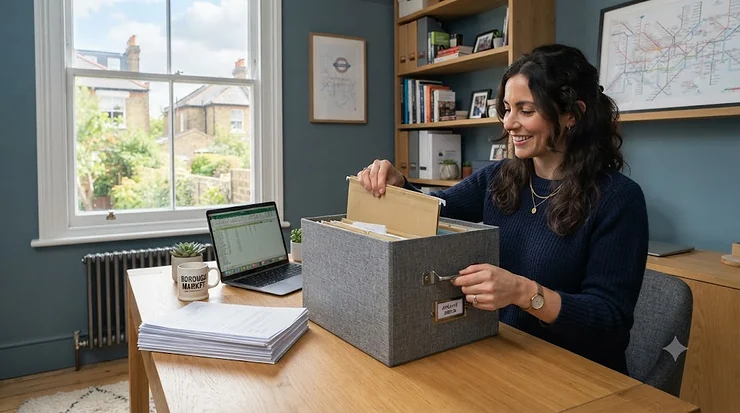
Paperwork breeds. Leave it unsupervised for a few months and a tidy in-tray somehow becomes a leaning tower of bank statements, warranty booklets and mystery envelopes you’re too afraid to open. A decent filing storage box is the unglamorous fix that actually works — cheaper than a filing cabinet, faster to set up than a drawer system, and flexible enough to live in a cupboard, under a bed, or on an office shelf.
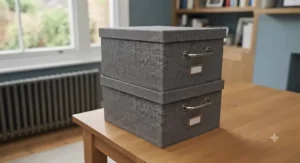
This guide takes the same honest approach we always do: real products currently sold in the UK, genuine specifications, and straightforward reasoning about who each one actually suits, rather than a rewritten spec sheet dressed up as a review. We’ve spread the seven picks across plastic and cardboard construction, portable and stackable designs, and budget through to premium archival-grade options, because the right filing storage box for a student’s exam certificates is rarely the right one for a landlord’s five years of tenancy paperwork.
You’ll also get the practical detail that most buying guides skip entirely: how to build a home filing system that doesn’t collapse within a month, what genuinely separates a plastic filing box from a cardboard one, and how long you’re actually required to keep certain documents in the first place. If you’re self-employed or file a tax return, HMRC’s own guidance on keeping pay and tax records is worth bookmarking alongside this guide, since it directly affects how much filing capacity you’ll actually need.
Quick Comparison Table
Here’s how the seven boxes compare at a glance before the deep dive. As with all product pricing, treat these as indicative ranges only — check current pricing and availability before buying.
| Filing Storage Box | Material | Capacity | Portability | Price Range | Best For |
|---|---|---|---|---|---|
| Really Useful Box 19 Litre with Suspension Files | Polypropylene plastic | 19 litres / 10 suspension files | Clip-lock handles | £15–£30 range | Long-term, damp-resistant filing |
| Bankers Box System File Store Module | FSC-certified cardboard | 6 compartments | Stackable, not carried | £10–£20 range (pack) | Lever arch and ring binder storage |
| Leitz Click & Store Medium Storage Box | Laminated cardboard | A4 + larger items | Metal carry handles | £10–£18 range | Portable document storage |
| Lifewit A4 File Organiser Box with Lid | Fabric-wrapped cardboard | A4 hanging files only | Metal side handles | £15–£25 range | A home filing system starter kit |
| Exacompta Canvas Transfer Box | Reinforced canvas board | 90mm spine, A4 | Metal finger hole | £10–£18 range | Archival-style long-term storage |
| Pukka Foolscap A4 Glossy Box File | Laminated board | 70–75mm spine | Metal ring pull | £4–£10 range | Budget single-category filing |
| Bankers Box Basic Duty File Storage Box | Recycled cardboard | Letter/legal | Reinforced hand holes | £8–£15 range (pack) | Bulk archiving and seasonal storage |
Looking across the table, the split that matters most is plastic versus cardboard. Plastic options like the Really Useful Box cost more upfront but shrug off damp garages and accidental spills, while cardboard options such as the Bankers Box range and Pukka box files are cheaper and lighter, but need a genuinely dry storage spot to last. If you’re filing documents you’ll need to grab and carry regularly, portability features — metal handles, a manageable weight, a proper lid — matter more than raw capacity.
💬 Just one click — help others make better buying decisions too!😊
Top 7 Filing Storage Boxes: Expert Analysis
Seven real, currently available filing storage boxes, each treated the same way: what the specs mean in daily use, what reviewers say about living with them, and where each one genuinely falls short.
1. Really Useful Box 19 Litre with Suspension Files — best plastic filing box for long-term storage
The Really Useful Box 19 Litre with Suspension Files opens this list because it solves the single biggest weakness of cardboard filing: it simply doesn’t care about damp, spills or the occasional knock. Made from polypropylene and manufactured in the UK, it ships with ten A4 suspension files already included, so it functions as a complete hanging filing system straight out of the box rather than something you need to buy accessories for separately.
The clip-lock handles are worth calling out specifically, because what most buyers overlook about filing boxes is how often the lid becomes the actual point of failure — a cardboard lid that’s been lifted on and off a hundred times simply stops sitting flush, while a moulded plastic clip lid keeps sealing properly for years. Reinforced corners and a raised lid lip let multiple boxes stack securely, which matters if you’re building a filing system across several boxes rather than relying on just one.
Aggregated reviewer sentiment for the Really Useful range is unusually consistent for a product this simple: owners repeatedly single out the built-in suspension rail design, which uses the box’s own moulded plastic ridges to hang files rather than a separate loose rail that can snap or go missing — a genuine design advantage over cheaper hanging-file boxes that rely on flimsy add-on rails. Independent commentary on the wider Really Useful range also notes the boxes genuinely interlock when stacked rather than simply resting on top of each other, reducing the risk of a stack sliding off a shelf.
Pros:
- ✅ Ten suspension files included, ready to use immediately
- ✅ Moulded-in hanging rails won’t snap like separate loose rails
- ✅ Manufactured in the UK with genuinely damp-resistant plastic
Cons:
- ❌ Heavier and bulkier than an equivalent cardboard box when empty
- ❌ Costs noticeably more than cardboard alternatives of similar capacity
At roughly £15–£30 depending on litre size, this is a mid-range pick, and given the included suspension files and long service life reviewers describe, it earns that price back over years of use rather than months.
2. Bankers Box System File Store Module — best for lever arch box storage
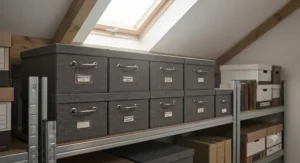
Made by Fellowes, the Bankers Box System File Store Module is designed specifically around lever arch files and ring binders rather than loose paperwork, which makes it the natural pick for anyone whose “filing” is really a shelf of binders that need containing rather than individual sheets that need hanging.
Each module holds six compartments sized for A4 or foolscap 80mm transfer files, lever arch files and ring binders, and — this is the detail that actually matters day to day — it uses a FastFold automatic assembly system that snaps into shape in seconds without tape or glue. Based on the spec comparison with flat-pack cardboard rivals, this is a genuine time-saver if you’re setting up several units at once rather than just one box. The modules stack up to three high, which is a sensible ceiling: stack cardboard much higher than that and the bottom module starts taking real structural strain.
A user review on the retailer’s own site described years of reliable use and called the assembly “very easy and quick,” which lines up with the FastFold design’s core selling point. The FSC-certified board and water-based inks are a genuine sustainability plus if that factors into your buying decision, and the six-compartment layout naturally encourages sorting binders by category — bills, insurance, warranties — rather than piling them in loosely.
Pros:
- ✅ Purpose-built for lever arch files and ring binders specifically
- ✅ FastFold assembly sets up in seconds without tools
- ✅ FSC-certified, fully recyclable cardboard construction
Cons:
- ❌ Not designed to be picked up and carried like a handled box
- ❌ Six fixed compartments limit flexibility for irregular-sized items
Sold in packs, individual modules typically work out to roughly £10–£20 each, making this one of the more affordable ways to bring genuine order to a shelf of accumulating lever arch files.
3. Leitz Click & Store Medium Storage Box — best for portable document storage
The Leitz Click & Store Medium Storage Box is built around a genuinely clever assembly mechanism — a pop-stud, clothes-popper-style fastening that lets the whole box fold completely flat when empty and click back into shape in seconds when needed. For anyone tight on storage space, that’s a real practical advantage over rigid boxes that take up the same footprint whether they’re full or empty.
Sturdy metal handles are the feature that earns this bar’s “portable document storage” positioning specifically: unlike box files that rely on a single spine-mounted pull ring, the Click & Store’s two-handed metal handles make it genuinely comfortable to carry a fully loaded box up and down stairs or out to a car boot. Reinforced metal corners protect against the classic cardboard failure mode — corners crushing first under repeated handling — while the laminated surface wipes clean rather than absorbing spills the way raw cardboard does.
Here’s what to weigh: the laminated, brightly coloured design (available across a genuine range of colours, not just office grey or black) makes this box double as general household storage for toys, photos or shoes, not just paperwork — useful if you want one product that multitasks, less useful if you specifically want something that reads as a serious filing solution. The label holder on the front is a small but genuinely useful touch for anyone managing several boxes at once.
Pros:
- ✅ Folds completely flat for storage when not in use
- ✅ Two-handed metal handles genuinely support portability
- ✅ Reinforced metal corners resist the usual cardboard crush points
Cons:
- ❌ Laminated finish looks more “home storage” than “office filing”
- ❌ Less rigid under heavy loads than a true plastic filing box
Priced around £10–£18, the Click & Store range represents solid value for anyone who genuinely needs to move a filing box between rooms or locations regularly rather than leaving it permanently on one shelf.
4. Lifewit A4 File Organiser Box with Lid — best starter kit for a home filing system
The Lifewit A4 File Organiser Box with Lid takes a different construction approach entirely: a fabric-wrapped exterior over a thick cardboard insert frame, with sliding plastic rails built into both sides specifically to support hanging A4 files without the rails wearing through the box walls over time.
What most buyers overlook about hanging-file boxes generally is that the rails, not the outer material, are usually the first thing to fail — cheap boxes let suspension files saw through unsupported cardboard edges within months of regular use. The Lifewit’s dedicated plastic rail channels solve that specific failure mode directly, which is a meaningfully better long-term design than boxes that expect suspension files to simply rest on bare card. The soft non-woven fabric interior lining is a genuine plus too, protecting document edges from the kind of light scuffing that raw cardboard interiors can cause over repeated use.
One honest limitation worth flagging clearly: this box is sized specifically for A4 hanging files and explicitly isn’t suitable for letter or legal-sized folders, so UK buyers should double-check their existing suspension files are genuinely A4 before assuming compatibility — a detail that’s easy to miss when scanning a product listing quickly. As a first purchase for someone building a home filing system from scratch, though, the ten-second assembly and metal carry handles make this a genuinely low-friction way to get started.
Pros:
- ✅ Dedicated plastic rail channels stop suspension files wearing through
- ✅ Soft fabric interior lining protects document edges
- ✅ Assembles in roughly ten seconds with no tools needed
Cons:
- ❌ A4-only sizing — not compatible with letter or legal folders
- ❌ Fabric exterior is less wipe-clean than a laminated or plastic finish
At around £15–£25, this sits in accessible mid-range territory, and the rail design specifically justifies the modest premium over the very cheapest hanging-file boxes on the market.
5. Exacompta Canvas Transfer Box — best for archival-style long-term storage
The Exacompta Canvas Transfer Box is built for documents you genuinely don’t want to touch again for years — think historic tax records, old mortgage paperwork, or family documents being kept “just in case.” Its 90mm spine gives it noticeably more capacity than a standard box file, and the reinforced canvas-covered board construction is designed specifically to hold its shape under the weight of a genuinely full box rather than bowing over time the way thinner card can.
The metal finger hole and spine label are small design choices that matter more than they sound: a metal-reinforced finger hole survives years of being pulled off a shelf far better than a simple cut-out in raw board, and a proper spine label means you can actually find the right box among a shelf of several without pulling each one out to check. Based on the spec comparison with lighter document boxes on this list, the trade-off for that extra durability is straightforward — this is a heavier, bulkier product than something like the Pukka box file, and it’s designed to live on a shelf rather than be carried around regularly.
Reviewer sentiment specifically verified for this exact model is thinner online than for the bigger consumer names on this list, so we’ll say plainly: we can confirm the 90mm spine, canvas-reinforced construction and metal fittings from manufacturer specifications, but we don’t have a large pool of independently aggregated customer reviews to draw on the way we do for the Really Useful Box or Bankers Box ranges. What we can say with confidence is that canvas transfer boxes as a category are a long-established, purpose-built archival format used across UK offices for exactly this kind of long-term document storage.
Pros:
- ✅ 90mm spine holds meaningfully more than a standard box file
- ✅ Metal-reinforced finger hole outlasts simple cut-out handles
- ✅ Genuinely purpose-built archival format, not a repurposed storage box
Cons:
- ❌ Smaller pool of verified independent customer reviews online
- ❌ Bulkier and less portable than lighter document storage options
Typically priced around £10–£18 each, canvas transfer boxes represent solid value for genuine long-term archiving, particularly when several are bought together for a full shelf of historic paperwork.
6. Pukka Foolscap A4 Glossy Box File — best budget pick for single-category filing
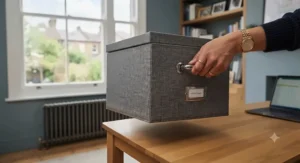
Sometimes you don’t need a filing system — you need one dedicated home for one specific category of paperwork, and that’s exactly where the Pukka Foolscap A4 Glossy Box File earns its place on this list. A 70mm spine, a glossy laminated finish, and a metal spring-clip closure with a ring pull for easy shelf retrieval cover the basics without any unnecessary extras.
Here’s what the spec sheet won’t tell you outright: a single box file like this is genuinely the most cost-effective way to separate one specific category — say, all your energy bills, or a single tax year’s paperwork — from the rest of your filing without paying for capacity or features you won’t use for that narrow purpose. The metal lid catch and spring clip are the components that matter most for longevity, since a plastic clip on a budget box file is usually the first thing to snap after repeated use, and Pukka’s metal hardware genuinely holds up better over time.
Buying several in assorted colours is a popular approach among UK reviewers researching budget box files specifically for colour-coding a home filing system by category — bills in one colour, insurance in another, warranties in a third — which turns a purely budget product into a genuinely functional visual filing system with almost no added cost.
Pros:
- ✅ Genuinely the cheapest option on this list per unit
- ✅ Metal spring clip and lid catch outlast plastic equivalents
- ✅ Available in multiple colours for simple category coding
Cons:
- ❌ Single-category capacity — you’ll need several for a full system
- ❌ Laminated cardboard offers no real protection from damp or spills
At roughly £4–£10 each, this is by far the most accessible entry point on this list, and buying a handful to colour-code a starter filing system rarely costs more than a single mid-range plastic box.
7. Bankers Box Basic Duty File Storage Box with Lid — best for bulk archiving and seasonal storage
Closing the list is the Bankers Box Basic Duty File Storage Box with Lid, a straightforward letter/legal-sized cardboard box built for exactly the kind of bulk, infrequent-access storage that doesn’t need a premium finish — think a full tax year’s paperwork once it’s been filed and doesn’t need touching again for months, or seasonal documents like Christmas receipts and warranty paperwork.
Built from a meaningful proportion of recycled materials, the box uses a tape-free lift-off lid design and reinforced hand holes rather than metal handles, keeping the cost genuinely low while still supporting reasonably comfortable carrying between rooms. What most buyers overlook about “basic duty” cardboard boxes specifically is that the stackable design is actually the more important feature than the lid for most home users — a home office corner with three or four of these stacked neatly takes up dramatically less visible space than the same boxes spread out individually.
This is a bar with an honest, narrow job: it’s not designed to be a daily-access portable document storage solution, and it’s not built to archival standards for irreplaceable documents either. For the specific use case of clearing a desk at the end of a tax year, boxing up completed paperwork, and stacking it out of the way until it’s needed again, it does exactly what’s required at a genuinely low cost per box.
Pros:
- ✅ Genuinely low cost per box when bought in bulk packs
- ✅ Stackable design saves meaningful floor and shelf space
- ✅ Made with a meaningful proportion of recycled cardboard
Cons:
- ❌ Basic-duty build isn’t intended for frequent daily access
- ❌ Lift-off lid is less secure than a clip-lock or latching design
Sold in multi-packs, individual boxes typically work out to around £8–£15 each, making this the sensible choice for anyone archiving a genuine volume of paperwork rather than filing a small, regularly accessed set of documents.
Full Spec Comparison: Material, Handles and Damp Resistance
| Filing Storage Box | Handle Type | Damp Resistance | Assembly | Price Range |
|---|---|---|---|---|
| Really Useful Box 19 Litre with Suspension Files | Clip-lock handles | High (plastic) | Ready to use | £15–£30 range |
| Bankers Box System File Store Module | None (stack only) | Low (cardboard) | FastFold, seconds | £10–£20 range |
| Leitz Click & Store Medium Storage Box | Metal carry handles | Moderate (laminated) | Pop-stud fold | £10–£18 range |
| Lifewit A4 File Organiser Box with Lid | Metal side handles | Low–moderate (fabric) | ~10 second build | £15–£25 range |
| Exacompta Canvas Transfer Box | Metal finger hole | Moderate (canvas board) | Ready to use | £10–£18 range |
| Pukka Foolscap A4 Glossy Box File | Metal ring pull | Low (laminated card) | Ready to use | £4–£10 range |
| Bankers Box Basic Duty File Storage Box | Reinforced hand holes | Low (recycled card) | Flat-pack fold | £8–£15 range |
The pattern that jumps out here is the clear trade-off between damp resistance and price: the one genuinely high damp-resistance option, the Really Useful Box, also carries the highest price tag on this list, while every cardboard-based option trades that resilience for a lower cost per box. If your filing storage box is going into a genuinely dry airing cupboard or office shelf, that trade-off barely matters; if it’s heading into a garage, loft or shed, it matters a great deal.
Practical Usage Guide: Setting Up Your Filing Storage Box System
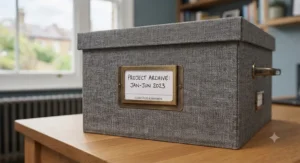
Buying the right filing storage box is only step one — how you set it up determines whether it still works six months later. Start by sorting paperwork into broad categories before you buy anything: household bills, insurance and warranties, financial and tax records, and anything sentimental or irreplaceable like certificates and passports. This rough sort tells you how many boxes you actually need far more reliably than guessing.
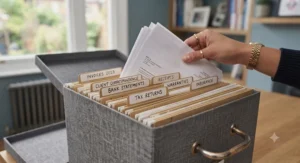
Label every box clearly on more than one visible face — spine and lid, ideally — since a box shoved onto a shelf with the label facing the wrong way is functionally unlabelled. If you’re using suspension files inside a plastic filing box like the Really Useful Box, resist the urge to overstuff a single hanging file; once you’re forcing the metal rails to bow under the weight, it’s time to split that category across two files rather than one.
For the first month specifically, keep an active “to file” tray separate from your archive boxes rather than filing directly into a lever arch box storage system daily — batching filing into a weekly ten-minute session is far more sustainable long-term than trying to file every single document the moment it arrives. Store boxes off the floor where possible, particularly in garages or utility rooms, since even a small amount of standing water from a leak or minor flood can ruin cardboard boxes within hours; gov.uk’s flood preparation guidance specifically recommends keeping important documents somewhere they can be moved quickly if flooding is a genuine risk in your area.
Real-World Scenarios: Matching the Box to Your Paperwork
The self-employed sole trader building a tax-season archive: HMRC’s own guidance requires records to be kept for a defined minimum period, so a full, stackable system matters more than portability. The Bankers Box Basic Duty File Storage Box for bulk archived years, paired with the lever-arch-focused Bankers Box System File Store Module for current-year binders, covers both active and archived paperwork without overspending on features that won’t be used.
The renter who moves flats every year or two: Portability is the priority here, not maximum capacity. The Leitz Click & Store Medium Storage Box‘s fold-flat design and genuine metal carry handles make it the standout choice — it survives being packed into a moving van repeatedly far better than a rigid box, and folds away to almost nothing between moves.
The family building a first proper home filing system: Starting simple matters more than starting comprehensive. A Lifewit A4 File Organiser Box for active, frequently accessed paperwork, combined with a few colour-coded Pukka Foolscap A4 Glossy Box Files for specific categories like insurance or warranties, gives a genuinely workable starting system without the upfront cost of a full plastic filing box setup.
Common Problems and Solutions
Problem: Suspension files keep tearing or slipping off the rails. This usually means the files are overloaded, or the box uses separate loose rails rather than the moulded-in design found on boxes like the Really Useful Box. Split overstuffed files into two, and consider switching to a box with built-in rail channels if the problem persists.
Problem: Cardboard boxes are softening or the corners are crushing. This is almost always a moisture issue, even in what feels like a dry space — check for a small nearby leak or simply higher-than-expected humidity, and consider a plastic filing box for that specific storage location going forward.
Problem: You can’t find anything without opening every box. A labelling problem, not a storage problem. Label both the spine and the lid, and consider a simple numbered or lettered system alongside category names so you can find things by process of elimination even with a vague memory of “it’s in one of the blue ones.”
Problem: A stack of boxes feels unstable or has slipped. Check whether the boxes actually interlock when stacked — some, like the Really Useful Box range, are specifically designed with locating recesses for this, while others simply rest on top of each other and are more prone to sliding, particularly on an uneven shelf.
Problem: You’re unsure whether you’re legally required to keep a document at all. For anything tax-related, HMRC’s guidance on pay and tax records (linked in the introduction above) sets out exactly what needs keeping and for how long — a useful starting point before you commit shelf space to something you may not actually need to retain.
What is a Filing Storage Box?
A filing storage box is a lidded container — typically plastic or cardboard — designed to hold A4 or foolscap documents, lever arch files, or suspension files in an organised, stackable or portable format. Unlike a filing cabinet, it requires no fixed installation and can be stored on a shelf, in a cupboard, or carried between locations as needed.
The format has genuinely deep roots in professional archiving: the archival document box — often called a Hollinger box in archival and library science — was specifically developed to standardise safe, long-term paper storage for institutions like the Library of Congress, and the basic principle behind that design (a rigid, properly sized box that protects documents from light, dust and handling damage) is exactly what a good modern filing storage box for the home is still trying to achieve, just at a domestic budget and scale.
How to Choose a Filing Storage Box for Your Home
Choosing the right filing storage box comes down to six practical criteria, roughly in order of importance for most UK households:
- Sort your paperwork volume before buying — a handful of important documents needs a single box file, while years of accumulated bills and statements needs a genuine multi-box system.
- Decide plastic versus cardboard based on storage location — damp garages and lofts favour plastic; dry office shelves and cupboards are fine with cardboard.
- Check compatibility with what you already own — lever arch files, A4 suspension files and loose A4 sheets all need genuinely different internal box designs.
- Prioritise portability only if you’ll actually move the box regularly — metal handles and fold-flat designs cost more and matter far less for a box that will live permanently on one shelf.
- Consider stackability for your specific storage space — narrow cupboards benefit far more from stackable modules than from wide, low boxes.
- Check how long you’re actually required to keep specific documents — this directly determines how many boxes you genuinely need, rather than how many feel intuitively “safe.”
Filing Storage Box vs Filing Cabinet
The core difference is flexibility versus permanence: a filing storage box is a standalone, movable container that costs little and needs no fixed space, while a filing cabinet is a dedicated piece of furniture with drawers, generally offering better security and a more structured layout but at meaningfully higher cost and a genuinely fixed footprint.
| Feature | Filing Storage Box | Filing Cabinet |
|---|---|---|
| Upfront cost | Low, scales with number of boxes | Higher, one-off larger purchase |
| Flexibility | Portable, stackable, easy to add more | Fixed location, fixed drawer capacity |
| Security | Minimal — most have no lock | Often lockable |
| Best For | Growing or changing filing needs, renters | Permanent home offices, sensitive documents |
The rotating flexibility of boxes is genuinely the more important factor for most home users, not just the lower price. Because you can simply add another box as your paperwork grows, you’re never stuck with a system that’s either too small or, worse, an expensive cabinet with three empty drawers you paid for but don’t need yet. For anyone renting, or genuinely uncertain how much filing capacity they’ll need in a year’s time, a filing storage box system is close to a risk-free choice — you can always add a Bankers Box Basic Duty File Storage Box or two later, whereas a filing cabinet is a single, fixed-size commitment from day one.
Plastic Filing Box: Pros, Cons and When It’s Worth It
A plastic filing box, typically made from polypropylene like the Really Useful Box range, trades a higher upfront price for genuine resilience against the two things that kill cardboard filing systems over time: moisture and physical wear from repeated opening and closing.
What most buyers overlook about plastic filing boxes specifically is that the real value isn’t the material itself so much as the sealing mechanism it enables — a properly moulded clip-lock lid keeps sealing tightly for years in a way a cardboard lift-off lid simply can’t, since repeated flexing gradually deforms cardboard while rigid plastic holds its shape. This matters enormously for anything stored somewhere with even mild humidity swings, such as a garage, shed, or under-stairs cupboard that isn’t fully climate controlled.
The honest trade-off is straightforward: a plastic filing box costs meaningfully more than an equivalent cardboard option, and it’s genuinely heavier both empty and loaded, which matters if you’re regularly carrying it rather than leaving it in place. For documents you’re storing indefinitely in a less-than-ideal environment — old tax records in a garage, family certificates in a loft — that extra cost is easy to justify. For actively used paperwork on an office shelf in a normal, dry room, cardboard options like the Leitz Click & Store or Bankers Box ranges do the job perfectly well at a lower price.
Portable Document Storage: What to Look For
Portable document storage is about more than just a handle — it’s the combination of weight, handle design and structural rigidity that determines whether a filing storage box is genuinely comfortable to carry when loaded, rather than merely liftable in a pinch.
Two-handed metal handles, like those on the Leitz Click & Store Medium Storage Box, distribute weight far more evenly than a single spine-mounted ring pull, which matters enormously once a box is genuinely full of paper — A4 paper is deceptively heavy in volume, and a single-point handle concentrates all of that weight onto one small area of cardboard or plastic that can eventually tear or crack. Here’s what to weigh: a box designed primarily for stacking, like the Bankers Box System File Store Module, simply isn’t built with portability in mind at all, and forcing it into a “carry between rooms regularly” role will shorten its working life considerably.
For genuinely portable document storage — moving house, taking documents to an accountant, or transporting paperwork between a home office and a workplace — prioritise a box with reinforced corners, two-handed carrying and a lid that locks securely enough to survive being tilted or turned during transport, rather than simply the largest capacity available.
Home Filing System: Building One That Actually Works
A home filing system succeeds or fails based on how much friction it takes to actually file something, not on how sophisticated the categorisation scheme looks on day one. The single most common reason home filing systems collapse within a few months is over-engineering: creating fifteen narrow categories when four or five broad ones would genuinely cover the same paperwork with far less daily decision-making required.
Start with genuinely broad categories — household bills, financial and tax, insurance and warranties, and personal/sentimental documents — using something like the Lifewit A4 File Organiser Box or a handful of colour-coded Pukka Foolscap A4 Glossy Box Files for each. Reviewer sentiment from UK organisation and decluttering sources consistently points to the same principle: a filing system that requires almost no thought to use correctly is the one that actually survives beyond the first month, while an elaborate system requiring decisions about sub-categories for every single document tends to break down the moment life gets busy.
Once the broad system is genuinely established and being used consistently for a few months, it’s entirely reasonable to split an overflowing category into two — but starting there rather than ending there is one of the most common home filing system mistakes worth avoiding from day one.
Lever Arch Box Storage: Getting Capacity Right
Lever arch box storage solves a specific problem that loose-paper filing boxes don’t: binders are rigid, bulky, and don’t compress the way loose paper does, so a box designed for suspension files often fits far fewer lever arch binders than its litre capacity might suggest.
Purpose-built options like the Bankers Box System File Store Module solve this by sizing compartments specifically around standard 80mm transfer files, lever arch files and ring binders from the outset, rather than adapting a general-purpose box after the fact. Here’s the capacity detail worth checking before buying: a typical six-compartment lever arch module comfortably holds six full-size binders standing upright, whereas trying to fit the same six binders into a general storage box designed primarily for loose paper often wastes significant vertical space or forces binders to lie flat, which makes retrieval considerably more awkward.
| Storage Type | Lever Arch Files Held (Approx.) | Best For |
|---|---|---|
| Bankers Box System File Store Module (per module) | 6 upright | Dedicated lever arch box storage |
| General 19L plastic filing box | 3–4 upright (tight fit) | Mixed loose paper and occasional binders |
| Single box file (e.g. Pukka) | Not designed for lever arch | Loose paper only |
If lever arch binders make up a meaningful share of your paperwork — common for anyone running household accounts, a small business, or a hobby with certificates and records — a purpose-built module is genuinely worth the modest extra cost over trying to force binders into general-purpose filing boxes.
Common Mistakes When Buying a Filing Storage Box
The most common mistake is buying based purely on litre capacity without checking what’s actually being stored — a large general storage box is often a poor fit for lever arch files specifically, as covered above, while a box sized precisely for hanging suspension files can be the wrong shape entirely for loose box-file-style paperwork.
A close second is ignoring the storage environment when choosing between plastic and cardboard — a cardboard box that looks perfectly fine on the shop shelf can soften and fail within a single damp winter in an unheated garage. Buyers also frequently underestimate how much paperwork they’ll actually accumulate, buying a single box file when a genuine multi-box system was needed from the start, which usually just means buying a second and third box within months anyway. Finally, skipping labels entirely — trusting memory to know which box holds which category — is one of the fastest ways to make an otherwise well-organised system practically useless within a year.
Long-Term Value, Safety and Maintenance
Thinking in total cost of ownership changes the calculation on several boxes in this list. A £6 cardboard box file that needs replacing every couple of years due to damp or wear can, over a decade, cost more than a single £25 plastic filing box that simply doesn’t degrade the same way — the cheaper option isn’t automatically the better value once replacement cycles are factored in.
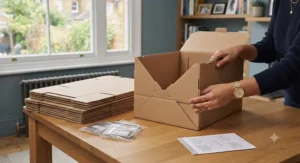
Maintenance is genuinely minimal across every product here: an occasional wipe-down for plastic boxes, keeping cardboard boxes off damp floors, and re-labelling as categories evolve covers the vast majority of upkeep needed. Document safety is worth a specific mention too — the flood preparedness guidance referenced earlier specifically recommends keeping important documents somewhere they can be moved quickly and, ideally, off the ground floor if flooding is a genuine risk in your area, which is a strong argument for storing irreplaceable paperwork like certificates and property documents in the most damp-resistant option available rather than the cheapest.
Frequently Asked Questions
❓ What's the difference between a filing storage box and a box file?
❓ Is a plastic filing box better than a cardboard one?
❓ How many boxes do I need for a home filing system?
❓ Can I store lever arch files in a normal filing storage box?
❓ How long do I need to keep tax and financial documents?
Conclusion
There’s no single “best” filing storage box — only the right one for what you’re storing, where it’s going, and how often you’ll need to reach it. For long-term, damp-resistant storage that just works for years, the Really Useful Box 19 Litre with Suspension Files is difficult to beat despite its higher upfront cost. Anyone drowning specifically in lever arch binders should look straight to the Bankers Box System File Store Module, while renters and regular movers are best served by the genuine portability of the Leitz Click & Store Medium Storage Box.
Whatever you choose, the details covered throughout this guide — plastic versus cardboard, portability versus stackability, and genuinely matching capacity to what you’re actually storing — matter far more to how well the system works in six months’ time than brand name alone. Sort your paperwork first, pick the material that suits where it’s going, and you’ll end up with a filing system that’s still working long after the initial tidy-up enthusiasm has worn off.
Recommended for You
- Desk Document Tray: 7 Stackable Trays UK
- Magazine Holder Office: 7 Best Picks for Tidy UK Desks (2026)
- 3 Drawer Pedestal: 7 Best Picks for UK Home Offices (2026)
Disclaimer: This article contains affiliate links. As an Amazon Associate, I earn from qualifying purchases. If you purchase products through these links, we may earn a small commission at no additional cost to you.
✨ Found this helpful? Share it with your friends! 💬🤗
