
In This Article
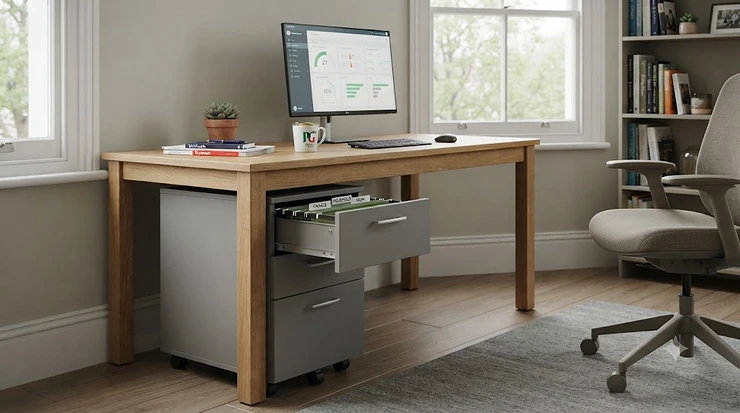
A mobile filing cabinet is a lockable storage unit on castors, small enough to tuck under or beside a desk, that lets you wheel your documents wherever you’re working instead of leaving them stranded in one room. That’s it — no mystery, no jargon. But the “on wheels” part is doing a lot of quiet work: it’s the difference between a filing cabinet and a piece of furniture that actually adapts to how you work now.

Here’s the thing nobody tells you before you buy one: most people don’t need a filing cabinet, they need a filing cabinet that moves. Maybe you’re hot-desking three days a week and refuse to carry a laptop bag stuffed with paperwork through reception every morning. Maybe your “home office” is actually a corner of the kitchen that has to become a dining room again by 6pm. Either way, a mobile filing cabinet solves a genuinely modern problem — flexible, unpredictable space — with a genuinely old-fashioned tool: a lockable box with wheels.
This guide walks through seven real, currently available mobile filing cabinets on amazon.co.uk, from budget MDF options under £70 to heavyweight steel pedestals that will outlast the desk you put them next to. We’ve dug into real specs, aggregated review sentiment, and the sort of practical detail — caster quality, drawer extension, weight capacity — that Amazon’s own listings tend to gloss over. According to the Health and Safety Executive, home and hybrid workstations fall under the same display screen equipment regulations as office ones, which is one more reason to get the physical setup right, not just the screen.
Quick Comparison Table
| Product | Build | Drawers | Best For |
|---|---|---|---|
| Bisley Wave 3-Drawer A4 Pedestal | Steel | 1 filing + 2 shallow | Long-term durability |
| SONGMICS OFC60 Steel Pedestal | Steel | 3 (lockable) | Shared office use |
| Bisley 2-Drawer Locking Pedestal | Steel | 2 (1 filing) | Narrow desks |
| DEVAISE Metal Smart Lock Cabinet | Metal | 3 (lockable) | Value + security |
| HOMCOM 3-Drawer Lockable Cabinet | MDF/Steel | 3 (lockable) | Tightest budgets |
| VASAGLE 2-Drawer Cabinet | Wood-effect | 2 (lockable) | Lightest, easiest to move |
| DEVAISE Wood Mobile Cabinet (Walnut) | Wood | 3 (unlocked) | Living-room-friendly looks |
Look at that spread and a pattern jumps out fast: steel dominates the top of the table, wood-effect and MDF dominate the bottom, and the middle ground is where lock quality starts to separate the genuinely useful from the merely cheap. If security matters even slightly — and for anything work-related, it usually does — that’s the column to scrutinise first, not the price tag. Weight capacity is the other quiet decider: a filing drawer stuffed with A4 paperwork is heavier than most people expect, often 10-15kg once full, so a flimsy caster set will announce itself within weeks, not years.
💬 Just one click — help others make better buying decisions too!😊
Top 7 Mobile Filing Cabinets: Expert Analysis
1. Bisley Wave 3-Drawer A4 Pedestal — the buy-it-once steel pedestal for serious offices
The Bisley Wave 3-Drawer A4 Pedestal is the option to reach for if you’ve been burned before by flatpack furniture that wobbles within a month. Constructed entirely from steel with a configuration of one full-depth filing drawer plus two shallow drawers, it’s built to the kind of tolerances you’d expect from a company that’s been making British office furniture since the 1930s. The filing drawer offers 100% extension, meaning you can see and reach every hanging file at the back without leaning over the desk — genuinely useful when you’re searching for one specific invoice among forty.
At roughly 26kg empty and with a fully lockable central mechanism, this is furniture, not a gadget. Based on the spec comparison with lighter MDF alternatives, the trade-off is obvious: you’re paying for steel gauge and hinge quality, not features. That’s precisely who it’s for — a small business owner, a solicitor working from a home study, or anyone who wants to buy a filing cabinet exactly once. Reviewers consistently note that the Wave range feels noticeably heavier and more solid than budget metal cabinets, though a handful mention the shallow drawers are better suited to stationery than bulky ring binders.
Pros:
- ✅ Full steel construction rated for decades of daily use
- ✅ 100% drawer extension reaches the back of every file
- ✅ Central lock secures all three drawers at once
Cons:
- ❌ Among the heaviest options here, harder to relocate solo
- ❌ Premium price bracket compared with MDF rivals
Expect this one to sit in the £250-£350 range at the time of research, positioning it firmly as a long-term investment rather than an impulse buy — check current price and stock before deciding, as steel furniture pricing shifts with material costs.
2. SONGMICS OFC60 Steel Pedestal — best lockable steel option for shared teams
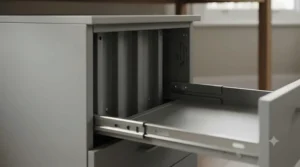
The SONGMICS OFC60 Steel Pedestal sits in that sweet spot between “cheap and flimsy” and “expensive and overbuilt.” It’s a genuinely steel three-drawer unit with suspension file hanging rails built into the bottom drawer, arriving mostly pre-assembled except for the castors — a detail that matters more than it sounds, since caster installation is usually the fiddliest part of any flatpack job.
What most buyers overlook about this model is the suspension rail detail: a lot of budget metal cabinets skip proper hanging rails and just give you a flat drawer base, which means files slump and crease over time. The OFC60 avoids that. On paper this means it functions like a proper filing cabinet rather than a metal drawer unit pretending to be one, which is exactly why it works well in shared or hot-desking environments where multiple people rotate through the same storage. Aggregated review sentiment for this range is strong on build quality and lock security, with the recurring minor complaint being that the drawers can feel slightly stiff on their very first use before the rails bed in.
Pros:
- ✅ Proper suspension file rails, not a flat drawer base
- ✅ Full steel body with lockable drawers
- ✅ Mostly pre-assembled, quicker setup than rivals
Cons:
- ❌ Castors require separate fitting
- ❌ Drawers can feel stiff for the first few uses
At around £80-£110, this is arguably the best value-for-durability pick in the whole line-up — worth checking current price, as SONGMICS runs frequent stock rotations across colourways.
3. Bisley 2-Drawer Locking A4 Pedestal with Wheels — best compact footprint for narrow desks
Not every desk has room for a three-drawer unit, and that’s where the Bisley 2-Drawer Locking A4 Pedestal with Wheels earns its place. It pairs one shallow drawer with one full A4 filing drawer, both lockable, in a footprint narrow enough to slide under most standard desks without clipping your knees. Because it’s still a genuine Bisley product, the steel gauge and drawer-runner quality match its bigger three-drawer sibling — you’re not sacrificing durability to save space.
Here’s what the spec sheet won’t tell you, but the layout makes obvious: two drawers force better filing discipline than three or four. Reviewers consistently note that the smaller footprint suits people who mainly need “active” filing — the handful of projects you’re touching this month — rather than long-term archive storage, which is arguably how a mobile cabinet should be used anyway. Based on the spec comparison with the Wave 3-drawer, you lose shallow storage capacity but gain manoeuvrability, which matters if you’re regularly wheeling it between a desk and a meeting room.
Pros:
- ✅ Compact width fits under narrow or shared desks
- ✅ Full Bisley steel build quality in a smaller shell
- ✅ Both drawers lock independently for security
Cons:
- ❌ Less shallow-drawer storage than 3-drawer models
- ❌ Not ideal for bulky archive-level filing needs
Typically priced in the £130-£160 range, this is a smart pick for anyone whose “office” changes shape from one day to the next.
4. DEVAISE Metal Smart Lock Cabinet — best value steel-and-lock combination
The DEVAISE Metal Smart Lock Cabinet is proof that you don’t need to spend Bisley money to get a metal frame and a working lock. Three drawers — two shallow for stationery, one deeper drawer with detachable hanging bars for A4, letter, and legal-size files — sit on a steel pedestal frame with a lock-and-key mechanism built into the front. Two of the five castors include brakes, and a rear anti-tip wheel stops the whole unit tipping forward when you open a fully loaded top drawer, a problem that genuinely plagues cheaper cabinets.
What most buyers overlook here is that “metal” doesn’t automatically mean “as solid as Bisley” — the gauge of steel is thinner, and the finish is more utilitarian. But for the price bracket, the lock quality and anti-tip engineering punch well above what you’d expect. Reviewers consistently praise the ease of assembly and the genuinely functional lock, with the odd comment that the drawer glide isn’t quite as silky as pricier steel rivals. On paper this means it’s the cabinet to pick if security and stability matter more to you than showroom polish.
Pros:
- ✅ Detachable hanging bars fit A4, letter and legal files
- ✅ Anti-tip rear caster prevents forward tipping
- ✅ Working lock and key at a mid-budget price
Cons:
- ❌ Steel gauge thinner than premium brands
- ❌ Drawer glide less smooth than top-tier models
Expect a price in the £70-£100 range, making it one of the strongest value-for-security picks in this entire round-up.
5. HOMCOM 3-Drawer Lockable Filing Cabinet — cheapest genuinely lockable option
If budget is the deciding factor, the HOMCOM 3-Drawer Lockable Filing Cabinet is where most people land. It uses an MDF and particle-board body rather than solid steel, but crucially still includes a central locking system that secures all three drawers with a single key turn — a feature some rivals at this price point simply skip. Four wheels sit underneath, two with brakes, and full-extension glides let the drawers open completely rather than stopping halfway.
Reviewers consistently report — this is the honest bit — that assembly takes longer than the box suggests, and a small number mention the drawer runners feel less smooth than metal alternatives after a few months of daily use. That’s the trade-off of MDF: it’s lighter, cheaper, and easier to move solo, but it won’t survive being dragged across a rough floor the way steel will. Based on the spec comparison, this is squarely the pick for students, freelancers furnishing a first home office, or anyone who wants “lockable and mobile” ticked off without spending three figures.
Pros:
- ✅ Central lock secures all three drawers at once
- ✅ Lightest build here, easiest to carry upstairs
- ✅ Full-extension glides open drawers completely
Cons:
- ❌ MDF body less durable than steel long-term
- ❌ Assembly reported as fiddlier than expected
Sitting under £70 in most colourways, this remains the most accessible genuinely lockable option in the round-up — well worth checking current price given how often HOMCOM rotates stock and finishes.
6. VASAGLE 2-Drawer File Cabinet — lightest cabinet for easy one-person moves
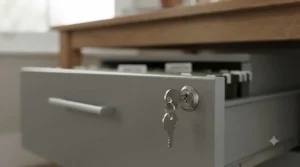
The VASAGLE 2-Drawer File Cabinet is built for people who move their storage more often than they fill it. With just two lockable drawers and a wood-effect finish over a lighter frame, it’s the easiest cabinet in this list to lift, carry, or reposition single-handedly — a genuine advantage if you’re the one person in a shared house rearranging the “office corner” every weekend. It fits A4 and letter-size hanging files in the lower drawer, with the upper drawer suited to stationery and smaller personal items.
What the spec sheet won’t tell you is how much that lighter weight changes daily behaviour: a heavier steel cabinet tends to get parked in one spot and left there, while a genuinely portable filing cabinet like this one actually gets wheeled around, which is arguably the entire point of buying “mobile” storage in the first place. Aggregated review sentiment is positive on ease of assembly and appearance, with an honest caveat that the lighter build means it’s not the cabinet to choose if you’re storing years of dense archive paperwork.
Pros:
- ✅ Noticeably lighter than steel rivals, easy to relocate
- ✅ Lockable drawers despite the lower price point
- ✅ Wood-effect finish blends into living spaces
Cons:
- ❌ Lower weight capacity than steel pedestal models
- ❌ Two drawers may be tight for heavy archiving
Priced around £55-£75, this is the pick for genuinely flexible workspace setups where the cabinet needs to move as often as you do.
7. DEVAISE Wood Mobile Cabinet (Walnut) — best looks for an open-plan living room office
The DEVAISE Wood Mobile Cabinet (Walnut) takes a different approach entirely: it prioritises looking like real furniture over looking like office equipment. Finished in an eco-friendly, scratch-resistant particle board with a walnut melamine face, it’s designed to sit comfortably in a living room or open-plan flat without screaming “filing cabinet.” Five castors, including one auxiliary caster under the file drawer specifically to prevent tipping, keep it stable when the bottom drawer is fully loaded.
Here’s the honesty point that matters: this particular model does not include a lock. If document security is a genuine requirement — client files, HR paperwork, anything sensitive — this is not the cabinet for that job, and no amount of styling changes that fact. What most buyers overlook is that the appeal here is aesthetic, not security-driven; reviewers consistently praise how it blends into a room, while a recurring complaint flags that suspension files sized for A4 need to be bought separately since the drawer is set up for letter-size hanging by default. Based on the spec comparison, this suits someone storing personal paperwork, craft supplies, or general household admin rather than confidential work documents.
Pros:
- ✅ Genuinely furniture-like walnut finish
- ✅ Anti-tip auxiliary caster under the file drawer
- ✅ Waterproof, scratch-resistant melamine surface
Cons:
- ❌ No lock — unsuitable for confidential documents
- ❌ A4 suspension files often need buying separately
Expect a price in the £75-£95 range, and be clear-eyed about the no-lock trade-off before buying — it’s a storage solution, not a security one.
Practical Usage Guide: Setup, Castors and Care
Getting a mobile filing cabinet home is the easy part; getting it working properly for years is where a bit of care pays off. Most models arrive part-assembled, with the castors as the final step — and this is the single most common point of failure reported across reviews, so it’s worth doing properly rather than rushing.
When fitting castors office furniture generally follows the same rule: check the load rating printed on the caster housing against the drawer’s stated weight capacity before you tighten anything. A drawer stuffed with A4 paperwork commonly weighs more than people guess, and a caster rated below that weight will flat-spot or seize within months, turning a smooth-rolling cabinet into a dead weight you have to drag. If your model includes brake casters, fit them on the side you’ll be standing at most often — usually the front two — so the cabinet locks in place exactly where you need it, not where it happened to stop rolling.
In the first 30 days, the most common mistake is overloading the top drawer before the bottom one, which shifts the centre of gravity forward and makes tipping far more likely on any cabinet without an anti-tip rear castor — check the product’s Cons list above before you load it that way. For ongoing maintenance, a monthly wipe of the caster wheels (dust and hair wrap around axles more than most people expect) and an occasional drop of light lubricant on drawer runners will keep glide smooth for years rather than months. If a drawer ever starts sticking, check the runners for debris before assuming the unit itself has failed — it’s very rarely the actual fault.

Real-World Scenarios: Who Actually Needs One
Specs only tell half the story — the other half is whether a mobile filing cabinet actually fits how you work day to day. Three profiles cover most of the people searching for one.
The hot-desker. Works in an office three days a week with no assigned desk, and currently carries a laptop bag stuffed with paperwork through reception every morning. For this person, a lightweight two-drawer unit like the VASAGLE 2-Drawer File Cabinet makes more sense than a heavy steel pedestal — it needs to move daily, not sit permanently under one desk, so weight and manoeuvrability outrank raw storage capacity. This is exactly the use case that proper hot-desking storage is built for: research from the CIPD’s flexible and hybrid working practices report shows the majority of UK organisations now offer some form of regular home or hybrid working, which is precisely why a fixed pedestal at an assigned desk makes less sense for a growing share of the workforce.
The home-office professional with a shared room. Works from a spare bedroom or a corner of a living room that has to double as normal living space in the evenings. Here, appearance matters as much as function, which is exactly the gap the DEVAISE Wood Mobile Cabinet fills — though anyone in this situation storing client or financial paperwork should pair it with a separate lockable drawer, since this particular model skips the lock entirely.
The small business owner or sole trader. Handles genuinely sensitive documents — invoices, contracts, HR records — daily, and needs both security and longevity. This is squarely Bisley or SONGMICS territory: steel construction, a working lock, and a drawer built to survive a decade of daily use rather than a couple of house moves.
How to Choose a Mobile Filing Cabinet
Buying the wrong one usually comes down to skipping one of these checks, not a lack of research generally. Work through them in order:
- Confirm the file size you actually need. UK offices run on A4; US-imported cabinets are sometimes sized for letter or legal paper, which won’t hang cleanly in an A4 frame without an adapter.
- Check the lock — properly. “Lockable” sometimes means one flimsy drawer catch rather than a central mechanism securing all drawers; read the actual mechanism description, not just the headline claim.
- Match caster load rating to drawer capacity. A filing drawer full of paper is heavier than it looks — undersized castors are the most common early failure point.
- Weigh portability against durability. Lighter MDF and wood-effect builds move easily but wear faster; steel lasts longer but is harder to relocate solo.
- Measure the gap under your desk, not just the cabinet’s footprint. Handle height and drawer-pull clearance both eat into the usable gap.
- Decide if you need an anti-tip caster. Any cabinet with a deep bottom drawer benefits from one, especially if it’ll ever be fully loaded and opened at the same time.
- Factor in assembly time, not just price. Flatpack steel units can take genuinely longer to assemble correctly than wood-effect ones — worth knowing before a busy week.
Common Mistakes When Buying a Mobile Filing Cabinet
The same handful of errors show up again and again in review sections, and nearly all of them are avoidable with five minutes of extra checking before purchase.
Buying on price alone without checking the lock mechanism is the biggest one — plenty of “lockable” cabinets only lock the top drawer, leaving the rest exposed. A close second is ignoring drawer depth versus desk clearance: a cabinet that’s technically narrow enough can still be too tall to clear the underside of some desks once castors are fitted, so always measure the assembled height, not the boxed dimensions. People also frequently underestimate how much a full filing drawer weighs, then wonder why the castors seized within a month — checking the stated maximum load capacity against realistic paper weight avoids that entirely. Finally, buying a cabinet sized for letter paper when working almost entirely in A4 is a surprisingly common and entirely preventable mistake — always confirm A4 compatibility explicitly rather than assuming.
Mobile Filing Cabinet vs Traditional Filing Cabinet
The comparison isn’t really about which is “better” — it’s about which matches how your work actually happens.
| Factor | Mobile Filing Cabinet | Traditional Filing Cabinet |
|---|---|---|
| Movement | Wheels, relocates in seconds | Fixed, usually bolted or too heavy to shift |
| Typical size | Compact, under-desk footprint | Larger, freestanding |
| Best For | Hot-desking, home offices, shared spaces | Dedicated permanent offices, archive rooms |
| Capacity | Lower, 2-3 drawers | Higher, often 4+ full-size drawers |
A traditional fixed filing cabinet still wins on raw capacity — if you’re archiving a decade of paperwork, a four-drawer vertical unit stores far more per square foot of floor space. But a mobile filing cabinet on wheels wins decisively on flexibility: it goes where the work is, which matters enormously if your desk changes daily or your home doubles as an office only part of the time. Realistically, most people don’t need archive-level storage at their actual workstation — that’s what a filing cabinet on wheels quietly solves, by keeping only the “active” files close at hand and mobile, while anything long-term lives elsewhere.
Long-Term Cost & Maintenance
Sticker price tells you almost nothing about total cost of ownership here, and it’s worth doing the maths before assuming the cheapest option is the best value. A £65 MDF cabinet that needs replacing in three years because the runners wore out works out more expensive per year than a £280 steel Bisley pedestal that’s still going strong after a decade — roughly £22 a year against £28, and that’s before factoring in the hassle of reassembling and disposing of the old one.
Maintenance costs are genuinely low across the board: replacement caster sets typically run a small fraction of the cabinet’s original price, and most locks use standard barrel mechanisms that rarely need professional attention. The real ongoing cost is time, not money — a poorly maintained cabinet with dirty caster wheels or dry runners becomes a daily annoyance long before it becomes a financial one. Budgeting five minutes a month for a wipe-down and an occasional drop of lubricant is, realistically, the entire maintenance schedule a mobile filing cabinet needs.
Features That Actually Matter (And Those That Don’t)
Marketing copy tends to flatten every feature into equal importance, which isn’t remotely how these things work in practice. Full drawer extension, a genuine central lock, and correctly rated castors are the three features worth paying extra for — they directly affect daily usability and how long the unit survives. Anti-tip design on the bottom drawer matters specifically if that drawer will ever be fully loaded, which for a genuine filing drawer is basically always.
On the other side, colour-matched drawer fronts, decorative handle styles, and “designer” branding rarely justify a meaningful price jump on their own — they’re aesthetic choices, not functional ones, and worth paying for only if the look genuinely matters to your space. Similarly, extra small drawers beyond two or three tend to fragment storage rather than add real capacity; most people end up using one drawer properly and treating the others as junk drawers regardless of how many the cabinet technically has.
Safety, Data Protection & Workplace Regulations
A locked drawer isn’t just a nice-to-have if the paperwork inside includes anything personal — client details, payroll information, HR files. Under UK GDPR, organisations have a duty to keep personal data secure, and the Information Commissioner’s Office is explicit that this extends to physical records, not just digital ones: its guidance on records management and security recommends securely storing paper records and operating a clear-desk policy wherever personal information is handled. A mobile filing cabinet with a working central lock is a genuinely practical way to meet that expectation at an individual desk level, particularly in shared or hot-desking environments where a locked drawer is often the only privacy a document gets.
There’s a physical safety angle too. A fully loaded cabinet on wheels that isn’t stable can become a trip or tipping hazard, especially in a home office squeezed into a hallway or landing. Choosing a model with brake castors and locking the wheels once it’s positioned removes most of that risk, and it’s worth checking your cabinet is on a flat, stable surface rather than an uneven rug or floorboard gap. None of this is complicated, but it’s exactly the sort of practical detail that gets skipped when a purchase is driven purely by price.

Frequently Asked Questions
❓ Are mobile filing cabinets actually secure?
❓ What's the difference between a filing cabinet on wheels and a mobile pedestal?
❓ Can a portable filing cabinet hold A4 hanging files?
❓ Do I need to buy suspension files separately?
❓ How much weight can a mobile filing cabinet hold?
Conclusion
A mobile filing cabinet is one of those purchases that looks simple until you actually need it to perform — and then the differences between a £60 MDF box and a £280 steel Bisley pedestal become very obvious, very fast. If you’re hot-desking or squeezing a home office into a shared room, prioritise weight and a genuine lock over raw drawer count; if you’re storing sensitive business paperwork long-term, steel construction and central locking are worth the extra spend. Either way, matching the cabinet to how your workspace actually behaves — not just how it looks in a listing photo — is what separates a good buy from a frustrating one.
Whichever of the seven options above fits your situation, the underlying advice doesn’t change: check the lock properly, match castors to real-world drawer weight, and measure your actual space before ordering. Do that, and a mobile filing cabinet stops being an afterthought and starts being the thing that quietly makes flexible working, well, actually flexible. Recent ONS analysis shows hybrid working has become a durable feature of UK employment rather than a passing trend, with more than a quarter of working adults now splitting their time between home and office — which is exactly the pattern mobile, lockable storage is designed to serve.
✨ Don’t Miss These Exclusive Deals!
🔍 Take your home office storage to the next level with these carefully selected mobile filing cabinets. Click through to check current pricing and availability, and bring some genuine flexible workspace order to your desk today!
Recommended for You
- 4 Drawer Filing Cabinet: 7 Brilliant UK Picks for 2026
- 3 Drawer Filing Cabinet: 7 Best Picks for UK Offices 2026
- 2 Drawer Filing Cabinet UK: 7 Brilliant Picks for 2026
Disclaimer: This article contains affiliate links. As an Amazon Associate, I earn from qualifying purchases. If you purchase products through these links, we may earn a small commission at no additional cost to you.
✨ Found this helpful? Share it with your friends! 💬🤗
