

In This Article
Stand in the storage aisle of any UK furniture shop for more than five minutes and you’ll feel it: the low hum of decision paralysis. On one side, a tall bookcase vs cube storage unit debate that sounds simple until you actually try to picture either one wedged into your actual living room, with your actual books and your actual clutter. Height or grid? Open shelves or closed cubes? It’s a bigger question than it looks.
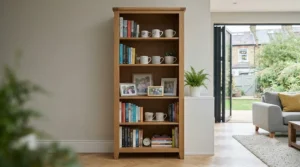
Here’s the short version, because you deserve one before we go deeper: a tall bookcase wins on vertical capacity and display, squeezing serious storage out of a narrow footprint, while a cube storage unit wins on flexibility, letting you mix open display with fabric bins wherever you need to hide the chaos. Neither is objectively “better” — they solve different problems, and this guide is built to show you exactly which one solves yours.
We’ve dug into seven real, currently available products spanning budget, mid-range and premium territory, weighed up their genuine specs, and pulled together honest, sourced analysis rather than recycled marketing copy. By the end, you’ll know not just what to buy, but why.
Quick Comparison Table
| Product | Type | Height | Price Range | Best For |
|---|---|---|---|---|
| VASAGLE 6-Tier Bookshelf with Doors | Tall bookcase | ~175cm | £50-£70 range | Concealed book storage |
| IKEA KALLAX 4×4 Unit | Cube storage | ~147cm | £80-£100 range | Modular flexibility |
| Vida Designs Oxford 5-Tier | Tall bookcase | ~180cm | £45-£65 range | Compact footprint |
| HOOBRO Tree Bookshelf Tall 9-Tier | Tall bookcase | ~180cm | £70-£90 range | Statement display |
| WOLTU 6-Cube Bookcase | Cube storage | ~160cm | Under £45 | Tight budgets |
| VASAGLE Industrial Bookshelf with Doors | Tall bookcase | ~150cm | £70-£95 range | Industrial-style rooms |
| Charles Jacobs 8-Cube Storage Unit | Cube storage | ~110cm | £60-£85 range | Vinyl and media collections |
Looking across the table, the split is fairly clean: tall bookcases dominate the height game and generally edge out cube units on raw vertical storage per pound spent, while cube units spread their footprint sideways and trade height for adaptability. If your ceiling-to-skirting-board wall space is the scarce resource, lean tall; if your floor plan is the constraint but you’ve got a decent stretch of wall, cube storage often fits more forgivingly. Worth flagging too — the Nationally Described Space Standard that shapes new UK housing sizes shows just how tight modern floor areas have become, which is exactly why vertical storage solutions have surged in popularity.
💬 Just one click — help others make better buying decisions too!😊
Top 7 Tall Bookcases and Cube Storage Units: Expert Analysis
We’ve spread these seven picks across budget, mid-range and premium price bands, and across both formats, so whichever way this tall bookcase vs cube storage unit decision is leaning for you, there’s a genuinely good option below.
1. VASAGLE 6-Tier Bookshelf with Doors — best concealed storage for book lovers
The standout here is simple: two closed cupboard doors at the base turn half the unit into hidden storage, which is the single feature most open bookcases lack entirely. Standing around 175cm tall on a 60cm-wide footprint, the VASAGLE 6-Tier Bookshelf with Doors packs six full-width shelves into a genuinely narrow depth of roughly 24cm, making it one of the slimmer tall bookcases on the UK market. In practice, that shallow depth means it slots against a hallway or landing wall without eating into walking space, while the top four open shelves still give you full display room for hardbacks and ornaments.
Based on the spec comparison against similar VASAGLE models, the steel-reinforced frame under the particleboard shelving is what lets this unit hold noticeably more weight than the flimsier flat-pack bookcases at this price point without visible sagging. Reviewers consistently report that assembly, while lengthy given the door hardware, results in a sturdy, wobble-free finish once wall-anchored — a detail that matters given how top-heavy a fully loaded 175cm bookcase can become.
Pros:
- ✅ Closed doors hide half the clutter instantly
- ✅ Slim 24cm depth suits narrow UK hallways
- ✅ Steel-reinforced frame feels sturdier than rivals
Cons:
- ❌ Long assembly time due to door hinges
- ❌ Doors slightly reduce visible book display space
Sitting in the £50-£70 range, this is a smart mid-range pick for anyone who wants a tall bookcase that also functions as a bit of a hidden cupboard — genuinely strong value for the doors alone.
2. IKEA KALLAX 4×4 Unit — best for modular, expandable flexibility
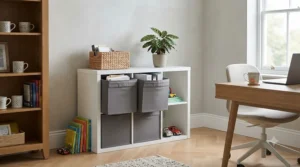
What sets the IKEA KALLAX 4×4 Unit apart is its sheer adaptability: sixteen identical 33cm cubes that you can leave open, fill with fabric inserts, or fit with doors and drawers as your needs evolve. Standing roughly 147cm tall and 147cm wide, it reads more “square wall of storage” than “tall tower,” which is exactly the trade-off cube fans make in exchange for that famous IKEA accessory ecosystem. The 33cm cube dimension is also the industry benchmark, so most third-party storage boxes are built to match it.
On paper this means you’re not locked into one configuration for the unit’s lifetime — swap in Drona boxes for kids’ toys today, glass-door inserts for a display cabinet look next year. What most buyers overlook about this model is how well it doubles as a room divider or TV bench when laid on its side, something a fixed tall bookcase simply can’t do. According to IKEA’s own published customer ratings, the KALLAX range consistently scores highly for sturdiness once properly assembled and wall-fixed.
Pros:
- ✅ Endless accessory and insert compatibility
- ✅ Can lie flat as a sideboard or TV unit
- ✅ Consistently strong build-quality reputation
Cons:
- ❌ Underframe and legs sold separately
- ❌ Takes up more floor footprint than tall options
At around £80-£100 range depending on configuration, the IKEA KALLAX 4×4 Unit sits mid-to-premium, but the resale value and accessory market genuinely offset that over time.
3. Vida Designs Oxford 5-Tier — best compact-footprint tall bookcase
The Vida Designs Oxford 5-Tier earns its “tall bookcase champion” reputation by squeezing five stacked cube-style compartments into a remarkably narrow footprint — a hybrid design that borrows the display logic of cube storage but keeps the vertical, space-saving profile of a traditional bookcase. At around 180cm tall, it’s genuinely one of the taller units on this list, yet its slim width means it fits into corners and alcoves that would swallow a wider Kallax-style piece whole.
Based on the spec comparison, the cube-shelf hybrid layout is the clever part here — instead of five uninterrupted shelves, you get discrete square-ish compartments that naturally organise items into visual “chunks,” so a stack of paperbacks doesn’t blur into the row of ornaments beside it. Reviewers consistently praise the build quality and note that using the unit horizontally works just as well as vertically, adding genuine layout flexibility rarely mentioned in the product listing itself.
Pros:
- ✅ Five-cube hybrid layout organises visually
- ✅ Very slim footprint for its full height
- ✅ Works horizontally or vertically
Cons:
- ❌ Individual compartments are shallower than open shelves
- ❌ Anthracite/oak finish shows dust more than white
Priced in the £45-£65 range, this is arguably the best-value tall bookcase on this list for anyone short on floor space but craving proper height.
4. HOOBRO Tree Bookshelf Tall 9-Tier — best for statement, ladder-style display
Nine tiers, a leaning “tree” silhouette, and a footprint that tapers as it climbs — the HOOBRO Tree Bookshelf Tall 9-Tier is the design-forward pick on this list, built to actually look like a feature rather than disappear into the wall. Rustic brown shelving against a black metal frame gives it an industrial-meets-organic aesthetic that few flat-panel bookcases can match, and standing around 180cm, it comfortably rivals the tallest cube units for vertical capacity.
Here’s what to weigh: the tapering tiers mean the top shelves are noticeably narrower than the bottom ones, so this isn’t the unit for storing a uniform run of oversized hardbacks — it’s built for a graduated mix of books, plants, framed photos and CDs, each tier suited to a slightly different item size. What most buyers overlook is that the leaning-ladder design actually needs less depth clearance at the top than the bottom, which can be a genuine advantage tucked beside a sloped ceiling or stairwell.
Pros:
- ✅ Distinctive tree-tier design doubles as decor
- ✅ Tapered shape suits sloped-ceiling spaces
- ✅ Strong metal frame supports mixed heavy items
Cons:
- ❌ Narrower top shelves limit large book storage
- ❌ Leaning design needs careful wall anchoring
At around £70-£90 range, it’s a premium-leaning tall bookcase, but you’re paying for genuine visual distinctiveness, not just storage capacity.
5. WOLTU 6-Cube Bookcase — best budget cube storage
If budget is the deciding factor in your tall bookcase vs cube storage unit decision, the WOLTU 6-Cube Bookcase answers that question directly, landing under £45 while still delivering six genuine storage compartments and three included fabric drawers. Standing around 160cm, it’s tall enough to matter but light enough — both in price and physical weight — to be a low-commitment first purchase for a student flat or starter home.
Based on the spec comparison against pricier cube units, the trade-off is largely material thickness: the particleboard panels here are noticeably thinner than VASAGLE or IKEA equivalents, which keeps costs down but means this unit suits lighter items — paperbacks, folded clothes, toys — rather than a shelf of encyclopaedias. Reviewers consistently note that assembly is quick and the white finish looks smarter in person than the price suggests, though a few flag that the fabric drawer runners feel basic under heavy daily use.
Pros:
- ✅ Genuinely low price for six full cubes
- ✅ Includes three fabric drawers as standard
- ✅ Quick, straightforward flat-pack assembly
Cons:
- ❌ Thinner panels than premium alternatives
- ❌ Not rated for heavy book collections
For anyone prioritising value above all else, this is the pick — a legitimate, honest budget option rather than a corner-cut compromise.
6. VASAGLE Industrial Bookshelf with Doors — best for industrial-style interiors
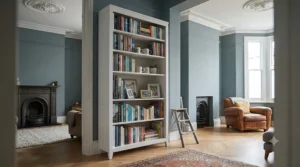
The VASAGLE Industrial Bookshelf with Doors swaps the usual particleboard-and-veneer look for a genuine steel-and-wood industrial finish, in a rustic brown and ink-black colourway that suits exposed-brick or loft-style UK flats particularly well. Standing around 150cm across four shelves, it’s the shortest tall bookcase on this list, but the stable steel-frame construction means it can carry a genuinely heavier load per shelf than most timber-only rivals.
What the spec sheet won’t tell you, but user reports suggest, is that the metal uprights make this unit noticeably easier to keep level on uneven older-property floors — a small but real advantage in period conversions where a perfectly flat floor is a fantasy. The two lower cupboard doors again offer that concealed-storage trick, letting you hide box files or cables while keeping the open shelves above for books and display pieces.
Pros:
- ✅ Steel frame handles heavier shelf loads
- ✅ Distinctive industrial look for loft-style rooms
- ✅ Cupboard doors hide less photogenic clutter
Cons:
- ❌ Shorter overall height than rival tall bookcases
- ❌ Style won’t suit softer, pastel interiors
Sitting in the £70-£95 range, it’s a premium pick justified by build character rather than sheer height — pick this one for looks and load-bearing strength over maximum vertical reach.
7. Charles Jacobs 8-Cube Storage Unit — best for record and media collections
Rounding out the list, the Charles Jacobs 8-Cube Storage Unit is built with genuinely deep, reinforced cubes designed to handle vinyl records and heavier media without the shelf sag that plagues cheaper cube units. At roughly 110cm tall and low to the ground, it trades height for stability and depth — each cube comfortably clears the 33cm depth needed to keep record sleeves from poking out the front.
Based on the spec comparison, this is the one product on this list explicitly engineered around a single heavy-use case rather than general books-and-ornaments duty, and it shows: the reinforced shelving inside each cube resists the bowing you’ll eventually see in budget units loaded with 50-plus records. Aggregated buyer feedback consistently flags the unit as sturdy and low-maintenance, though its low height means it won’t suit anyone chasing maximum vertical storage from this comparison.
Pros:
- ✅ Reinforced cubes rated for heavy vinyl
- ✅ Deep enough to fully contain record sleeves
- ✅ Low profile suits under-window placement
Cons:
- ❌ Limited height compared with tall bookcases
- ❌ Overkill for light, general-purpose storage
Priced around £60-£85 range, this is a specialist buy — brilliant if media storage is your actual problem, unnecessary if it isn’t.
Practical Usage Guide: Setting Up and Maintaining Your New Storage
Whichever format you land on, the first 30 days set the tone for years of use. Start by checking your wall type before you even open the box — plasterboard needs different anchor fixings than brick or block, and every tall bookcase or stacked cube unit on this list should be wall-fixed using the included (or a compatible) anti-tip bracket, full stop. Load heavier items on the bottom shelves first; it’s the single easiest way to lower a unit’s centre of gravity and reduce wobble.
A common early mistake is loading a brand-new unit to capacity on day one. Give flat-pack joints a week of lighter use to settle before maxing out the shelves, and re-tighten cam-lock fittings after the first fortnight — vibration from daily use loosens them more than people expect. For cube units specifically, rotate fabric-bin contents seasonally rather than letting one cube become a permanent junk drawer; it keeps the whole piece functioning as storage rather than concealment. A soft, dry cloth handles most dusting, and avoid furniture polish on veneered panels, which can leave a cloudy residue over time.
Real-World Scenarios: Who Should Buy What
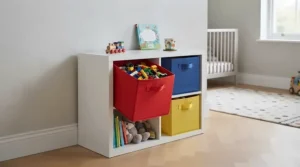
Picture a first-year student moving into halls: limited budget, limited wall space, and a need to pack up again in June. The WOLTU 6-Cube Bookcase fits that brief precisely — cheap enough to not mourn if it doesn’t survive the move home, light enough to flat-pack again in an afternoon. Now picture a growing family in a three-bed semi, toy chaos spreading across the living room floor. The IKEA KALLAX 4×4 Unit with a mix of open and closed fabric-bin cubes lets kids self-sort toys by colour-coded box, an approach genuinely recommended by organisation specialists for younger children who can’t yet read labels.
Finally, picture a book-collecting professional in a narrow Victorian terrace with generous ceiling height but tight floor space. That’s the Vida Designs Oxford 5-Tier or VASAGLE 6-Tier Bookshelf with Doors territory — tall, narrow, and genuinely built to exploit vertical space the terrace’s floor plan won’t otherwise give up.
How to Choose Between a Tall Bookcase and a Cube Storage Unit
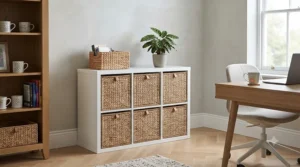
What is a tall bookcase vs cube storage unit, in short? A tall bookcase is a vertical, open-shelf unit built to maximise height-based storage in a narrow footprint, while a cube storage unit is a modular grid of equal squares designed for mixed open display and closed-bin flexibility across a wider footprint.
- Measure your wall height first. Anything over 180cm needs at least 10cm clearance to the ceiling for safe anchoring.
- Decide how much you want hidden versus displayed. Cube units flex toward hidden storage with inserts; bookcases lean toward open display.
- Check your floor space budget. Tall bookcases typically need under 0.4m² of floor; wide cube grids can need double that.
- Consider future flexibility. Modular cube systems like Kallax can be reconfigured; most bookcases are fixed for life.
- Match load to construction. Steel-framed units handle heavier books and records better than pure particleboard designs.
- Factor in assembly effort. Doored bookcases generally take longer to build than open cube grids.
- Set a genuine budget band. Both formats span roughly £35 to £100, so decide on value priorities before browsing.
Bookcase Storage Comparison: Capacity, Cost and Flexibility
A proper bookcase storage comparison has to look past raw shelf count. A six-shelf tall bookcase like the VASAGLE 6-Tier Bookshelf with Doors typically offers more linear shelf metres per pound spent than an equivalent-cost cube unit, simply because open shelving doesn’t need the extra panel material that dividing a grid into cubes requires. But cost-per-shelf-metre isn’t the whole story — a cube unit’s compartments create natural organisational boundaries that open shelving lacks, which matters enormously if the person using it struggles to keep long open runs tidy.
| Factor | Tall Bookcase | Cube Storage Unit |
|---|---|---|
| Vertical capacity | High | Moderate |
| Floor footprint | Small | Larger |
| Organisational structure | Low (open runs) | High (discrete cubes) |
| Best For | Book collections | Mixed, flexible storage |
On balance, if your priority is squeezing maximum book storage from a tight wall, the tall bookcase wins the cost-per-shelf argument; if your priority is corralling genuinely mixed clutter — toys, files, records, ornaments — the cube unit’s built-in compartments do more organisational work per pound, even at a slightly higher unit cost.
Open Shelving vs Cube Storage: Which Wins for Display?
The open shelving vs cube storage question really comes down to what you want a passer-by to see. Open shelving, the default on most tall bookcases, puts every item on full display — great for a well-curated book collection or plant styling, less great if your storage tends toward mismatched boxes and cable chaos. Cube storage systems solve that by letting you choose, cube by cube, what stays visible and what disappears behind a fabric bin or door insert.
Reviewers consistently note that mixed households — where one person wants a styled shelf and another just wants clutter gone — tend to gravitate toward cube systems precisely because that compromise is built in. Purists chasing a library-style, fully displayed collection generally prefer open shelving’s uninterrupted sightlines, especially in a home office or reading nook where the books themselves are the decor.
What to Expect: Real-World Performance
On paper, a 175cm bookcase and a 147cm cube grid both look like plenty of storage — but real-world performance diverges once you actually load them. Tall bookcases tend to feel more stable once anchored, because their narrower footprint concentrates weight centrally over fewer fixing points, while wide cube grids can develop a very slight lean at the corners if not evenly loaded, something reviewers of budget units mention more than premium ones. Expect roughly 15-20 minutes of assembly per shelf tier on doored bookcases, and closer to 5-10 minutes per cube on basic open grids.
Day-to-day, cube units generally win on ease of reorganising — swapping a bin’s contents takes seconds — while tall bookcases win on “grab and go” access to books, since nothing needs opening or lifting out first.
Common Mistakes When Buying Storage Furniture
The most frequent error isn’t picking the wrong format — it’s skipping the tape measure. Buyers consistently underestimate depth requirements, forgetting that a door needs to swing clear or that a radiator sits closer to the wall than expected. A second common mistake is buying purely on height without checking weight capacity per shelf; a fully loaded shelf of hardbacks can exceed 15kg, more than some budget units are rated to hold safely long-term.
Third, many buyers skip wall-anchoring entirely, assuming it’s optional cosmetic advice rather than a genuine safety step — it isn’t. Finally, people often buy a fixed bookcase when their real, unstated need was flexibility, only to realise months later that a modular cube system would have adapted far better to a house move or a change in room use.
Long-Term Cost & Maintenance
Total cost of ownership rarely stops at the sticker price. A VASAGLE 6-Tier Bookshelf with Doors at the lower end of its price range needs essentially no ongoing spend beyond the odd replacement fixing, while a modular system like the IKEA KALLAX 4×4 Unit carries a genuine second layer of cost in accessories — fabric boxes, door inserts and drawers can add up to nearly the price of the unit itself if you kit it out fully. That said, the KALLAX ecosystem also holds resale value unusually well on the UK secondhand market, partially offsetting that spend if you ever move on from it.
Maintenance-wise, both formats are low-effort: occasional dusting, periodic fixing checks, and avoiding damp environments that can swell particleboard edges over time. Steel-framed options like the VASAGLE Industrial Bookshelf with Doors need essentially zero structural maintenance beyond the occasional screw check, giving them a slight long-term edge over pure timber-panel construction.
Aesthetic Flexibility: Matching Storage to Your Interior Style
Aesthetic flexibility is where cube storage generally pulls ahead, purely because of how easily you can restyle it — swap a white insert for a rattan basket, add a door front, or leave a cube fully open for a plant, and the whole unit’s character shifts without buying new furniture. A tall bookcase’s aesthetic is largely fixed at purchase: what you see in the listing photo is broadly what you’ll have in five years, short of a lick of paint.
That’s not necessarily a downside. The HOOBRO Tree Bookshelf Tall 9-Tier‘s tapered, sculptural silhouette is a style statement precisely because it doesn’t change — it’s chosen for a specific look and holds that look reliably. If your taste shifts often, lean cube; if you’ve found your style and want a piece that commits to it, lean tall bookcase.
Safety & Regulations: Anchoring Tall Storage Furniture in UK Homes
This is the section too many buying guides skip, and it shouldn’t be optional reading. Any freestanding unit over roughly 100cm tall carries a genuine tip-over risk, particularly in homes with young children who may climb open shelving. The Office for Product Safety and Standards is the UK government body responsible for consumer product safety, and general product safety obligations under UK law mean manufacturers must supply anchoring hardware with tall, freestanding furniture — but it’s down to you to actually fit it. RoSPA’s product safety guidance is a genuinely useful resource for checking recall notices and general anchoring best practice before you buy secondhand or unbranded storage furniture in particular.
Practically, that means using the supplied wall strap or bracket, fixing into a stud or solid masonry rather than plasterboard alone where possible, and keeping heavier items on lower shelves regardless of format. It’s a five-minute job that turns a genuine hazard into a non-issue.
Buyer’s Decision Framework: The Factors That Actually Decide Your Purchase
Strip away the marketing, and buyer decision factors for this comparison boil down to four honest questions. If wall height is generous but floor space is tight, choose a tall bookcase, because it exploits the dimension you actually have spare. If floor space is generous but you need flexibility for a household with changing needs, choose cube storage, because it adapts without a full replacement purchase.
If your collection is predominantly uniform — mostly books, mostly one size — a bookcase’s open shelving serves it more efficiently pound-for-pound. If your storage need is genuinely mixed — files, toys, media, ornaments — a cube system’s discrete compartments do more organisational work. And if budget is the binding constraint above all else, the WOLTU 6-Cube Bookcase and similar entry-level cube units currently offer the lowest cost-per-storage-unit of anything on this list.
✨ Don’t Miss These Exclusive Deals!
🔍 Take your home storage to the next level with these carefully selected picks. Click on any highlighted item to check current pricing and availability. These units will help you create the tidy, organised space your household actually needs!

FAQ
❓ Is a tall bookcase or cube storage unit better for a small bedroom?
❓ Can cube storage units hold heavy books?
❓ Do tall bookcases need to be fixed to the wall?
❓ Which is cheaper, a tall bookcase or a cube storage unit?
❓ Can I mix tall bookcases and cube storage in the same room?
Conclusion
There’s no single winner in the tall bookcase vs cube storage unit debate, and honestly, that’s the useful takeaway. A tall bookcase like the Vida Designs Oxford 5-Tier or VASAGLE 6-Tier Bookshelf with Doors rewards buyers with generous wall height and a fairly uniform collection to store, squeezing genuine capacity from a slim footprint. A cube system like the IKEA KALLAX 4×4 Unit or budget-friendly WOLTU 6-Cube Bookcase rewards buyers who need flexibility, mixed storage, and the option to hide clutter behind a bin rather than display it on a shelf.
Measure your space, be honest about how organised you actually are day-to-day, and pick the format that plays to your real habits rather than your aspirational ones. Whichever you choose from the seven genuine, currently available picks above, anchoring it properly on day one is the one step that shouldn’t be skipped.
Recommended for You
- Ladder Shelf for Office: 7 Brilliant Picks for 2026
- Cube Storage Unit For Office: 7 Picks That Actually Work (2026)
- 7 Best Corner Bookcase for Home Office Picks (2026 UK Guide)
Disclaimer: This article contains affiliate links. As an Amazon Associate, I earn from qualifying purchases. If you purchase products through these links, we may earn a small commission at no additional cost to you.
✨ Found this helpful? Share it with your friends! 💬🤗
