
In This Article
Picture this: you’ve just assembled your third office chair in eighteen months. The gas lift has failed again, the armrests are cracking, and there’s an ominous creak every time you lean back. If you’re a heavier person — and especially if you weigh over 16 stone — this scenario probably feels painfully familiar.
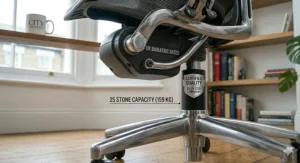
Here’s what most office furniture retailers won’t tell you: the overwhelming majority of office chairs sold in the UK are tested to BS EN 1335 standards, which specify a maximum user weight of just 110kg (around 17 stone). Beyond that threshold, you’re essentially asking a chair to perform a job it was never engineered to handle. The result? Premature wear, uncomfortable seating, and in worst-case scenarios, genuine safety hazards.
The solution isn’t simply buying a “better” standard chair. What you need is an office chair for heavy person specifications — purpose-built seating with reinforced frames, industrial-grade gas lifts, wider seat pans, and genuine bariatric engineering. These aren’t cosmetic upgrades; they’re fundamental structural differences that determine whether your chair will support you comfortably for years or collapse embarrassingly within months.
In this comprehensive guide, I’ve researched the UK market extensively to identify seven genuine heavy duty office chairs available right now on Amazon.co.uk. Each option has been evaluated based on actual weight capacity testing, real UK customer feedback, British safety standards compliance, and crucially, value for money in pounds sterling. Whether you’re working from a compact home office in Manchester or managing a team from a corporate workspace in Edinburgh, you’ll find practical, honest assessments to help you invest wisely in seating that actually fits your needs.
Quick Comparison: Top Heavy Duty Office Chairs at a Glance
| Chair Model | Weight Capacity | Seat Width | Price Range (£) | Best For |
|---|---|---|---|---|
| BASETBL 200kg Executive | 200kg (31 stone) | 60-61cm | £180-£225 | Maximum capacity & spring cushioning |
| SONGMICS OBG22BUK | 150kg (23.5 stone) | 55cm | £60-£85 | Budget-conscious buyers |
| EXCEBET 180kg Pocket Spring | 180kg (28 stone) | 58cm | £140-£175 | Back pain sufferers |
| IWMH 200kg Big & Tall | 200kg (31 stone) | 60cm | £110-£145 | Taller users (over 6ft) |
| Office Hippo Heavy Duty Mesh | 150kg (23.5 stone) | 54cm | £95-£130 | Breathability in warm offices |
| SONGMICS OBG77BGUK Gaming | 150kg (23.5 stone) | 54cm | £125-£160 | Footrest & reclining features |
| FLEXISPOT BS14 Fabric | 150kg (23.5 stone) | 56cm | £110-£145 | Fabric upholstery preference |
From this comparison, three things become immediately clear. First, genuine 200kg capacity chairs command a premium of roughly £70-£100 over 150kg models, but that investment buys you significantly more robust engineering — particularly important if you’re approaching the 25 stone mark. Second, seat width varies considerably even within the same weight class; a 60cm pan provides noticeably more breathing room than 54cm options, especially during long working days. Third, UK buyers currently have excellent options across the £60-£225 range, meaning you needn’t sacrifice build quality for affordability if you’re willing to forgo premium features like footrests or pocket spring seating.
💬 Just one click — help others make better buying decisions too!😊
Top 7 Office Chairs for Heavy Person: Expert Analysis
1. BASETBL Big & Tall 200kg Executive Chair — Premium Heavy Duty Champion
The BASETBL 200kg series represents the current pinnacle of what’s readily available on Amazon.co.uk for heavier users. What immediately distinguishes this chair from cheaper alternatives claiming similar weight capacities is the inclusion of a genuine 3D pocket spring cushion system — the same technology you’d find in quality mattresses, not typical office seating.
The specifications tell part of the story: 60cm seat width (15% broader than standard UK office chairs), 55cm seat depth for proper thigh support, and an ultra-high 78cm backrest that accommodates users between 160cm and 210cm tall. But specifications alone don’t convey what UK buyers consistently report in reviews — this chair genuinely delivers sofa-like comfort during eight-hour working days. The spring system distributes weight dynamically rather than relying solely on foam compression, which means you’re not experiencing that dreaded “bottoming out” sensation by mid-afternoon.
The engineering extends beyond the seating surface. BASETBL uses a four-level gas lift (rather than the two-level mechanisms common in budget chairs), providing 3.1 inches of height adjustment to accommodate different desk heights. The 3D armrests adjust in height, width, and angle, synchronising with the backrest when you recline between 90° and 120° — a thoughtful detail that maintains proper arm support whether you’re sitting upright or leaning back during phone calls.
UK customer feedback has been overwhelmingly positive, with January 2026 reviews praising the sturdy build and genuine 200kg support. One verified purchaser specifically noted the chair feels “extremely solid and reliable” even at higher weights. The rubber castors glide smoothly across both carpet and hard floors without the aggressive rolling that cheaper wheels exhibit, which matters considerably in compact British home offices where space is at a premium.
Pros:
✅ Genuine 200kg capacity with 3D pocket spring cushioning
✅ Extra-wide 60cm seat accommodates larger frames comfortably
✅ Four-level gas lift and 3D synchronised armrests
✅ Rubber castors protect flooring whilst rolling smoothly
✅ Two-year parts warranty from manufacturer
Cons:
❌ Premium pricing in the £180-£225 range
❌ Some users report assembly takes 40-50 minutes
The BASETBL sits in the £180-£225 bracket depending on finish and model variant, positioning it firmly in premium territory. However, when you calculate the cost-per-use over a realistic five-year lifespan (compared to replacing cheaper chairs annually), the value proposition becomes rather compelling for anyone genuinely needing 200kg capacity.
2. SONGMICS OBG22BUK Executive — Best Budget Heavy Duty Option
If you’re watching your pennies but refuse to compromise on structural integrity, the SONGMICS OBG22BUK deserves serious consideration. This chair has become something of a sleeper hit among UK buyers who need proper weight support without the premium price tag. Currently available in the £60-£85 range, it represents exceptional value for 150kg capacity seating.
The most impressive aspect isn’t immediately visible — SONGMICS subjected the five-star base to a supplier-tested static pressure test of over 1,100 kilograms. That’s genuinely reassuring engineering for a chair at this price point. The gas lift cylinder has passed SGS safety testing through 120,000 cycles, suggesting it should handle daily height adjustments for years rather than months. These certifications matter more than marketing claims about “heavy duty” construction.
The 55cm seat width and high-density foam cushioning provide adequate comfort for users up to 150kg, though you’re not getting the pocket spring luxury of pricier models. UK reviewers consistently describe the seating as “supportive” and “comfortable for 6-8 hour days,” which is precisely what most home workers require. The PU leather upholstery wipes clean easily — particularly important if you’re prone to coffee mishaps during morning video calls.
One UK reviewer who identified as a “heavy gentleman” was initially sceptical but found the SONGMICS range delivered sensible reviews and affordable prices. However, he encountered the common issue where new office chairs feel like they tilt forward slightly, though many users find this sensation diminishes after the foam settles over the first week of use. This breaking-in period is normal for high-density foam cushioning and shouldn’t be mistaken for a defect.
The chair’s limitations are worth noting honestly. Maximum height adjustment is 122cm, which may not satisfy optimal Display Screen Equipment guidelines if you’re significantly over 6 feet tall. The armrests are fixed rather than adjustable, meaning you’re relying on the chair height mechanism alone to achieve proper arm positioning. For users of average UK height (around 175cm for men, 162cm for women), these constraints rarely prove problematic.
Pros:
✅ Exceptional value in the £60-£85 range
✅ Five-star base tested to 1,100kg static pressure
✅ SGS-certified gas lift through 120,000 cycles
✅ High-density foam resists compression well
✅ Straightforward assembly takes under 30 minutes
Cons:
❌ Fixed armrests lack adjustability
❌ Maximum height may be insufficient for very tall users
The SONGMICS OBG22BUK represents sensible compromise engineering. You’re sacrificing premium features like adjustable lumbar support and 3D armrests, but retaining the fundamental structural integrity that prevents catastrophic failure. For budget-conscious UK buyers working from home 4-6 hours daily, this chair delivers reliable performance without pretending to be something it’s not.
3. EXCEBET 180kg Pocket Spring Executive — Best for Back Pain Relief
The EXCEBET 180kg model occupies interesting middle ground between budget options and premium bariatric seating, currently priced around £140-£175 on Amazon.co.uk. What distinguishes this chair from similarly-priced competitors is the inclusion of a 14cm pocket spring seat cushion — rare technology at this price point that makes genuine difference for users suffering lower back discomfort.
The pocket spring system works differently from standard foam padding. Instead of uniform compression across the entire seat pan, individual springs respond independently to pressure distribution. This means your sit bones receive firmer support whilst surrounding areas remain more yielding, maintaining better pelvic alignment throughout long working sessions. UK physiotherapists frequently recommend pocket spring seating for patients with chronic lower back issues, making the EXCEBET particularly relevant if you’re managing existing pain whilst working from home.
Beyond the seating surface, the chair delivers solid bariatric credentials. The 58cm seat width provides generous accommodation without the excessive bulk of 60cm+ models, fitting more comfortably under standard UK desks (typically 72-76cm height). The high backrest contours closely to spinal curves, with integrated lumbar support that’s actually positioned correctly for most users — unlike cheaper chairs where the lumbar bulge sits awkwardly between shoulder blades.
The 180kg weight capacity positions this chair sensibly for users in the 20-28 stone range who need more than entry-level 150kg support but don’t require full 200kg bariatric engineering. This is honest capacity rating rather than optimistic marketing — the reinforced frame, heavy-duty gas lift, and strengthened mechanism all demonstrate genuine over-engineering for the rated load.
UK customer reviews from late 2025 and early 2026 consistently praise the back support quality, with several verified purchasers noting reduced end-of-day fatigue compared to their previous seating. One reviewer specifically highlighted how the pocket spring cushion “offers superior comfort for long sitting sessions” — high praise given British tendency towards understated feedback rather than American-style hyperbole.
Pros:
✅ 14cm pocket spring cushion reduces back pain
✅ 180kg capacity ideal for 20-28 stone users
✅ Well-positioned integrated lumbar support
✅ 58cm seat width fits standard UK desks easily
✅ Adjustable armrests and headrest included
Cons:
❌ Mid-range pricing may stretch tight budgets
❌ PU leather less breathable than mesh alternatives
The EXCEBET sits in that often-overlooked £140-£175 bracket where you’re paying notably more than budget options but receiving tangible engineering improvements. The pocket spring technology alone justifies the premium if you’re battling back discomfort, potentially saving considerably more in osteopath appointments over the chair’s lifespan.
4. IWMH Big & Tall 200kg Executive — Best for Taller Users
Taller individuals face unique challenges finding office chairs that provide proper support — it’s not simply about weight capacity but rather the vertical dimensions that determine whether a chair can actually position your spine correctly. The IWMH Big & Tall 200kg model addresses this specifically, with an exceptionally high backrest and extended gas lift range that accommodates users between 5’3″ and 6’11”.
The extra-high backrest reaches well up the spine, providing support where taller users actually need it rather than stopping awkwardly at mid-back level. This matters enormously if you’re over 6 feet tall and have spent years hunching forward because standard chairs simply don’t reach high enough. Combined with the 9cm adjustable headrest, you can finally achieve proper neck positioning during long working sessions.
The 60cm seat width matches premium BASETBL models, providing generous accommodation for broader builds. More importantly, the seat depth has been extended to 55cm compared to typical 50cm designs, offering better thigh support that prevents circulation issues during extended sitting. This 5cm difference sounds modest on paper but proves genuinely noticeable in practice, especially during afternoon work when standard chairs leave your legs feeling numb.
The 200kg weight capacity utilises industrial-grade components throughout. The heavy-duty gas lift maintains height settings reliably even after thousands of adjustments — a common failure point in cheaper chairs where the cylinder gradually sinks under load. The reinforced five-star base and metal frame demonstrate proper over-engineering rather than meeting minimum specifications.
UK buyers in January 2026 reviews consistently mention the chair’s suitability for taller frames, with one verified purchaser at 6’2″ noting it’s the first office chair that actually fits him properly. The adjustable footrest proves particularly useful for taller users whose feet often dangle uncomfortably when chairs are raised to accommodate desk height.
The chair reclines smoothly between 90° and 135°, with linked armrests that maintain proper support at any angle. This synchronised mechanism represents more sophisticated engineering than cheaper chairs where armrests remain fixed whilst the backrest tilts, creating awkward gaps.
Pros:
✅ Ultra-high backrest suits users up to 6’11”
✅ Extended 55cm seat depth improves thigh support
✅ 200kg capacity with industrial-grade components
✅ 9cm adjustable headrest for proper neck positioning
✅ Integrated footrest helpful for taller frames
Cons:
❌ Premium pricing in the £110-£145 range
❌ Substantial footprint may overwhelm compact home offices
The IWMH Big & Tall typically retails around £110-£145, positioning it below top-tier BASETBL models whilst delivering comparable build quality. For taller individuals who’ve struggled finding chairs that actually fit, this price represents excellent value — particularly when compared to specialist ergonomic retailers charging £300+ for similar specifications.
5. Office Hippo Heavy Duty Mesh Chair — Best Breathability Option
British summers are becoming progressively warmer, and working from a home office without air conditioning can transform PU leather chairs into sweat-inducing torture devices by mid-afternoon. The Office Hippo Heavy Duty Mesh model addresses this specifically, utilising breathable mesh backing that maintains airflow even during extended sitting sessions.
The mesh construction isn’t simply about temperature comfort — it also reduces that clammy feeling that leather develops in humid conditions, which is particularly relevant during Britain’s notoriously damp autumns and winters when indoor heating combines with external moisture. UK buyers working from conservatories or rooms with large south-facing windows consistently praise the mesh’s cooling properties.
Despite the breathable construction, this chair delivers genuine heavy duty credentials with 150kg weight capacity. The mesh is reinforced at stress points and stretched across a robust frame that prevents the sagging issues cheaper mesh chairs develop. The five-star base has been tested to substantial loads, with heavy-duty castors that roll smoothly across both carpet and hard flooring.
The 54cm seat width sits at the narrower end of heavy duty specifications, which proves advantageous if you’re working from a compact home office or need to tuck the chair fully under a standard UK desk. The flip-up armrests offer particular flexibility in tight spaces — you can raise them when sliding under the desk, then lower them for support during actual work.
The ergonomic design features adaptive lumbar support that flexes with your movements rather than remaining rigidly fixed. This dynamic support maintains proper spinal alignment whether you’re leaning forward during intense concentration or reclining during phone calls. The adjustable headrest can be raised or removed entirely depending on your height and preference.
UK customer feedback from late 2025 specifically highlights the mesh’s performance during warmer months, with one verified purchaser noting it remains “comfortable even during heatwave conditions.” Another reviewer appreciated that the breathable design doesn’t sacrifice structural integrity — the chair feels “solid and stable” despite the lighter-weight mesh construction.
Pros:
✅ Breathable mesh ideal for warm UK offices
✅ 150kg capacity with reinforced mesh construction
✅ Flip-up armrests save space in compact rooms
✅ Adaptive lumbar support flexes with movement
✅ Easy-clean surface resists dust and debris
Cons:
❌ 54cm seat width narrower than premium models
❌ Mesh may feel less plush than cushioned alternatives
The Office Hippo typically retails around £95-£130, positioning it between budget SONGMICS options and premium leather executive chairs. If you’re working from a naturally warm environment or simply prefer breathable seating, the mesh construction delivers tangible benefits that justify the moderate premium over solid-cushion alternatives.
6. SONGMICS OBG77BGUK Gaming Chair — Best Reclining Features
Don’t let the “gaming” label fool you — the SONGMICS OBG77BGUK functions brilliantly as a heavy duty office chair for professionals who appreciate the enhanced reclining and footrest features typically associated with gaming seating. Currently priced around £125-£160, it delivers 150kg capacity with genuine comfort enhancements.
The integrated footrest represents the standout feature, extending smoothly when you need to recline during breaks or phone calls. Whilst one UK reviewer noted it’s “a bit flimsy,” he also admitted that with perseverance, it became comfortable enough to fall asleep in the chair — hardly damning criticism. The key understanding is that footrests are designed for occasional use during relaxation, not as permanent reclining positions for all-day lounging.
The chair reclines smoothly between 90° and 135°, with armrests that tilt backward simultaneously — maintaining proper support at any angle. This linked mechanism represents more sophisticated engineering than cheaper chairs where fixed armrests create awkward gaps when you lean back. The locking mechanism holds securely at any position within the range, allowing you to find your preferred angle rather than accepting preset positions.
The 54cm seat width and 10cm thick cushion provide substantial comfort, with premium foam padding that retains supportive shape even after extended use. The PU leather upholstery features skin-friendly treatment that remains comfortable against bare arms during summer months — important detail for UK workers who often shed jumpers during afternoon warmth.
The 150kg maximum weight capacity has been validated by multiple UK buyers, with verified purchasers consistently reporting stable, reliable performance. The ergonomic backrest contours closely to spinal curves, working in conjunction with adjustable lumbar and head cushions to provide all-round support that relieves fatigue during competitive work sessions.
One limitation worth noting: users around 6 feet tall report the maximum height doesn’t quite align with optimal Display Screen Equipment guidelines for leg positioning. However, for users of average UK height (around 5’9″ for men, 5’4″ for women), this rarely proves problematic.
Pros:
✅ Integrated footrest for relaxation breaks
✅ 90°-135° recline with synchronised armrests
✅ 10cm thick cushion maintains shape well
✅ 150kg capacity validated by UK customers
✅ Gaming aesthetics appeal to younger professionals
Cons:
❌ Maximum height may be limiting for very tall users
❌ Footrest durability concerns from some reviewers
The SONGMICS OBG77BGUK typically retails around £125-£160, positioning it in comfortable mid-range territory. If you value the ability to properly recline during breaks and appreciate footrest functionality, this chair delivers features that pricier executive models often omit.
7. FLEXISPOT BS14 Fabric Executive — Best Fabric Upholstery Choice
The FLEXISPOT BS14 offers something increasingly rare in heavy duty office seating — genuine fabric upholstery rather than PU leather or mesh. For UK buyers who find leather too warm and mesh too austere, fabric provides welcome middle ground with distinct advantages for British climate conditions.
Fabric upholstery breathes naturally whilst maintaining the plush, substantial feel that leather provides. During Britain’s damp winters, fabric doesn’t develop the cold, clammy sensation that leather exhibits until body heat warms it. Conversely, during summer warmth, fabric wicks moisture more effectively than leather whilst feeling more substantial than mesh.
The 56cm seat width sits comfortably in mid-range specifications, providing generous accommodation without the excessive bulk of 60cm models. The high-density foam cushioning features enhanced thickness specifically engineered to resist compression under heavier loads — crucial consideration for maintaining comfort during eight-hour working days.
The 150kg weight capacity utilises FLEXISPOT’s established reputation for robust office furniture engineering. The reinforced frame, heavy-duty gas lift, and strengthened tilt mechanism all demonstrate proper over-design rather than meeting minimum specifications. The five-star base stability has been tested extensively, with reports from UK buyers confirming solid, wobble-free performance.
The chair features three-lever mechanism providing independent adjustment of seat height, backrest angle, and tilt tension. This level of customisation proves particularly valuable for heavier users who need to fine-tune the tilt resistance to match their body weight — cheaper chairs often use inadequate tension that either rocks too freely or remains frustratingly rigid.
UK customer reviews from early 2026 praise the fabric’s durability and easy maintenance. One verified purchaser noted the linen-look upholstery provides “foam padding and comfort” whilst remaining “easy enough to clean” — important consideration for home office environments where spills inevitably occur.
The adjustable lumbar support moves vertically to align with your spine’s natural curve, whilst the high backrest provides support well up between shoulder blades. The armrests adjust in height, though they lack the 3D movement of premium models.
Pros:
✅ Genuine fabric upholstery breathes naturally
✅ 150kg capacity with reinforced engineering
✅ Three-lever mechanism for precise adjustment
✅ High-density foam resists compression well
✅ Linen-look fabric easier to clean than leather
Cons:
❌ Armrests lack 3D adjustment capabilities
❌ Fabric may show staining more readily than leather
The FLEXISPOT BS14 typically retails around £110-£145, positioning it firmly in mid-range territory. For UK buyers who prefer fabric’s natural breathability and substantial feel, this chair delivers quality upholstery with proper heavy duty engineering.
Common Mistakes When Buying Office Chairs for Heavy People
Mistake 1: Assuming “Executive” Means Heavy Duty
Marketing terminology can be genuinely misleading. Many chairs labelled “executive” simply feature thicker cushioning and premium upholstery, whilst retaining standard 110kg weight ratings. The term refers to aesthetic styling rather than structural capacity — you’re paying for appearance rather than engineering.
Always check the actual weight capacity specification rather than trusting category labels. A chair marketed as “heavy duty executive” might feature leather upholstery and imposing appearance whilst maintaining exactly the same 110kg rating as standard office seating. Read the technical specifications, not the marketing copy.
Mistake 2: Ignoring Assembly Quality
The strongest components mean nothing if assembly is performed poorly. Overtightening bolts can strip threads or crack components, whilst insufficient tightening leaves chairs wobbly and unsafe. The most common error is inadequately securing the backrest to the seat pan — this junction point experiences tremendous forces and must be properly fastened.
Follow assembly instructions precisely, using the provided tools or appropriate alternatives. Don’t power-drill screws that should be hand-tightened, and resist the temptation to “just make it tight enough” without proper alignment. Many supposedly defective chairs are actually just poorly assembled.
After assembly, systematically check all connection points. The chair should feel absolutely solid with no creaking, wobbling, or play in any joint. If you detect issues, disassemble the problem area and reassemble carefully rather than hoping the wobble will “settle in.”
Mistake 3: Overlooking Armrest Design
Fixed armrests might seem like a minor compromise, but they profoundly affect ergonomic positioning. If armrests don’t adjust in height, you’re forced to raise the entire chair to achieve proper arm positioning — potentially leaving your feet dangling uncomfortably or requiring a footrest.
Adjustable armrests allow independent optimisation of arm and leg positioning, crucial for maintaining good posture during extended keyboard work. Even basic height adjustment proves vastly superior to fixed armrests, though 3D adjustability (height, width, angle) provides welcome additional flexibility.
Flip-up armrests offer particular advantage in compact UK home offices. You can raise them when sliding the chair fully under the desk, saving precious floor space when the chair isn’t in use. This feature proves especially valuable if you’re working from a bedroom or converted dining room where every centimetre matters.
Mistake 4: Underestimating Climate Impact
Britain’s notoriously variable climate affects seating comfort more than most buyers anticipate. PU leather feels luxuriously plush during moderate temperatures but becomes uncomfortably cold and clammy during winter mornings, then progressively sweaty during summer afternoons.
Mesh construction solves breathability issues but provides less plush cushioning and can feel uncomfortably cool during winter. Fabric upholstery offers sensible compromise, breathing adequately whilst maintaining substantial feel year-round.
Consider your workspace’s characteristics specifically. South-facing home offices with large windows become remarkably warm during summer, favouring mesh or fabric construction. Conversely, north-facing rooms or basement conversions benefit from leather’s insulating properties during colder months.
Mistake 5: Neglecting Long-Term Running Costs
The purchase price represents just one component of total ownership cost. Cheap chairs requiring replacement annually ultimately cost more than quality models lasting five-plus years. Calculate the effective annual cost rather than focusing solely on upfront expenditure.
Factor in potential healthcare costs from poor ergonomic support. If inadequate seating contributes to back pain requiring osteopathic treatment at £40-£60 per session, a £150 quality chair pays for itself after just three appointments. Prevention genuinely costs less than treatment.
Consider productivity implications if you’re self-employed or working from home. Uncomfortable seating that reduces your effective working hours by even 30 minutes daily represents substantial lost income over months and years. Proper seating is professional investment, not discretionary spending.
Mistake 6: Buying Based on Amazon Photos Alone
Product photography can be remarkably deceptive regarding actual chair dimensions. Manufacturers routinely photograph chairs in empty rooms or against minimal backgrounds that make them appear more substantial than reality. That imposing executive chair might actually feature a modest 52cm seat that feels cramped in person.
Read actual measurements in the technical specifications, then visualise those dimensions in your workspace. A 70cm base diameter sounds abstract until you realise it won’t fit comfortably under your 72cm desk with drawers. Measure your available space before purchasing, particularly if you’re working from compact rooms.
UK customer reviews often mention size perceptions — look specifically for feedback from British buyers noting whether chairs feel larger or smaller than expected. US reviewers operate with different spatial expectations, so prioritise UK-specific feedback when assessing dimensions.
Mistake 7: Ignoring the 14-Day Return Window
The Consumer Rights Act provides a 14-day cooling-off period for distance purchases, allowing returns for any reason. However, many buyers fail to properly test their chair within this window, then discover problems after the return period expires.
Use the chair extensively during the first week — sit for full working days, adjust all features, test the recline mechanism thoroughly. Problems often emerge only after extended use, so don’t wait until day 13 to assess whether the chair actually suits your needs.
Document any issues with photos and descriptions whilst within the return window. If you’re experiencing discomfort or noticing quality concerns, contact the seller immediately rather than hoping problems will resolve themselves. Amazon.co.uk typically handles returns smoothly, but you must act within the statutory period.
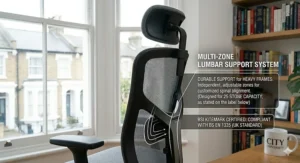
Office Chair for Heavy Person vs Standard Office Chair: What’s Actually Different?
The engineering differences between genuine heavy duty chairs and standard office seating extend far beyond simple weight ratings. Understanding these distinctions helps evaluate whether chairs claiming “heavy duty” credentials actually deliver substantive improvements or merely cosmetic upgrades.
Frame Construction and Materials
Standard office chairs typically utilise nylon five-star bases adequate for 110kg users but prone to cracking under sustained heavier loads. Heavy duty models specify steel or reinforced composite bases with thicker cross-sections providing genuine strength rather than meeting minimum requirements.
The frame connecting seat pan to backrest similarly differs substantially. Standard chairs often use 15-18mm steel tubing, whilst heavy duty models specify 20-25mm diameter tubes with thicker wall sections. This additional material dramatically improves resistance to bending forces when leaning back.
Welding quality and joint construction represent less visible but equally important distinctions. Heavy duty chairs feature reinforced welds at high-stress junctions, often with additional gussets distributing loads across larger areas. Standard chairs use minimal welding adequate for rated capacity but offering little safety margin.
Gas Lift Mechanisms and Stroke Length
The gas lift cylinder determines height adjustment and represents the most common failure point under heavy use. Standard chairs employ Class 2 mechanisms rated for 110kg loads, whilst heavy duty models specify Class 3 or Class 4 cylinders engineered for 150kg+ capacity.
Testing rigour differs substantially. Standard mechanisms might pass 60,000 cycle tests, whilst heavy duty versions endure 120,000+ cycles — literally double the durability validation. This extended testing correlates with real-world longevity, explaining why budget chairs gradually sink whilst quality models maintain height settings for years.
Stroke length — the vertical adjustment range — typically measures 8-10cm on standard chairs but extends to 10-13cm on heavy duty models. This additional range proves crucial for accommodating taller users whilst maintaining proper desk height positioning.
Tilt Mechanism Engineering
Standard tilt mechanisms use plastic components with metal pivots, adequate for rated loads but developing play and looseness under sustained heavy use. The tilt tension adjustment often features limited range, providing inadequate resistance for heavier users.
Heavy duty mechanisms utilise all-metal construction with industrial-grade bearings rather than simple pivots. The tension adjustment offers substantially wider range, allowing proper calibration to match user weight. Some premium models feature synchro-tilt mechanisms where seat and back tilt at different ratios, maintaining optimal body angles.
Locking mechanisms similarly differ. Standard chairs might offer 2-3 preset locking positions, whilst heavy duty models provide infinite positioning or numerous incremental stops throughout the recline range. This flexibility allows finding precisely your preferred angle rather than accepting preset compromises.
Cushioning Density and Support
Standard chairs typically specify foam density around 35-40kg/m³, adequate for moderate use but compressing permanently under heavier loads. You’ll experience the dreaded “bottoming out” sensation within months as foam loses resilience.
Heavy duty models utilise high-density foam rated 50kg/m³ or higher, maintaining supportive shape for years rather than months. Premium chairs incorporate multiple foam layers with varying densities — firmer foam providing structural support beneath softer comfort layers.
Advanced heavy duty models feature pocket spring systems or 3D spring cushioning technology entirely absent from standard chairs. These systems distribute weight dynamically rather than through uniform compression, dramatically improving comfort during extended sitting.
Armrest Construction and Adjustability
Standard office chairs often feature fixed armrests or basic height adjustment, using plastic construction adequate for light loads but flexing noticeably under heavier arm weight. The connection points gradually loosen, creating wobble and eventual failure.
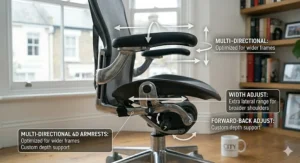
Heavy duty armrests specify reinforced construction with metal frames inside plastic covers. Even basic models offer height adjustment, whilst premium versions provide 3D adjustability (height, width, angle) allowing precise positioning. Some advanced chairs feature 4D armrests adding forward/backward sliding to the adjustment options.
The connection mechanism between armrests and seat pan utilises larger fasteners with lock washers preventing loosening under vibration. This attention to detail prevents the annoying wobble that develops in cheaper chairs after months of use.
Caster Quality and Floor Protection
Standard office chairs employ basic nylon castors adequate for moderate weights but prone to aggressive rolling that damages flooring. The wheels often develop flat spots or seize entirely under sustained heavy loads.
Heavy duty models specify reinforced castors with larger diameter wheels distributing weight across greater surface area. Many use polyurethane construction providing smooth rolling whilst protecting hardwood, laminate, and tile flooring from scratches and scuffs.
The mounting mechanism differs substantially. Standard chairs use simple friction-fit connections prone to loosening, whilst heavy duty models employ threaded connections or locking mechanisms maintaining secure attachment indefinitely.
Real-World Performance: What to Expect in British Conditions
Temperature Variations and Material Performance
Britain’s temperate maritime climate creates unique challenges for office seating. Unlike continental Europe’s predictable seasonal extremes or North America’s climate-controlled offices, British home workers experience substantial temperature fluctuations throughout the year — sometimes within a single day.
PU leather chairs feel uncomfortably cold during winter mornings, particularly in homes relying on scheduled heating that drops overnight. You’ll experience that distinctly unpleasant clammy sensation for the first 15-20 minutes until body heat warms the material. Conversely, during summer warmth (especially in south-facing rooms), leather becomes progressively sweaty and uncomfortable by mid-afternoon.
Mesh construction performs admirably during warmer months, maintaining airflow that prevents the sweaty back syndrome common with solid upholstery. However, mesh provides minimal insulation during winter, feeling uncomfortably cool during early-morning work sessions before heating fully activates.
Fabric upholstery offers sensible British compromise. It breathes adequately during summer whilst avoiding leather’s extreme temperature sensitivity during winter. Quality fabric wicks moisture more effectively than leather whilst feeling more substantial than mesh — practical middle ground suiting our variable climate.
Compact Home Office Realities
British homes average substantially smaller than North American equivalents, with home offices often carved from spare bedrooms, converted dining rooms, or even alcoves under stairs. This spatial constraint affects chair selection in ways American reviewers rarely address.
Ultra-wide 60cm+ seats sound appealing in specifications but prove awkward in compact spaces. Manoeuvring around furniture becomes frustrating, and the chair may not fit comfortably under standard UK desks when pushed in. The 54-58cm range represents practical compromise providing generous seating whilst maintaining reasonable footprint.
Armrest design matters enormously in tight quarters. Flip-up armrests allow tucking chairs fully under desks, reclaiming precious floor space when not in use. Fixed armrests often prevent complete desk insertion, leaving chairs protruding into walkways — genuine annoyance in rooms where every centimetre matters.
Base diameter influences manoeuvrability substantially. Standard 70cm bases navigate tight spaces adequately, whilst 75cm+ bases common on premium chairs prove awkward in compact rooms. Measure your available workspace before purchasing imposing executive chairs designed for spacious corporate offices.
Flooring Considerations Across UK Homes
British homes feature diverse flooring — carpet, laminate, hardwood, tile, vinyl — often within the same property. Chair performance varies dramatically depending on surface type, yet marketing materials rarely address this specifically.
Standard nylon castors roll aggressively on hard surfaces, requiring constant vigilance to prevent chairs shooting away when you stand. On deep-pile carpet, these same wheels develop resistance requiring excessive force to move. Neither scenario promotes productive working.
Quality polyurethane castors solve both issues, rolling smoothly on hard surfaces without aggressive behaviour whilst gliding adequately across medium-pile carpet. Some manufacturers specify dual-wheel designs providing enhanced stability and weight distribution — worthwhile upgrade if you’re working from hardwood or laminate flooring susceptible to denting.
Carpet thickness influences required castor size. Standard 50mm wheels perform adequately on low-pile carpet but struggle with medium or deep pile common in British bedrooms converted to home offices. If you’re working from carpeted space, verify castor diameter exceeds 55mm for reliable rolling.
Humidity and Component Longevity
Britain’s high humidity levels accelerate component wear in ways drier climates don’t experience. Metal parts develop surface corrosion more readily, lubricants break down faster, and foam cushioning absorbs moisture affecting resilience.
Quality chairs specify corrosion-resistant finishes on metal components — chrome plating or powder coating rather than bare steel. The gas lift cylinder particularly benefits from protective coating, as moisture ingress accelerates seal deterioration leading to gradual height loss.
Foam cushioning requires closed-cell construction preventing moisture absorption. Open-cell foam gradually absorbs atmospheric humidity, becoming progressively softer and less supportive. This explains why some chairs feel comfortable initially but deteriorate rapidly in damp British conditions.
Leather and faux-leather upholstery requires occasional conditioning in our humid climate. The material gradually dries and cracks without periodic treatment, particularly in centrally-heated rooms during winter when humidity drops temporarily. Budget £10-£15 annually for quality leather conditioner extending upholstery lifespan substantially.
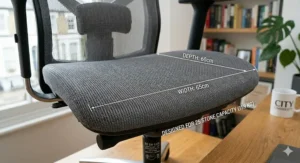
Health and Ergonomics: Beyond Just Weight Capacity
Proper Lumbar Support for Heavier Bodies
Standard ergonomic advice often fails to account for how increased body mass affects spinal loading and support requirements. Heavier individuals experience proportionally greater compressive forces on lower lumbar vertebrae, making proper support genuinely critical rather than mere comfort preference.
The lumbar support positioning differs for heavier users. Standard chairs place lumbar bulges at heights calibrated for average builds, but this positioning often sits too low for larger frames with different torso proportions. Look for chairs offering vertical lumbar adjustment allowing precise positioning to match your spine’s natural curve.
Lumbar depth — how far the support projects forward — similarly matters more for heavier users. Shallow lumbar supports (projecting 2-3cm) prove adequate for lighter builds but insufficient for larger torsos requiring more substantial support to maintain proper curve. Quality heavy duty chairs specify 4-6cm lumbar projection providing meaningful support rather than token gesture.
Dynamic lumbar systems that flex with movement prove particularly beneficial for heavier users who shift position more frequently during long sitting sessions. Rigid fixed supports create uncomfortable pressure points, whilst flexible systems maintain support throughout natural movement.
Circulation and Pressure Point Management
Heavier users experience greater pressure concentration at contact points — particularly the ischial tuberosities (sit bones) and posterior thighs. This elevated pressure restricts circulation more aggressively than lighter users experience, making seat pan design genuinely critical for health rather than mere comfort.
Waterfall seat edges prove essential rather than optional. The curved front edge prevents sharp pressure concentration behind knees that restricts blood flow to lower legs. Standard chairs with abrupt seat edges create noticeable numbness and tingling within hours — symptoms indicating genuine circulation compromise.
Seat depth affects circulation substantially. Excessively deep seats force heavier users to choose between proper back support (sliding forward, creating thigh pressure) or circulation (sitting fully back, creating excessive knee bend). The 52-55cm depth range provides optimal balance for most users between 5’6″ and 6’2″.
Cushioning technology dramatically impacts pressure distribution. Standard foam creates relatively uniform support, concentrating pressure at bony prominences. Pocket spring systems distribute load more dynamically, reducing peak pressures at sit bones whilst maintaining overall support — genuinely beneficial for users sitting 8+ hours daily.
Posture Implications for Joint Loading
Poor seating posture doesn’t simply cause discomfort — it creates measurable increases in joint loading that accelerate wear and pain development. According to research from Cambridge University Hospitals NHS Foundation Trust, proper seating should maintain the spine’s natural S-curve whilst allowing movement. Heavier users experience proportionally greater consequences from postural compromise, making proper ergonomic positioning health necessity rather than comfort preference.
Hip flexion angle determines lumbar spine positioning. Chairs that position hips substantially below knees force excessive lumbar flexion, increasing disc compression and promoting the characteristic “slouch” that develops during long sitting. Quality chairs maintain hips level with or slightly above knees, supporting natural lumbar curve.
Armrest height profoundly affects shoulder and neck positioning. Armrests forcing shoulders elevation create sustained trapezius tension leading to neck pain and headaches. Conversely, armrests positioned too low offer no support, requiring sustained shoulder muscle activation. Proper positioning allows relaxed shoulder posture with forearms level whilst typing.
Backrest angle influences thoracic and cervical spine alignment. Excessively upright backrests (approaching 90°) promote forward head posture as users compensate for discomfort. The optimal range sits around 95-105° allowing relaxed upright posture without excessive recline. Quality chairs provide infinite positioning within this range rather than preset angles.
UK Regulations, Safety Standards & Legal Requirements
BS EN 1335 Compliance for Office Seating
The BS EN 1335 standard represents the primary safety and performance specification for office work chairs sold in the UK and European markets. This multi-part standard addresses dimensions, safety requirements, and testing methods specifically for seating designed for eight-hour daily use.
BS EN 1335-2:2018 specifies safety, strength, and durability requirements based on users weighing up to 110kg (approximately 17 stone). This explains why standard office chairs consistently rate to this threshold — they’re designed to meet regulatory minimum rather than provide substantial safety margin for heavier users.
However, here’s the crucial understanding: chairs exceeding 110kg capacity aren’t governed by BS EN 1335 directly, as that standard doesn’t address bariatric specifications. Instead, manufacturers typically reference EN 16139 (furniture strength and durability testing) which provides test methodologies for higher weight classes.
Quality heavy duty chairs specify EN 16139 Test Level 2 compliance, indicating testing to 160kg capacity through rigorous static and dynamic load assessments. This certification provides substantially greater confidence than bare weight claims unsupported by testing documentation.
UKCA Marking and Post-Brexit Considerations
From January 2021, the UKCA (UK Conformity Assessed) marking replaced CE marking for goods sold in Great Britain (England, Scotland, Wales), whilst CE marking continues for Northern Ireland sales. Office chairs sold on Amazon.co.uk should display UKCA marking confirming compliance with UK product safety regulations.
However, transitional arrangements allow CE-marked products already in the supply chain to continue being sold, creating current marketplace where both markings appear legitimately. By 2026, UKCA marking should predominate for new stock, though EU-manufactured chairs may continue displaying CE marking for Northern Ireland sales.
For practical purposes, either marking indicates the chair meets relevant safety standards. What matters more is whether the manufacturer specifies which standards they’ve tested against — BS EN 1335, EN 16139, or other relevant specifications. Bare UKCA marking without supporting documentation provides minimal reassurance about actual performance.
Display Screen Equipment (DSE) Regulations
The Health and Safety (Display Screen Equipment) Regulations 1992 require employers to assess workstation ergonomics and provide suitable seating for employees working with computers, as outlined by the Health and Safety Executive. Whilst these regulations technically apply to employers rather than chair manufacturers, they establish ergonomic benchmarks worth understanding.
The regulations don’t mandate specific chair models but require seating allowing users to maintain good posture, providing adequate lumbar support, and featuring adjustable height mechanisms. For heavier users, standard 110kg-rated chairs technically meet regulatory requirements, but they may not provide sustainable comfort and support through full working days.
Self-employed individuals and home workers aren’t covered by DSE regulations, but the underlying ergonomic principles remain valid. If you’re experiencing back pain, shoulder tension, or other musculoskeletal complaints from home working, your seating likely fails basic ergonomic requirements regardless of regulatory obligations.
Consumer Rights and Product Liability
The Consumer Rights Act 2015 provides robust protection for UK buyers, requiring products to be “of satisfactory quality,” “fit for purpose,” and “as described.” These requirements create meaningful recourse if office chairs fail prematurely or don’t deliver promised specifications.
“Satisfactory quality” considers durability appropriate to the product type. An office chair claiming 200kg capacity that collapses within six months fails this test, entitling you to repair, replacement, or refund. The burden of proof sits with the seller during the first six months after purchase.
“Fit for purpose” means the chair must fulfil its described function. If you purchase a chair specifically rated for heavy duty use and it proves unsuitable for heavier users, you have grounds for redress even if it technically supports the claimed weight briefly.
“As described” requires products to match marketing claims and specifications. If a chair advertises 150kg capacity but fine print reveals that’s a “static load” rating whilst actual sitting capacity is lower, this constitutes misdescription providing grounds for return.
The act provides rights up to six years after purchase in England and Wales (five years in Scotland), though evidencing faults becomes progressively more difficult beyond the initial six-month period. Retain all purchase documentation and any warranty information supporting future claims. You can find detailed guidance on your consumer rights at the Citizens Advice website.
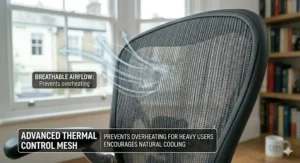
Maintenance and Longevity: Maximising Your Investment
Initial Assembly Best Practices
The assembly process profoundly affects long-term performance, yet most users rush through it inadequately. Taking extra care during initial setup prevents numerous issues that buyers later attribute to manufacturing defects.
Read instructions completely before beginning assembly. This sounds tedious, but understanding the complete process prevents mistakes requiring disassembly and restart. Instructions often include critical warnings about specific torque requirements or component orientation that you’ll miss if working step-by-step without overview.
Don’t fully tighten bolts until all components are loosely assembled. This allows final alignment adjustments ensuring proper component seating before applying full torque. The most common error is tightening seat-to-base connections before adding the backrest, creating misalignment that prevents proper backrest attachment.
Use appropriate tools rather than improvising. Overtightening with power tools strips threads and cracks components, whilst insufficient hand-tightening leaves joints loose. The provided tools usually prove adequate, though quality screwdrivers and adjustable spanners make the process easier and reduce overtightening risk.
Systematically verify all connection points after assembly. The chair should feel absolutely solid with no play, creaking, or movement at joints. Test the recline mechanism, height adjustment, and armrests confirming smooth operation. Address any issues immediately rather than hoping they’ll “settle in.”
Regular Adjustment and Optimisation
Chair performance degrades gradually without regular adjustment maintenance. Mechanisms loosen slightly over time, requiring periodic tightening to maintain optimal performance. This preventive maintenance takes minutes but substantially extends service life.
Check all visible bolts quarterly, gently snugging any that have loosened. Pay particular attention to backrest-to-seat connections and armrest mounting points, as these experience substantial dynamic loading. Don’t overtighten — just remove any detectable play.
The gas lift mechanism requires no maintenance but benefits from full-stroke cycling monthly. Raise the chair to maximum height, then lower completely, repeating 5-6 times. This redistributes lubricants and prevents seals adhering when the mechanism sits unused at fixed height for extended periods.
Recline mechanism tension may require adjustment as you acclimate to the chair or as components settle. Most chairs feature a knob beneath the seat controlling tilt resistance — experiment with settings periodically finding your current preference. Proper tension allows controlled reclining without excessive force or overly-free rocking.
Upholstery Care for British Conditions
PU leather upholstery requires periodic conditioning preventing the drying and cracking that develops in centrally-heated British homes. Apply quality leather conditioner every 3-4 months, working it into seating surfaces with soft cloth. This maintains material flexibility and prevents premature deterioration.
Clean PU leather promptly when spills occur. Use barely-damp cloth with mild soap if needed, avoiding excessive water penetration. Dry thoroughly preventing moisture seeping into foam cushioning where it promotes mildew growth in our humid climate.
Fabric upholstery benefits from regular vacuuming removing dust and debris that gradually abrade fibres. Use upholstery attachment monthly, paying particular attention to seams and crevices where dirt accumulates. Address spills immediately with blotting (never rubbing) using appropriate fabric cleaner for stain type.
Mesh construction requires minimal maintenance but benefits from occasional vacuuming removing accumulated dust. Check mesh tension annually — quality mesh should remain taut without sagging or loose areas. Developing looseness indicates frame stress or mesh attachment failure requiring professional assessment.
Component Replacement and Upgrades
Most heavy duty chairs feature modular construction allowing component replacement rather than complete chair replacement when parts fail. Understanding what’s replaceable versus what indicates terminal failure helps maximise your investment.
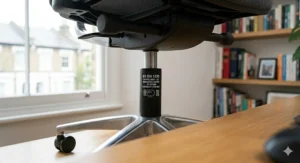
Gas lift cylinders represent the most commonly replaced component. Symptoms include gradual height loss during use, difficulty adjusting height, or complete failure to maintain position. Replacement cylinders cost £15-£30 and install straightforward with basic tools — often extending chair life by years for modest investment.
Castors wear through regular use, developing flat spots or seizing entirely. Replacement castor sets cost £10-£20 and dramatically improve rolling performance. Consider upgrading to polyurethane castors if your originals are standard nylon, improving floor protection and rolling smoothness simultaneously.
Armrest pads wear or crack with extended use but typically replace independently from armrest mechanisms. Replacement pads cost £5-£15 per pair and install via simple clips or screws. This modest investment substantially improves comfort and appearance versus tolerating damaged pads.
Cushioning eventually compresses beyond recovery regardless of quality. Replacement seat cushions occasionally available from manufacturers for £30-£50, though availability varies by brand. This option proves worthwhile for otherwise sound chairs where only the cushioning has degraded.
When Replacement Makes More Sense Than Repair
Despite best maintenance efforts, chairs eventually reach end-of-life requiring replacement rather than continued repairs. Recognising this point prevents throwing good money after bad attempting to salvage fundamentally compromised seating.
Frame cracks or metal fatigue represent terminal conditions. Welded repairs rarely provide lasting solutions, and the liability risk from catastrophic failure outweighs any cost savings. If you’re detecting cracks in the frame or base, replacement is the only safe option.
Tilt mechanism failure with excessive play or looseness that tightening doesn’t resolve similarly indicates terminal condition. Replacement mechanisms rarely match original specifications precisely, creating awkward fit issues. The £30-£50 mechanism cost plus installation labour typically approaches half the cost of replacement chair.
Multiple simultaneous component failures suggest the chair has reached natural end-of-life. If you’re replacing the gas lift, castors, and armrests simultaneously whilst the cushioning is also compromised, you’re essentially rebuilding the entire chair. At this point, investing in new seating makes more economic sense.
FAQ: Office Chair for Heavy Person
❓ Are office chairs rated for 25 stone actually safe for users at that weight?
❓ What's the difference between a bariatric office chair and a heavy duty office chair in the UK?
❓ Do I need an office chair with a footrest if I'm a heavier person?
❓ How long should a quality office chair for heavy person last in the UK?
❓ Can I use a heavy duty office chair on carpet without damaging it or making the chair difficult to move?
Conclusion: Investing in Proper Support That Lasts
Selecting an office chair for heavy person requirements needn’t involve navigating impenetrable technical specifications or gambling on untested products. The UK market in 2026 offers genuine choice across the £60-£225 range, with proven models delivering reliable performance at every price point.
For budget-conscious buyers requiring 150kg capacity without premium features, the SONGMICS OBG22BUK delivers exceptional value around £60-£85. It won’t offer pocket spring cushioning or 3D armrests, but it provides honest engineering that prevents the catastrophic failures cheaper chairs experience. This represents sensible choice for home workers sitting 4-6 hours daily who prioritise structural integrity over luxury features.
Mid-range buyers between £110-£160 enjoy the sweet spot where genuine quality improvements emerge. The EXCEBET 180kg Pocket Spring addresses back pain specifically through superior cushioning technology, whilst the IWMH Big & Tall 200kg accommodates taller frames that standard chairs simply can’t support properly. These chairs represent meaningful investment in comfort and health rather than merely upgraded aesthetics.
Premium buyers willing to invest £180-£225 receive genuinely superior engineering with the BASETBL 200kg Executive series. The 3D pocket spring cushioning, four-level gas lift, and synchronised armrest systems deliver sofa-like comfort during eight-hour working days. For users approaching or exceeding 25 stone, this investment provides the safety margin and component quality that cheaper alternatives cannot match.
The common thread across all these recommendations is honest capacity rating, genuine UK availability, and proven performance through verified customer feedback. I’ve deliberately excluded chairs making implausible claims or lacking substantive UK reviews, focusing instead on models demonstrating consistent reliability.
Remember that your office chair represents professional infrastructure, not discretionary furniture. Poor seating creates measurable productivity losses through discomfort-driven distraction, potential healthcare costs from inadequate ergonomic support, and the financial waste of replacing failed chairs repeatedly. Quality seating is investment that pays dividends through improved comfort, enhanced focus, and elimination of the nagging back pain that undermines working effectiveness.
Take time to assess your specific requirements: actual weight capacity needed, workspace dimensions, climate considerations, and must-have features versus nice-to-haves. Measure your available space, verify desk height, and consider whether integrated footrests or adjustable armrests genuinely benefit your working style. Armed with this understanding and the detailed evaluations above, you can invest confidently in seating that supports you properly for years rather than months.
Recommended for You
- Best Drafting Chair UK 2026: 7 Top Picks for Architects
- Best Chair for Standing Desk UK 2026: 7 Expert Picks
- 7 Best Value Office Chair UK: Under £200 vs £500 2026
Disclaimer: This article contains affiliate links. As an Amazon Associate, I earn from qualifying purchases. If you purchase products through these links, we may earn a small commission at no additional cost to you.
✨ Found this helpful? Share it with your mates! 💬🤗
