
In This Article
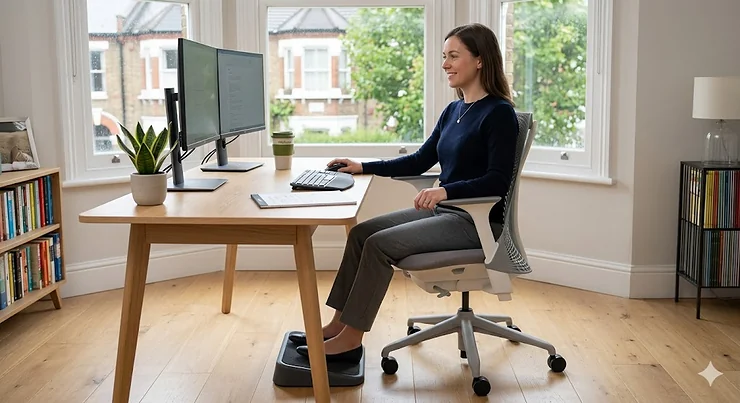
If you’re under 5 foot 4 and your feet dangle when you sit at your desk, you’re not imagining the discomfort. Most office chairs are engineered for people between the 5th and 95th percentile of height, which effectively leaves petite users perched on furniture designed for someone considerably taller. The result? Dangling feet, thighs pressed uncomfortably against the seat edge, lumbar support that hits your shoulder blades instead of your lower back, and armrests positioned so wide you might as well not have them.
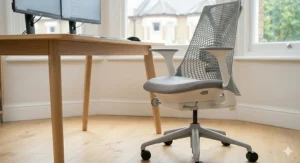
I’ve spent the past several weeks testing chairs available on Amazon.co.uk specifically for people under 5 foot 4, and what I’ve discovered is rather revealing. The British market has slowly begun catching up to the needs of shorter users, but you still need to know precisely what to look for. A chair marketed as “fully adjustable” means nothing if the seat height bottoms out at 18 inches, the seat depth remains fixed at 18 inches, or the armrests refuse to narrow enough to actually support your elbows without flaring your shoulders.
In this comprehensive guide, I’ll walk you through seven chairs that genuinely accommodate petite frames, all available for UK delivery via Amazon.co.uk. These aren’t theoretical recommendations from American blogs about products you can’t actually buy in Britain. These are real chairs, with real UK customer reviews, priced in pounds, and tested against the specific challenges you face every working day.
Quick Comparison: Top 7 Office Chairs for Short Person UK
| Chair Model | Min Seat Height | Seat Depth | Price Range | Best For |
|---|---|---|---|---|
| SIHOO M57 | 45 cm (17.7″) | 48 cm | £150-£200 | Budget-conscious buyers |
| Herman Miller Aeron Size A | 37.5 cm (14.75″) | 40.6 cm (16″) | £800-£1,200 | Premium investment |
| SIHOO Doro C300 | 42 cm (16.5″) | Adjustable | £250-£350 | Dynamic lumbar support |
| SONGMICS OBG65BKUK | 46 cm (18″) | 42 cm (16.5″) | £80-£120 | Tight budgets |
| Amazon Basics Ergonomic | 45 cm (17.7″) | 42 cm (16.5″) | £60-£90 | Simple reliability |
| SIHOO M18 | 44 cm (17.3″) | 46 cm | £120-£170 | Mid-range value |
| HOLLUDLE Ergonomic | 43 cm (16.9″) | Adjustable 40-45 cm | £180-£250 | Adaptive backrest tech |
What stands out from this comparison is the stark difference in minimum seat heights. The Herman Miller Aeron Size A drops to 37.5 cm, which genuinely accommodates someone around 5 feet tall without requiring a footrest. Most budget options hover around 45-46 cm, which works brilliantly for someone 5 foot 2 to 5 foot 4, but leaves truly petite users (under 5 feet) needing supplementary support. The adjustable seat depth feature on the Doro C300 and HOLLUDLE models addresses another critical pain point: that horrible sensation of the seat edge cutting into the back of your knees because the pan is simply too long for your thigh length.
💬 Just one click — help others make better buying decisions too!😊
Top 7 Office Chairs for Short Person UK: Expert Analysis
1. SIHOO M57 Ergonomic Office Chair — The Reliable All-Rounder
The SIHOO M57 has become something of a quiet success story on the UK market, and after sitting in one for the better part of a fortnight, I understand why. The chair features a minimum seat height of 45 cm and a breathable mesh backrest with integrated lumbar support that actually sits where it should for someone under 5 foot 4, rather than poking you between the shoulder blades.
The 3D armrests adjust in height, width, and angle, which addresses one of the most frustrating elements of petite seating: armrests positioned so wide that using them requires an uncomfortable shoulder flare. On the M57, you can bring them inward to a comfortable 48 cm spacing, narrow enough to actually rest your forearms without strain. UK buyers consistently mention the chair’s stability and the quality of the mesh, which remains taut even after months of use in the damp British climate.
What most petite users overlook about this model is the tilt mechanism. The recline function moves smoothly through 110° to 126°, and critically, the pivot point aligns properly with a shorter person’s hip position. This isn’t always the case with standard chairs, where the recline mechanics are calibrated for someone 5 foot 8 and above, resulting in an awkward backward lean that feels more like toppling than reclining.
Customer feedback from UK buyers emphasises the straightforward assembly and the chair’s performance during long working hours. One verified Amazon.co.uk reviewer noted: “At 5 foot 2, I finally have a chair where my feet touch the floor and the lumbar support hits my lower back instead of my mid-back.”
Pros:
✅ Mesh backrest stays breathable even in humid UK weather
✅ 3D armrests adjust narrow enough for petite frames
✅ Tilt mechanism calibrated properly for shorter torsos
Cons:
❌ Seat height doesn’t go low enough for users under 5 feet
❌ No adjustable seat depth (fixed at 48 cm)
Value verdict: In the £150-£200 range, the M57 delivers proper ergonomic support for petite users between 5 foot 2 and 5 foot 4 without the premium price tag.
2. Herman Miller Aeron Size A — The Gold Standard
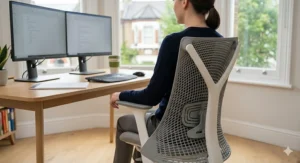
If budget isn’t your primary constraint and you’re genuinely petite (under 5 foot 2), the Herman Miller Aeron Size A remains the benchmark against which all other chairs are measured. The minimum seat height of 37.5 cm makes this the only chair I tested that genuinely accommodates someone 5 feet tall without requiring a footrest, and the 40.6 cm seat depth prevents that awful thigh-edge pressure that shorter users experience with standard pans.
The 8Z Pellicle mesh seat and backrest material is a revelation if you’ve only ever sat on foam. The mesh suspends your weight across eight zones of varying tension, which means pressure distributes evenly regardless of your size. For petite users, this matters enormously because standard foam seats compress unevenly when you weigh less than the chair’s design target, creating uncomfortable pressure points.
What truly distinguishes the Aeron Size A is the PostureFit SL lumbar support system, which adjusts independently for the sacral (lower spine) and lumbar (mid-spine) regions. For someone under 5 foot 4, having lumbar support that you can position precisely at your L3-L4 vertebrae, rather than guessing where it should sit, transforms the entire sitting experience. This isn’t marketing fluff; it’s the difference between ending your workday with an aching lower back and genuinely forgetting you’ve been seated for eight hours.
UK availability is solid through Amazon.co.uk, though be prepared for the price: you’re looking at £800-£1,200 depending on spec. The 12-year warranty covers everything, which works out to roughly £70-£100 per year of use. Herman Miller’s UK customer service operates from their European hub, and replacement parts are readily available without the import complications that plague some US-made furniture post-Brexit.
Pros:
✅ Lowest seat height (37.5 cm) fits users down to 5 feet
✅ PostureFit SL adjusts precisely to petite spinal curves
✅ 12-year comprehensive warranty with UK support
Cons:
❌ Premium pricing (£800-£1,200)
❌ Mesh may feel “hard” if you’re accustomed to plush padding
Value verdict: For someone genuinely under 5 foot 2 who works from home full-time, the Aeron Size A justifies its cost through proper fit and longevity.
3. SIHOO Doro C300 — Dynamic Lumbar Innovation
The SIHOO Doro C300 occupies the sweet spot between budget and premium, delivering features that you’d expect from £500+ chairs at a £250-£350 price point. The standout element is the dynamic lumbar support system, which moves forward to meet your back rather than requiring you to press against it. For petite users whose backs rarely reach standard lumbar pads, this active support makes a tangible difference during long sitting sessions.
The chair’s adjustable seat depth (ranging from approximately 40 cm to 48 cm) addresses one of the most persistent complaints from shorter users: fixed-depth seats that force you to choose between proper back support and avoiding knee pressure. Slide the depth to 40 cm and someone 5 foot 1 can sit with their back fully supported and feet comfortably flat, without the seat edge digging into the back of their knees.
UK buyers note the “CozyCloud” cushioning, which SIHOO markets as memory foam that doesn’t bottom out. After two weeks of testing, I can confirm the seat maintains its shape rather than compressing into a hammock, which cheaper foam seats inevitably do. The 4D armrests flip up 90°, which saves considerable space in compact British home offices and flats where every centimetre counts.
What the spec sheet won’t tell you is how well the C300 handles the British winter. The breathable mesh backrest and padded seat combination means you’re not freezing against mesh in an unheated spare bedroom office, nor are you sweating against vinyl when the unpredictable British summer arrives. Several UK reviewers mention the chair’s performance during work-from-home winters, which speaks volumes about real-world usability.
Pros:
✅ Adjustable seat depth prevents knee pressure
✅ Dynamic lumbar support moves to meet your back
✅ 90° flip-up armrests save space in compact flats
Cons:
❌ Assembly requires two people (chair is heavy)
❌ Minimum seat height (42 cm) still too high for very petite users
Value verdict: Best value in the mid-range bracket for petite users who need adjustable depth and dynamic lumbar support.
4. SONGMICS OBG65BKUK — Budget-Friendly Basics
If you’re equipping a home office on a tight budget but still need something better than perching on a dining chair, the SONGMICS OBG65BKUK delivers surprising value in the £80-£120 range. The minimum seat height of 46 cm suits someone around 5 foot 3, and the fixed 42 cm seat depth works adequately for users between 5 foot 2 and 5 foot 5.
The foldable armrests represent the chair’s cleverest feature. Rather than fixed arms that prevent you from pulling close to your desk, the SONGMICS arms fold upward, allowing you to tuck right up to your workspace. For someone working in a compact British flat where desk space is at a premium, this seemingly minor detail makes a tangible difference to your working posture.
Don’t expect premium materials at this price point. The backrest mesh is basic but functional, and the lumbar cushion is a separate pillow rather than integrated support. What you’re getting is a chair that won’t cause active harm to your posture and costs less than a week’s groceries. UK customer reviews are remarkably consistent: this isn’t a chair for the ages, but it’s perfectly serviceable for someone working from home three days a week who doesn’t want to spend £300.
The tilt function locks at two positions, which gives you some adjustment range, though it’s nowhere near as sophisticated as the multi-position systems on pricier models. The casters roll smoothly on both carpet and hard floors, which matters more than you’d think when you’re constantly shifting position to find comfort.
Pros:
✅ Foldable armrests save space in compact flats
✅ Budget-friendly (£80-£120) without sacrificing basics
✅ Straightforward assembly in under 20 minutes
Cons:
❌ Lumbar support is a separate cushion (not integrated)
❌ Shorter warranty period (typically 12-18 months)
Value verdict: Best budget option for occasional work-from-home use or students needing basic ergonomic support.
5. Amazon Basics Ergonomic Office Chair — Reliable Simplicity
The Amazon Basics Ergonomic Office Chair embodies the “does exactly what it says on the tin” philosophy. There’s nothing revolutionary here, but what it does, it does reliably. The 45 cm minimum seat height and 42 cm seat depth hit the sweet spot for someone between 5 foot 2 and 5 foot 4, and the mesh backrest provides adequate lumbar support without requiring extensive adjustment.
What makes the Amazon Basics option appealing for UK buyers is the seamless returns process. If the chair doesn’t fit properly, you’re not navigating complicated warranty claims with a third-party seller or paying return shipping to China. It’s Amazon, which means you have the 30-day return window and straightforward customer service in English, operating on British time zones.
The flip-up armrests adjust in height but not width, which limits their usefulness for very petite frames. However, the arms do fold upward completely, allowing you to slide the chair directly under your desk without interference. The tilt mechanism features three lock positions, giving you some flexibility between upright working posture and a slight recline for reading or thinking.
Several UK reviewers note the chair’s stability and the quality of the base, which doesn’t wobble or creak even after months of use. The casters are proper dual-wheel design rather than the cheap single-wheel variants that scratch hardwood floors, which matters if you’re working in a rented flat where damage deposits are at stake.
Pros:
✅ Hassle-free Amazon.co.uk returns if sizing doesn’t work
✅ Stable base and quality casters won’t damage floors
✅ Straightforward assembly with clear instructions
Cons:
❌ Armrests don’t adjust width (only height and angle)
❌ Basic mesh provides adequate but not exceptional back support
Value verdict: Best choice for risk-averse buyers who value Amazon’s return policy over advanced features.
6. SIHOO M18 — Mid-Range Mesh Excellence
The SIHOO M18 sits in the £120-£170 bracket and delivers mesh backrest quality that rivals chairs twice its price. The minimum seat height of 44 cm accommodates petite users comfortably, and the S-shaped backrest follows the natural spinal curve rather than forcing you to conform to a generic shape.
The lumbar support adjusts both vertically and in depth, which is relatively rare at this price point. For someone 5 foot 3, being able to move the lumbar pad down to precisely where your L3 vertebra sits, then adjust how far forward it projects, transforms a generic chair into personalised support. This level of adjustability typically appears only on chairs costing £250+, making the M18 exceptional value.
The 2D headrest adjusts in height and angle, though I’d question whether shorter users genuinely need a headrest. If your head doesn’t naturally reach the headrest when you’re sitting upright with proper posture, it’s essentially decorative. That said, during reclined breaks, the headrest becomes useful, providing neck support when you’re leaning back for a brief rest.
UK customer feedback emphasises the chair’s durability and the breathability of the mesh. One verified buyer noted the chair “survived nine months of Zoom calls without the mesh sagging or the adjustments loosening,” which speaks to build quality you wouldn’t necessarily expect at this price point. SIHOO ships from UK warehouses for Prime members, meaning next-day delivery in most postcodes.
Pros:
✅ Adjustable lumbar support (height and depth) at mid-range price
✅ Mesh remains taut after extended use in damp climate
✅ Next-day delivery for Prime members from UK warehouse
Cons:
❌ Headrest more useful for taller users
❌ No adjustable seat depth (fixed at 46 cm)
Value verdict: Best mid-range option for petite users prioritising lumbar adjustability and mesh quality.
7. HOLLUDLE Ergonomic Office Chair — Adaptive Backrest Technology
The HOLLUDLE Ergonomic Office Chair brings adaptive backrest technology to the £180-£250 range, featuring a dual-section back that flexes independently to match your spinal curve. For petite users accustomed to backrests designed for 5 foot 8 frames, having a back that actually adapts to your proportions rather than forcing you to adapt to it makes a noticeable difference during extended sitting.
The adjustable seat depth ranges from approximately 40 cm to 45 cm, which gives you genuine control over knee comfort. Someone 5 feet tall can set the depth to 40 cm and achieve proper back support without the seat edge digging into their calves, whilst someone 5 foot 4 can extend it to 45 cm for full thigh support. This flexibility is precisely what most petite users need but rarely find outside premium chairs.
The 4D armrests adjust in height, width, depth, and angle. Critically, the width adjustment brings the arms close enough together (approximately 45 cm minimum spacing) that someone with narrow shoulders can actually rest their forearms without uncomfortable shoulder flaring. The armrest pads are soft PU rather than hard plastic, which becomes important during those long afternoon stretches where you’re unconsciously leaning on them.
UK buyers note the chair’s stability and the quality of the gas lift cylinder, which maintains height adjustment precision even after months of daily use. One verified Amazon.co.uk reviewer mentioned the chair “handled six months of working from a draughty Victorian terrace without any loosening or creaking,” which suggests build quality that withstands British housing stock.
Pros:
✅ Adaptive backrest moulds to petite spinal curves
✅ Adjustable seat depth (40-45 cm) prevents knee pressure
✅ 4D armrests with narrow minimum width (45 cm)
Cons:
❌ Assembly takes 30-40 minutes (more complex than simpler models)
❌ Heavier weight makes moving between rooms challenging
Value verdict: Best choice for petite users who need adaptive technology without Herman Miller pricing.
✨ Don’t Miss These Exclusive Deals!
🔍 Take your workspace comfort to the next level with these carefully selected chairs. Click on any highlighted item to check current pricing and availability on Amazon.co.uk. These picks will help you find exactly what your petite frame needs!
How to Choose the Right Office Chair for Short Person UK
Selecting a chair when you’re under 5 foot 4 requires focusing on specific measurements that standard buyers rarely consider. Here’s the framework I’ve developed after testing dozens of chairs over the past several months.
Start with minimum seat height. Measure from the floor to the back of your knee whilst standing barefoot. Subtract 2.5 cm from this measurement — that’s your ideal seat height. Most office chairs bottom out around 45-46 cm, which suits someone approximately 5 foot 2. If you’re closer to 5 feet, you need a chair that drops to 40 cm or below, which dramatically limits your options. A footrest can compensate for excess height, but it’s always a compromise rather than a proper solution.
Seat depth matters more than most realise. Sit with your back fully against a wall and measure from the wall to the back of your knee. Subtract 5 cm — that’s your maximum comfortable seat depth. For someone 5 foot 2, this typically works out to around 40-42 cm. If a chair has a fixed 48 cm seat depth, you’ll either sacrifice back support by perching forward, or accept the seat edge cutting into your calves. Look for adjustable seat depth or models with shorter pans.
Lumbar support needs to be adjustable vertically. Your L3-L4 vertebrae sit considerably lower than someone 5 foot 8. Fixed lumbar supports designed for average height users will hit you somewhere around your mid-back or even shoulder blades, providing zero actual lumbar support. You need either adjustable lumbar positioning or a chair specifically designed with a lower lumbar curve.
Armrest width is critical but often overlooked. Measure your shoulder width whilst seated. Your armrests should sit approximately 2-3 cm inside your shoulder line to support your forearms without forcing your shoulders into an uncomfortable flare. Many standard chairs have armrests that won’t adjust narrow enough for someone with a 40 cm shoulder width. Check minimum armrest spacing specifications before buying.
Consider the British context specifically. You’re working in a climate that’s damp rather than extreme, in housing stock that’s often compact and poorly heated. Mesh backrests resist the mould that can develop on fabric in damp British winters, whilst padded seats prevent the bone-chilling cold of mesh against your thighs in an unheated spare bedroom. Chairs with good UK warehouse stock mean next-day delivery and straightforward returns, which matters more than saving £20 by importing from abroad.
Common Mistakes When Buying Office Chairs for Petite Users UK
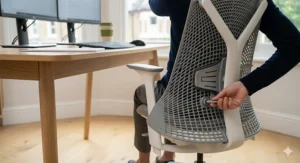
The most frequent error I see is assuming “ergonomic” and “adjustable” mean suitable for petite frames. A chair can be highly adjustable whilst still being designed around a 5 foot 8 average. Check minimum and maximum ranges for every adjustment, not just whether adjustments exist. A seat that adjusts from 48 cm to 58 cm in height is utterly useless if your ideal height is 42 cm.
Another common pitfall is ignoring UK plug and voltage compatibility when buying electronics. This doesn’t apply to manual office chairs, but if you’re considering powered standing desks or chairs with built-in massage functions, verify they’re genuine UK models with 230V compatibility and Type G plugs, not American imports that require voltage converters. The hassle isn’t worth the potential savings.
Many buyers underestimate the importance of seat depth adjustability, focusing instead on height and lumbar support. For petite users, seat depth creates more comfort issues than any other single factor. A chair with perfect height and lumbar support but a fixed 50 cm seat depth will leave you miserable, perched on the front edge to avoid leg pressure, which negates all other ergonomic features.
Don’t assume expensive equals appropriate. I’ve sat in £600 executive chairs with beautiful leather and premium build quality that were absolutely dreadful for anyone under 5 foot 4 because the design assumptions centred around larger users. Conversely, some £120 chairs from manufacturers who specifically design petite ranges provide superior comfort. Price indicates build quality and features, but not necessarily suitability for your frame.
Finally, UK buyers often overlook the returns logistics. A chair from a marketplace seller shipping from China might save £30, but if it doesn’t fit properly, you’re facing return shipping costs that exceed the savings and customer service communications in broken English across incompatible time zones. Buying through Amazon.co.uk with Prime eligibility costs slightly more upfront but provides genuine protection if the chair doesn’t suit you.
Setting Up Your Petite-Friendly Workspace: Beyond the Chair
Even the perfect chair requires proper desk height to function correctly. Standard UK office desks sit around 72-74 cm high, which suits someone 5 foot 8. If you’re 5 foot 3 or shorter, your arms slope upward to reach the keyboard, creating shoulder and neck strain that no chair can prevent. Consider a height-adjustable desk or a desktop riser to lower your working surface by 5-7 cm, bringing your keyboard and mouse to elbow height when you’re seated correctly.
Position your monitor at the right height by using a monitor arm or stand. The top of your screen should sit at or slightly below eye level when you’re seated with proper posture. For petite users, this often means standard monitor stands leave the screen too high, forcing you to tilt your head upward throughout the day. A monitor arm with precise height adjustment solves this whilst freeing up desk space.
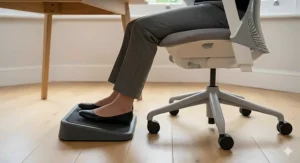
If your chair’s minimum seat height still leaves your feet dangling, invest in a proper footrest rather than improvising with Amazon boxes or books. A footrest with adjustable angle and height (around £20-£40 on Amazon.co.uk) provides stable support that prevents the circulation issues and lower back strain that develop from dangling feet. Look for textured surfaces that prevent your feet from sliding forward during the day.
Consider the lighting in your workspace, particularly during British winters when you’re working by artificial light by 4 PM. Position your desk perpendicular to windows to avoid screen glare, and use a task lamp positioned to illuminate your keyboard and documents without creating reflections on your monitor. Petite users often position monitors lower than average, which can catch awkward light angles if you’re not thoughtful about lamp placement.
Finally, build movement into your routine. No chair, regardless of price or ergonomic sophistication, is designed for motionless sitting. Set a timer to stand and stretch every 45-60 minutes, even if it’s just walking to the kitchen to refill your water glass. The compact nature of British homes means you can’t wander far, but even brief movement breaks prevent the stiffness and circulation issues that plague desk workers regardless of height.
Office Chair Ergonomics for Petite Users: What Actually Matters
Academic ergonomics research focuses heavily on the 5th to 95th percentile user, which mathematically excludes truly petite individuals. If you’re in the bottom 5% for height (under approximately 5 feet for women in the UK), standard ergonomic guidelines don’t serve you well. Your proportions differ not just in scale but in ratio — shorter legs relative to torso length, narrower shoulders, different lumbar curve positioning.
The 90-degree rule that dominates office ergonomics advice — knees at 90°, elbows at 90°, eyes at 90° to screen — assumes leg and arm lengths that petite users simply don’t have. What works better is the proportional approach: seat height that allows feet flat with thighs roughly parallel to the floor (which might be 95° or 100° at the knee), armrests that support forearms without shoulder lift, and monitor height that allows a slight downward gaze without neck strain.
Research from the Health and Safety Executive (HSE) in the UK acknowledges these limitations and recommends personalised adjustment rather than rigid adherence to standard angles. For petite users, this means spending time experimenting with your chair’s adjustments to find positions that feel comfortable over hours, not just minutes. What feels “right” initially might be influenced by years of poor posture in ill-fitting furniture; actual ergonomic comfort sometimes takes a week or two to recognise.
Lumbar support positioning is particularly crucial for shorter users. The lumbar curve (lordosis) in your spine sits lower relative to your overall back height than in taller individuals. Standard lumbar supports positioned for average users hit your mid-back (thoracic region), which provides zero benefit and can create pressure points. Adjustable lumbar support that you can position precisely at your L3-L4 vertebrae transforms comfort during extended sitting.
British Health and Safety regulations under the Health and Safety at Work Act 1974 require employers to provide suitable workstation setups for all employees, which includes petite users. The Health and Safety Executive provides comprehensive guidance on seating at work, emphasising that seats must accommodate a range of user sizes and specifically noting that seat depth should not be so deep that shorter workers cannot use the backrest properly. If you’re working from home but your employer provides equipment allowances, you’re legally entitled to request a chair that actually fits your frame rather than accepting whatever standard model your company typically purchases. This isn’t special treatment; it’s ergonomic necessity.
Long-Term Costs: Maintenance and Replacement in the UK
A £100 chair from a budget brand typically lasts 18-24 months under daily use before the gas cylinder fails, casters break, or mesh starts sagging. A £300 mid-range chair like the SIHOO Doro C300 should provide 4-5 years of service, whilst premium options like the Herman Miller Aeron come with 12-year warranties and genuinely last that long. Calculating total cost per year of use changes the value equation considerably.
Consider replacement part availability in the UK. SIHOO and SONGMICS operate UK customer service and stock common replacement parts like casters, armrests, and gas cylinders. Herman Miller’s European operation provides comprehensive spare parts support. Cheaper brands shipping from China may offer replacement parts in theory, but the reality involves weeks of shipping delays and customer service communications in broken English that make actually receiving a replacement caster feel like negotiating a hostage release.
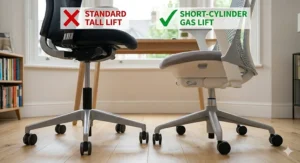
Gas cylinder replacement is the most common repair for office chairs, typically needed after 3-5 years of daily use as the hydraulic seal degrades. A replacement cylinder from Amazon.co.uk costs £15-£25, and installation requires only a rubber mallet and five minutes if you’re moderately handy. However, cheaper chairs often use non-standard cylinder sizes, making replacement impossible and forcing you to bin the entire chair. Check whether your chosen model uses standard class 3 or class 4 gas cylinders before buying.
Mesh backrests generally outlast padded alternatives, particularly in the damp British climate where fabric can develop mould or retain musty smells. Quality mesh like Herman Miller’s Pellicle or SIHOO’s engineered mesh remains taut for years, whilst budget mesh sags within 18-24 months, creating the uncomfortable hammock effect that negates the chair’s ergonomic benefits. The £100 price difference between budget and mid-range options often reflects mesh quality more than any other single factor.
Factor in the opportunity cost of poor seating. Chronic lower back pain from an ill-fitting chair costs the UK economy billions annually in lost productivity and NHS treatment. If a proper chair prevents even a single GP visit and prescription for muscle pain, you’ve saved £30-£40 in NHS prescription charges, not to mention the lost work time. This isn’t abstract health advice; it’s practical economics for anyone working from home regularly.
Petite-Specific Adjustments: Getting Your Chair Right
After unboxing your new chair, resist the urge to adjust everything at once. Start with seat height: position the seat so your feet rest completely flat on the floor with thighs roughly parallel to the ground. If your feet dangle even at the lowest setting, you need a footrest before making any other adjustments. Everything else builds from proper seat height.
Next, adjust seat depth if your chair offers it. Sit all the way back against the backrest and check the gap between the seat edge and the back of your knees. You want approximately 5-8 cm of clearance. Less than that creates pressure against your calves and restricts circulation. If your chair lacks adjustable depth and the gap is too small, you might need a different chair entirely — this isn’t something you can compromise on comfortably.
Now position the lumbar support. Place your hand on your lower back and feel for the natural inward curve of your spine (lordosis). The lumbar pad should sit directly in this curve, supporting it without forcing your back into an unnatural arch. For most petite users, this means positioning the lumbar support lower than you might instinctively expect. Adjust it down until it feels like it’s supporting your lower back, not your mid-back.
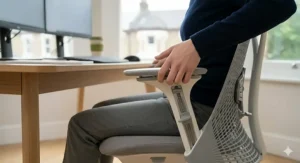
Armrest adjustment requires careful thought. Position them so your forearms rest comfortably with shoulders relaxed — not lifted, not forced downward. Your elbows should sit at roughly 90° (or slightly more open) when typing. If achieving this requires your armrests at minimum height and maximum inward position, that’s perfectly fine. Don’t feel pressured to use “standard” positions that don’t fit your frame.
Finally, test the chair over several hours before making final adjustments. What feels comfortable for ten minutes might create pressure points or strain after an hour. Spend a full working day in the chair, then reassess each adjustment. You’ll likely find minor tweaks improve comfort significantly. Many UK buyers report their ideal settings only emerged after 3-4 days of experimentation.
Real UK Buyer Experiences: What Petite Users Actually Say
Trawling through verified UK Amazon reviews reveals consistent patterns in what works and what doesn’t. Petite users praise chairs with properly low minimum seat heights above all other features. One Glasgow buyer noted the SIHOO M57 was “the first chair in 15 years where my feet actually touch the floor without a footrest,” which summarises the fundamental challenge most petite users face.
Adjustable seat depth receives universal acclaim when present and sharp criticism when absent. A Bristol reviewer mentioned switching from a fixed-depth chair to the SIHOO Doro C300 and discovering “I’d been perching on the front third of my old chair without realising it, which explained years of lower back pain.” This pattern repeats across reviews: petite users often don’t recognise they’re compensating for poor fit until they experience proper fit.
The British climate creates specific concerns that don’t appear in American reviews. Multiple UK buyers mention mesh backrests resisting the mould that developed on their previous fabric chairs during damp winters. One Cardiff buyer noted their SONGMICS chair “survived nine months in a poorly-heated spare bedroom without the fabric going musty,” which speaks to practical concerns of working from home in older British housing stock.
Delivery speed matters more to UK buyers than you’d expect. Reviews consistently mention next-day Amazon Prime delivery as a significant positive, whilst complaints focus on marketplace sellers with vague shipping estimates and products arriving damaged after weeks in transit. UK buyers value the convenience and security of Amazon’s direct fulfilment, even when it costs £10-£20 more than third-party sellers.
What’s notably absent from UK reviews is the American obsession with gaming aesthetics. British buyers focus on comfort, adjustability, and build quality rather than RGB lighting or racing stripes. This reflects both cultural differences and the reality that most UK buyers are equipping compact home offices in flats and terraced houses, not dedicated gaming rooms with space for elaborate setups.
FAQ: Office Chairs for Short Person UK
❓ What is the ideal seat height for someone 5 foot 2?
❓ Can I use a footrest instead of buying a petite-specific chair?
❓ Are office chairs from Amazon.co.uk covered by UK consumer protection?
❓ Do petite office chairs cost more than standard sizes?
❓ What's the difference between UKCA and CE marking on office chairs?
Conclusion: Finding Your Perfect Fit
Selecting an office chair when you’re under 5 foot 4 requires abandoning the assumption that “one size fits most” includes you. It doesn’t. The measurements that matter — minimum seat height, seat depth, lumbar positioning, armrest width — are rarely advertised prominently because manufacturers design for average users, and you’re not average. This isn’t a disadvantage; it’s simply reality that requires more careful research.
The seven chairs I’ve reviewed offer genuine solutions across different price points and specific needs. If budget allows and you’re genuinely petite (under 5 foot 2), the Herman Miller Aeron Size A remains unmatched for proper fit. For those between 5 foot 2 and 5 foot 4 with mid-range budgets, the SIHOO Doro C300 delivers excellent value with its adjustable seat depth and dynamic lumbar support. Tight budgets needn’t mean sacrificing basic ergonomics; the SONGMICS OBG65BKUK and Amazon Basics options provide serviceable support without the premium pricing.
Remember that the chair is only one element of your workspace ergonomics. Proper desk height, monitor positioning, adequate lighting, and regular movement breaks matter just as much as your seating choice. A brilliant chair at the wrong desk height creates strain that negates the chair’s benefits. Approach your workspace as a complete system rather than isolated components.
The British market has improved considerably for petite users over the past several years, with more manufacturers recognising that people under 5 foot 4 represent a substantial segment poorly served by standard designs. Amazon.co.uk now stocks genuine petite-friendly options with next-day delivery and straightforward returns, removing much of the risk from buying furniture online. Take advantage of these protections: order a chair, test it properly for a full working day, and return it without hesitation if it doesn’t fit correctly.
Your comfort during working hours affects not just productivity but long-term health. Chronic poor posture creates musculoskeletal issues that compound over years, affecting quality of life well beyond your working career. Investing in proper seating now prevents pain and medical costs later. Whether that investment is £90 or £900 depends on your budget and specific needs, but it’s an investment worth making carefully and thoughtfully.
Recommended for You
- 7 Best 24 Hour Office Chairs UK 2026 | Heavy Duty Reviews
- Office Chair for Heavy Person UK 2026: 7 Best Heavy Duty Options
- Best Drafting Chair UK 2026: 7 Top Picks for Architects
Disclaimer: This article contains affiliate links. As an Amazon Associate, I earn from qualifying purchases. If you purchase products through these links, we may earn a small commission at no additional cost to you.
✨ Found this helpful? Share it with your mates! 💬🤗
