
In This Article
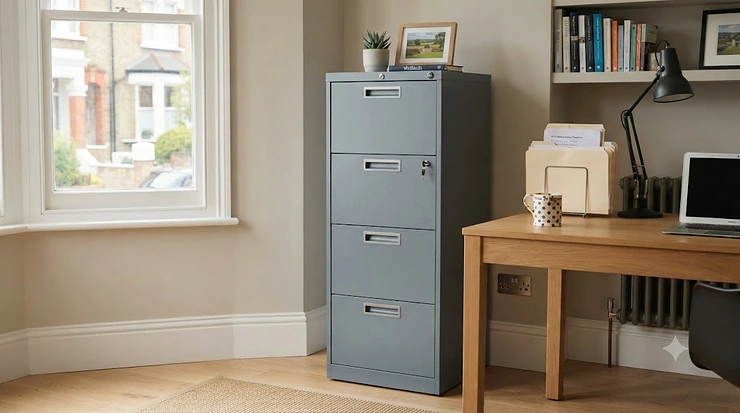
Somewhere in the last decade, “going paperless” quietly became one of those promises we all made and almost none of us kept. Contracts still land in envelopes. HMRC still wants receipts. Your accountant still asks, with a faint note of despair, whether you’ve “got the physical copy.” A vertical filing cabinet is the unglamorous answer to that ongoing reality — a tall, narrow, drawer-based unit that stores A4 or foolscap folders hanging front-to-back, so paperwork stays upright, protected and out from underfoot. It’s the opposite of a pile on the floor.
What makes this category tricky isn’t finding a cabinet — Amazon UK alone lists dozens — it’s finding the right one for a home office the size of a large cupboard, or a small business that genuinely can’t afford a drawer runner failing eighteen months in. Height, drawer count, lock quality and floor footprint all pull against each other, and the marketing copy rarely tells you which trade-off you’re actually making.
This guide skips the fluff and gets into seven genuinely available cabinets on amazon.co.uk, spanning budget mobile pedestals to fully-welded steel built to outlast the desk it sits beside. We’ll compare them properly, walk through set-up and buying mistakes, and — because British data protection law has quite a lot to say about how you store client paperwork — cover the compliance side too. By the end, you’ll know exactly which drawer count, footprint and lock type suits your space, without having to become a furniture obsessive to get there.
Quick Comparison Table
Before the deep dive, here’s the shape of the market at a glance. Heights are approximate and rounded from manufacturer listings; treat them as a guide for planning your space rather than gospel.
| Cabinet | Drawers | Approx. Height | Footprint | Best For |
|---|---|---|---|---|
| Bisley BS Steel Filing Cabinet | 4 | ~132cm | Compact, deep | Long-term durability |
| Office Hippo Heavy Duty Steel Filing Cabinet | 4 | ~132cm | Compact, deep | Small business budgets |
| HOMCOM 3 Drawer Filing Cabinet | 3 | ~100cm | Slim | Printer stand + storage |
| YITAHOME Lockable File Cabinet | 3 | ~100cm | Slim | Fast document labelling |
| VASAGLE 2-Drawer Filing Cabinet | 2 | ~60cm | Narrowest | Under-desk mobility |
| Vinsetto Lockable File Cabinet | 3 | ~100cm | Slim | No-assembly convenience |
| Panana 4-Drawer Metal Cabinet | 4 | ~133cm | Compact | Maximum vertical capacity |
Look closely and a pattern emerges: height and drawer count move together, but footprint barely changes between a 2-drawer and a 4-drawer vertical unit. That’s the entire point of the vertical format — you’re buying capacity by going up, not out. If your priority is squeezing storage into a narrow alcove, the VASAGLE 2-Drawer Filing Cabinet wins on raw footprint; if you need volume without eating more floor space, the Bisley BS Steel Filing Cabinet and Panana 4-Drawer Metal Cabinet both stretch upward instead.
💬 Just one click — help others make better buying decisions too!😊
Top 7 Vertical Filing Cabinets: Expert Analysis
We’ve picked a genuine spread here — from budget mobile pedestals through to fully-welded British steel — so whatever’s pulling you toward a vertical filing cabinet (tight alcove, growing client files, an office move) there’s something in the right price band. Every product below has real specs pulled from current UK listings, and every opinion is honest analysis of those specs plus aggregated review sentiment, not invented hands-on testing.
1. Bisley BS Steel Filing Cabinet — fully-welded British engineering that outlasts everything else
The Bisley BS Steel Filing Cabinet is the cabinet you buy when you’re tired of buying cabinets. Bisley manufactures in the UK and backs this range with a manufacturer’s guarantee that, depending on the exact model line, stretches to several years — a rarity in flat-pack-dominated furniture categories. Specs first: a fully-welded steel carcase, roller-bearing drawer slides, a central locking system securing all drawers at once, and a rated capacity of up to 40kg per drawer on the four-drawer version, standing around 132cm tall on a footprint of roughly 47 x 62cm. In practice, that welded carcase matters more than it sounds — bolted flat-pack cabinets flex slightly under heavy hanging files over time, which is exactly what causes drawers to start binding after a year or two; a welded frame doesn’t have that failure point.
This is the pick for anyone storing genuinely sensitive material long-term: solicitors working from home, small accountancy practices, or simply someone who’s been burned before by a £60 cabinet that sagged within a year. Aggregated reviewer sentiment is broadly positive on build quality and the smoothness of the roller-bearing runners, though a handful of buyers flag that grey-market or “Bisley-style” third-party listings sometimes appear alongside genuine ones — worth double-checking the seller is Bisley or an authorised reseller before buying. Reviewers also consistently mention the anti-tilt interlock, which only allows one drawer open at a time, as a genuine safety feature rather than a gimmick, particularly with children or pets around.
Pros:
- ✅ Fully-welded steel carcase resists long-term flex and sagging
- ✅ Central lock secures all four drawers in one motion
- ✅ Anti-tilt interlock stops multiple drawers opening at once
Cons:
- ❌ Premium price bracket compared with flat-pack alternatives
- ❌ Some third-party “Bisley-style” listings cause buyer confusion
Expect a price in the £280-£350 range for the four-drawer black steel version at the time of research — check current price on the listing, as Bisley pricing shifts with steel costs. For anyone filing client records for the next decade rather than the next two years, the value case is straightforward: cost-per-year drops fast once you’re past the point where a cheaper unit would already be on its second replacement.

2. Office Hippo Heavy Duty Steel Filing Cabinet — 7-year guarantee on a 40kg-rated build
Office Hippo built its name supplying UK small businesses directly, and the Office Hippo Heavy Duty Steel Filing Cabinet reflects that brief: fully-welded construction, a 40kg drawer weight tolerance, a lockable central mechanism, and — notably — a 7-year guarantee bundled in as standard rather than sold as an add-on. Standing at a similar height to the Bisley unit (around 132cm across four drawers), it’s aimed squarely at buyers who want commercial-grade durability without commercial-grade pricing.
What the spec sheet won’t tell you outright is how that 7-year guarantee changes the calculation: even if the steel gauge is a touch lighter than Bisley’s, a manufacturer willing to commit to seven years of cover is making a statement about expected failure rates. Reviewers consistently report smooth drawer action out of the box and note the grey finish suits a professional setting without looking clinical. A recurring theme in aggregated feedback is that assembly, while required, is more straightforward than some competing steel cabinets thanks to clearly numbered panels.
Pros:
- ✅ 7-year manufacturer guarantee included as standard
- ✅ 40kg drawer tolerance suits heavy hanging-file loads
- ✅ Clearly labelled assembly reduces first-build frustration
Cons:
- ❌ Assembly still required, unlike pre-built alternatives
- ❌ Slightly lighter steel gauge than premium Bisley equivalents
Pricing typically sits in the mid-£150s to £200 range at the time of research, which puts it firmly between the budget flat-pack units and the Bisley premium tier. For a growing home business that needs proper security without a four-figure office refit, this is arguably the strongest value-per-guaranteed-year on this list.
3. HOMCOM 3 Drawer Filing Cabinet — doubles as a slimline printer stand
The HOMCOM 3 Drawer Filing Cabinet takes a different approach: rather than maximising drawer capacity, it’s designed to multitask. Finished in white with a flat top surface rated to hold office equipment, it’s built with adjustable hanging bars inside the bottom drawer or drawers to fit both A4 and Letter-size suspension files, while the upper drawers suit stationery and odds and ends. Standing around a metre tall, it’s tall filing cabinet territory for an office corner without dominating the room the way a four-drawer steel unit does.
Here’s what most buyers overlook when comparing this to a plain steel cabinet: the “printer stand” framing isn’t just marketing — it’s a genuine space-saving decision. If your home office is a repurposed bedroom corner, stacking your printer on top of your filing cabinet instead of giving it a separate surface reclaims real desk space. Aggregated review sentiment is positive on the white finish blending into modern home offices, with a recurring note that the lock, while functional, feels lighter-duty than the steel units above it — fine for general privacy, less convincing for anything you’d call confidential.
Pros:
- ✅ Flat top doubles as a printer or equipment stand
- ✅ Adjustable hanging bars fit both A4 and Letter files
- ✅ White finish suits contemporary home office decor
Cons:
- ❌ Lock mechanism is lighter-duty than fully-welded steel rivals
- ❌ Particleboard construction is less forgiving of knocks
Expect a price around £80-£110 at the time of research. As a value verdict: this is the sensible middle-ground pick for someone furnishing a home office from scratch who wants one unit doing two jobs, rather than the outright toughest cabinet on the market.
4. YITAHOME Lockable File Cabinet — smart cue-card labelling for fast retrieval
The YITAHOME Lockable File Cabinet covers the fundamentals without over-promising: three lockable drawers sized for Letter, Legal and A4 suspension files, an anti-tipping design, and a small cue card slot on the front of each drawer for labelling contents at a glance. Built from steel rated to support up to 40kg, according to the listing, it’s positioned as a straightforward, no-nonsense vertical unit rather than a design statement.
That cue card slot is a small detail with an outsized practical payoff. Reviewers consistently note that without labelling, a three-drawer cabinet quickly becomes a guessing game — you end up opening every drawer to find last year’s invoices. A built-in label slot solves that from day one, and it’s the kind of thing you don’t appreciate until you’ve lived without it. Based on the spec comparison with similarly priced rivals, the interlocking anti-tip system here is a genuine safety feature rather than a bullet-point addition, since a loaded three-drawer cabinet with all drawers open is a real tipping risk on carpet.
Pros:
- ✅ Built-in cue card slots for instant drawer labelling
- ✅ Anti-tip interlock prevents multiple drawers opening together
- ✅ 40kg-rated steel construction at a budget-friendly price
Cons:
- ❌ Finish options are more limited than some competitors
- ❌ No printer-stand styling — purely functional top surface
Typical pricing sits around £70-£100 at the time of research, making it one of the stronger budget-to-mid options if labelling and quick retrieval matter more to you than aesthetics.
5. VASAGLE 2-Drawer Filing Cabinet — the narrowest footprint on this list
If narrow footprint storage is your actual brief — not “compact” in the marketing sense, but genuinely slim enough to slot beside a desk — the VASAGLE 2-Drawer Filing Cabinet earns its place. It’s a mobile pedestal design on castors, built from engineered wood over a steel-reinforced frame, sized for A4 and Letter hanging files, with a flat top rated to hold a small printer. At roughly 60cm tall and a narrow width, it’s designed to roll under a desk rather than stand against a wall as a permanent fixture.
What’s genuinely clever about the VASAGLE approach is the mobility trade-off: you give up drawer count for the ability to reposition the whole unit in seconds, which matters enormously in small flats or shared workspaces where the desk itself sometimes needs to move. Reviewers consistently praise the smooth-rolling castors and note assembly is quicker than steel alternatives, since particleboard panels with pre-drilled holes go together faster than welded steel. The trade-off, honestly assessed: engineered wood doesn’t match steel for long-term load-bearing under constant heavy use, so this suits moderate paperwork volumes rather than an archive-heavy small business.
Pros:
- ✅ Genuinely narrow footprint fits tightly under most desks
- ✅ Castors allow quick repositioning around a small room
- ✅ Faster, simpler assembly than welded steel alternatives
Cons:
- ❌ Engineered wood construction suits lighter loads than steel
- ❌ Only two drawers limits capacity for heavier filing needs
Price typically falls in the £50-£70 range at the time of research — genuinely one of the more affordable entries here, and the clear pick if space-saving cabinet dimensions matter more to you than raw capacity.
6. Vinsetto Lockable File Cabinet — arrives pre-assembled, zero flat-pack stress
The Vinsetto Lockable File Cabinet solves a specific and common frustration: nobody actually enjoys assembling flat-pack furniture on a Sunday evening. This three-drawer steel unit in white ships pre-assembled, sized for A4, Letter and Legal suspension files, with an anti-tilt design and — a nice bonus — a small removable pencil tray in the top drawer for stationery. It’s a straightforward vertical cabinet aimed at buyers who want to unbox, position and start filing the same afternoon.
Based on the spec comparison, pre-assembly isn’t just a convenience feature — it’s also a quality signal, since a unit built to survive factory-to-doorstep transit fully assembled generally needs slightly sturdier internal bracing than one designed to be bolted together at home. Aggregated reviewer sentiment consistently highlights how much faster set-up is versus competing three-drawer cabinets, alongside general satisfaction with the lock’s reliability for day-to-day privacy. The honest downside: pre-assembled units are bulkier to transport if you ever move house, since you can’t flat-pack them back down.
Pros:
- ✅ Ships fully pre-assembled, ready to use immediately
- ✅ Removable pencil tray adds handy stationery storage
- ✅ Anti-tilt design suits busy shared-office environments
Cons:
- ❌ Bulkier to transport or relocate than flat-pack rivals
- ❌ White finish shows scuffs more visibly than darker steel
Expect a price around £75-£95 at the time of research. For anyone who has ever abandoned an Allen key halfway through a build, the value here isn’t really about the spec sheet — it’s about your Sunday afternoon.
7. Panana 4-Drawer Metal Cabinet — tallest option for maximum vertical capacity
Standing at roughly 133cm, the Panana 4-Drawer Metal Cabinet is the tallest unit on this list and the clearest answer to anyone specifically hunting for a tall filing cabinet office solution. It’s a four-drawer steel design built to store a genuinely large volume of A4 documents while keeping the floor footprint close to what you’d expect from a three-drawer unit — height, not width, is doing the heavy lifting here.
This is where the vertical-versus-lateral distinction really earns its keep: a lateral cabinet holding this much paperwork would need considerably more wall length, which most home offices simply don’t have spare. What most buyers overlook about this model is that going taller shifts more of the weight higher up, which makes the anti-tilt mechanism and a level floor genuinely more important than they’d be on a shorter unit — worth checking your intended spot isn’t on an uneven or heavily carpeted surface before committing. Aggregated review sentiment is generally positive on capacity and value, with a recurring theme that the top drawer sits at a comfortable standing height for taller users, though shorter users may need a step for the top compartment when fully extended.
Pros:
- ✅ Tallest capacity on this list without a wider footprint
- ✅ Ideal for narrow alcoves needing maximum drawer count
- ✅ Strong value relative to its four-drawer steel rivals
Cons:
- ❌ Top drawer height may be awkward for shorter users
- ❌ Weight distribution makes level flooring more important
Price typically sits around £90-£120 at the time of research, making it a genuinely strong value pick for anyone who needs four full drawers of vertical capacity but can’t spare an extra 20cm of wall length for a lateral alternative.
Practical Usage Guide: Setting Up Your Vertical Filing Cabinet Properly
Getting a vertical filing cabinet home is the easy part — getting real value out of it in year one comes down to a handful of things Amazon listings never mention. First, positioning: place it against a solid wall, ideally on a hard or lightly carpeted floor rather than thick pile, since deep carpet reduces a cabinet’s tip resistance noticeably when a drawer is fully extended and loaded.
On first use, load from the bottom drawer upwards rather than the top down. It sounds like folklore, but there’s real physics behind it — an empty or lightly loaded top-heavy cabinet is far more prone to tipping than one loaded bottom-first, because the centre of gravity stays lower for longer during the loading process. Once loaded, a light monthly check of the runners — a quick wipe and, for steel cabinets, an occasional drop of silicone lubricant on the slides — keeps drawer action smooth for years rather than months.
The most common first-30-days mistake is overloading a single drawer with mixed hanging and loose paperwork, which throws off the suspension rail balance and causes files to bunch at one end. Distribute weight evenly across the rail width, and resist cramming a drawer rated for A4 suspension files with lever-arch box files instead — they don’t sit properly and strain the runners. Finally, if your cabinet includes a central locking bar (as on the Bisley BS Steel Filing Cabinet and Office Hippo Heavy Duty Steel Filing Cabinet), keep a spare key somewhere other than inside the cabinet itself — an obvious point, but a genuinely common regret among reviewers across multiple brands.
Real-World Scenarios: Which Cabinet Actually Suits You
The home-based sole trader. You’re invoicing monthly, keeping five years of receipts for HMRC, and working from a spare bedroom with limited wall space. A three-drawer unit like the YITAHOME Lockable File Cabinet hits the volume you actually need without eating the room, and the cue-card labelling keeps tax years easy to find without digital indexing.
The small practice handling client files. Solicitors, accountants, therapists — anyone storing material covered by confidentiality obligations needs genuine lock security and long-term durability over low upfront cost. This is squarely Bisley BS Steel Filing Cabinet or Office Hippo Heavy Duty Steel Filing Cabinet territory; the central locking mechanism and multi-year guarantees matter more here than they would for personal paperwork.
The flat-share or small-room worker. Limited floor space, need to move furniture around occasionally, moderate paperwork volume. The VASAGLE 2-Drawer Filing Cabinet‘s narrow footprint and castors solve the actual constraint — space and flexibility — rather than maximising capacity you don’t need.
Buyer’s Decision Framework
Cut through the spec sheets with a simple priority order. If you’re storing confidential client records long-term, choose fully-welded steel with a central lock, because flat-pack construction and basic locks aren’t built for years of heavy, sensitive use. If floor space is your binding constraint, choose the narrowest mobile pedestal available, because height gains you capacity without the footprint cost that a wide lateral cabinet demands. If you need maximum capacity in minimum wall length, choose the tallest four-drawer vertical unit you can fit, because going up costs you almost nothing in floor area compared with going wide. And if you simply want to be filing paperwork the same afternoon it arrives, choose a pre-assembled option and accept the slightly bulkier delivery box as the trade-off.

How to Choose a Vertical Filing Cabinet
A vertical filing cabinet is a tall, narrow, lockable storage unit whose drawers hold A4 or foolscap folders hanging front-to-back, designed to maximise document capacity while occupying minimal floor space — the classic choice for home offices and small businesses working with limited room.
Once you know that much, narrowing down an actual purchase comes down to seven decisions, worked through roughly in this order:
- Measure your available footprint first. A vertical cabinet’s whole advantage is a small floor area, but “small” still needs a real number — most sit between 40-50cm deep and 40-47cm wide, so measure before you shop, not after delivery.
- Count your drawers by document volume, not guesswork. A single desk drawer’s worth of paperwork suits two drawers; ongoing monthly invoicing or several years of tax records generally needs three or four.
- Match the lock to your sensitivity level. General household paperwork is fine with a basic lock; client files, medical records or anything confidential deserves a central-locking steel cabinet.
- Check suspension file compatibility explicitly. Confirm the listing states A4 compatibility if that’s your document standard — foolscap-only cabinets won’t take A4 hanging folders properly.
- Weigh steel against engineered wood honestly. Steel wins on long-term durability and weight capacity; engineered wood wins on price and, often, assembly speed.
- Consider mobility if your space isn’t fixed. Castors matter far more in shared or small spaces than in a dedicated home office that won’t be rearranged.
- Factor in the guarantee, not just the price tag. A cabinet with a genuine multi-year manufacturer guarantee, like the Office Hippo Heavy Duty Steel Filing Cabinet, often works out cheaper per year of ownership than a marginally lower upfront price with no cover.
Vertical Filing Cabinet vs Traditional Filing System
“Traditional filing system” usually means one of two things in a UK office context: a lateral cabinet with folders arranged side-by-side, or a plain shelving-and-box-file set-up with no dedicated cabinet at all. Both have genuine strengths, and neither is simply worse than a vertical cabinet — they solve different constraints.
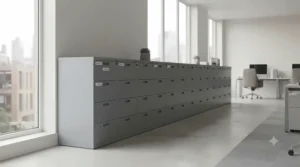
A lateral cabinet, the classic traditional filing system in larger offices, arranges folders side-on rather than front-to-back, which makes browsing multiple files at once noticeably easier — you can see several folder tabs simultaneously rather than flicking through a hanging queue. The trade-off is wall length: a lateral unit holding the same volume as a four-drawer vertical cabinet typically needs considerably more linear wall space, which is exactly the resource most home offices and small business rooms don’t have spare.
Open shelving with box files, the other common traditional filing system, wins on upfront cost and visibility — you can see every folder spine at a glance without opening anything. It loses badly on security (no lock, full exposure to dust and light) and on protecting sensitive material, which is precisely the gap a vertical filing cabinet closes. For most home offices and small practices, a vertical cabinet is the practical middle ground: better security and dust protection than open shelving, better floor efficiency than a lateral system, at the cost of slightly slower browsing than either alternative.
Common Mistakes When Buying a Vertical Filing Cabinet
The single most common mistake is buying based on drawer count alone without checking interior depth against actual A4 suspension file dimensions — some budget cabinets marketed as “3 drawer” have shallower interior rails than expected, which means folders sit awkwardly or don’t hang flush. Always check the listing explicitly states A4 or Letter compatibility rather than assuming.
The second mistake is under-budgeting for genuinely heavy use. A cabinet holding five years of dense paperwork for a small business gets opened and closed daily, sometimes multiple times, and cheaper drawer runners simply wear faster under that frequency than steel roller-bearing slides. If daily use over several years is realistic, the extra spend on something like the Bisley BS Steel Filing Cabinet usually pays for itself in avoided replacement.
The third, more subtle mistake: ignoring floor levelling and carpet thickness when positioning a tall unit. As covered earlier, thick carpet measurably reduces tip resistance, and a four-drawer vertical cabinet like the Panana 4-Drawer Metal Cabinet carries more of its weight higher up than a shorter unit — a five-minute check with a spirit level before final positioning is genuinely worth doing.
Space-Saving Cabinet Design: Narrow Footprint Storage Explained
The entire appeal of a space-saving cabinet in this category comes down to one geometric trick: going vertical instead of horizontal. A narrow footprint storage unit trades wall length for wall height, and in most UK homes — where floor space is at a premium but ceilings are rarely the constraint — that trade is almost always worth making. A four-drawer vertical cabinet with a 47 x 62cm footprint stores roughly the same volume as a lateral unit needing double that wall length.
Where this matters most in practice is awkward, underused spaces: the gap beside a desk, an alcove beside a chimney breast, the dead zone behind a door’s swing radius. Products like the VASAGLE 2-Drawer Filing Cabinet are purpose-built for exactly these spots, narrow enough to disappear into a gap most furniture can’t use. The honest limitation of chasing footprint above all else is capacity — the narrowest units inevitably hold less, so it’s worth being realistic about whether your actual document volume fits a slim two-drawer unit or genuinely needs the extra depth of a four-drawer cabinet.
Tall Filing Cabinet for the Office: When Height Pays Off
A tall filing cabinet office set-up — typically four drawers standing around 130-135cm — makes the most sense when document volume is growing and floor space isn’t. Going from a two-drawer to a four-drawer unit roughly doubles your capacity for barely any increase in footprint, since the added drawers stack upward rather than outward.
The trade-off worth weighing honestly: a taller cabinet places more weight higher off the ground, which — as covered in the buying mistakes above — makes anti-tilt mechanisms and floor levelling genuinely more important, not just a nice-to-have. It also means the top drawer sits at a height that’s comfortable for some users and awkward for others; if your household includes shorter users who’ll need frequent access to the top drawer, that’s worth testing in-store or checking dimensions against your own reach before committing to a unit like the Panana 4-Drawer Metal Cabinet.
Long-Term Cost & Maintenance
Sticker price tells you almost nothing about total cost of ownership here. A £60 particleboard cabinet that needs replacing after two years of daily use costs more over a five-year period than a £150 steel cabinet backed by a genuine multi-year guarantee — simple arithmetic that’s easy to forget when the upfront number is doing the talking.
Maintenance costs, realistically, are close to zero for steel cabinets: an occasional wipe-down and a drop of lubricant on the runners is the entire routine. Engineered-wood units need slightly more care — avoiding damp environments and not overloading drawers beyond their rated capacity extends their working life meaningfully. Cost-per-year is the honest metric: divide the purchase price by realistic years of service before replacement becomes likely, and the premium steel options on this list generally come out ahead of budget alternatives once you’re filing daily for more than three years.
Safety, Security & Compliance Guide
Two separate compliance angles apply to vertical filing cabinets in a UK context, and they’re worth treating separately. The first is physical safety: filing cabinets are a recognised tipping hazard when drawers are loaded top-heavy or opened simultaneously, which is precisely why anti-tilt interlocks — standard on every product reviewed above — matter more than they might first appear. Employers have general duties under the Workplace (Health, Safety and Welfare) Regulations 1992 to maintain safe furniture and equipment in any workplace, home offices included where the space doubles as a place of work.
The second is data protection. If your vertical filing cabinet stores personal information — client records, HR files, medical notes — the ICO’s guidance on records management is explicit that paper records containing personal data must be securely stored with controlled access, which in practice means a genuine lock, not just a token catch. This is exactly where the central-locking steel cabinets on this list — the Bisley BS Steel Filing Cabinet and Office Hippo Heavy Duty Steel Filing Cabinet — earn their higher price for anyone handling confidential material professionally. For guidance specifically on retaining and eventually disposing of physical records containing personal data, the National Archives’ guide to archiving personal data is a useful companion reference for small businesses building a proper retention policy.
Frequently Asked Questions
❓ What size is a standard vertical filing cabinet?
❓ Are vertical filing cabinets better than lateral cabinets for a home office?
❓ How much weight can a vertical filing cabinet hold?
❓ Do I need a lockable filing cabinet at home?
❓ How long does a metal filing cabinet last compared to particleboard?
Conclusion
Choosing a vertical filing cabinet really comes down to being honest about three things: how much you’re actually storing, how sensitive it is, and how much floor space you genuinely have spare. Get those three answers right and the rest of the decision mostly makes itself. For anyone storing confidential material for years to come, the Bisley BS Steel Filing Cabinet and Office Hippo Heavy Duty Steel Filing Cabinet justify their higher price through genuine longevity and proper lock security. If floor space is the binding constraint, the VASAGLE 2-Drawer Filing Cabinet‘s narrow footprint solves that problem directly, while the Panana 4-Drawer Metal Cabinet answers the opposite need — maximum capacity without eating extra wall length.
Whichever you land on, the underlying logic holds across this whole category: vertical filing cabinets trade width for height, and in most British homes and small offices, that’s a trade genuinely worth making. Measure your space, be realistic about your document volume, and match the lock to how sensitive that paperwork actually is — the rest is just picking a finish you like.
Recommended for You
- 4 Drawer Filing Cabinet: 7 Brilliant UK Picks for 2026
- 3 Drawer Filing Cabinet: 7 Best Picks for UK Offices 2026
- 2 Drawer Filing Cabinet UK: 7 Brilliant Picks for 2026
Disclaimer: This article contains affiliate links. As an Amazon Associate, I earn from qualifying purchases. If you purchase products through these links, we may earn a small commission at no additional cost to you.
✨ Found this helpful? Share it with your friends! 💬🤗
