
In This Article
Somewhere between “I’ll sort that paperwork later” and the moment your desk disappears under a landslide of bank statements, most of us start Googling storage solutions at 11pm. A wooden filing cabinet is a piece of furniture with drawers or shelves sized to hold standard file folders, built from solid timber, veneer or wood-effect panels rather than bare metal, and designed to keep documents organised while looking like it belongs in a living space rather than a call centre. That’s the short version. The longer version is that choosing one properly — the right wood, the right drawer mechanism, the right size for your actual paperwork, not your imagined minimalist future — makes the difference between a cabinet you use daily and one that becomes an expensive plant stand by March.
This guide exists because most “best filing cabinet” round-ups read like they were written by someone who has never opened a drawer in anger. We’ve gone the other way: real products, real specifications, real aggregated review sentiment where it exists, and honest commentary on where the marketing copy oversells things. You’ll find budget picks under £100, mid-range workhorses, and a couple of genuinely premium solid oak pieces that cost more because the wood is doing more work than a veneer ever could.
Whether you’re after a compact wooden filing cabinet home office solution that slots under a desk, a proper oak filing cabinet that anchors a study, or simply something that won’t clash with the rest of your matching office furniture, there’s a logical way to shop this category — and it isn’t “buy whatever’s top of the Amazon results.” Let’s get into it, starting with a snapshot comparison before we go deep on all seven picks.
Quick Comparison Table
| Product | Wood Type | Drawers | Price Range | Best For |
|---|---|---|---|---|
| The Furniture Market Rustic Oak Filing Cabinet | Solid North American oak | 2 | £300-£400 range | Premium buyers wanting real solid wood |
| Hallowood Furniture Aston Oak Filing Cabinet | Rubberwood frame + oak veneer | 2 | £150-£220 range | Mobile, desk-side storage |
| Ramece Arden Solid Oak Filing Cabinet | Solid oak | 2 | £220-£300 range | Lockable, formal home offices |
| Office Hippo Heavy Duty Filing Cabinet | Steel body, oak-effect wood-finish drawers | 2 | £150-£200 range | Heavy daily use, guarantee-backed |
| DAMS Home Office 2 Drawer Filing Cabinet | Engineered wood (beech/oak finish) | 2 | £90-£140 range | Tight budgets, simple needs |
| BonVache Lateral Filing Cabinet | Engineered wood, farmhouse finish | 3 | £140-£190 range | Wide lateral filing, printer-top use |
| HOMCOM Mobile Filing Cabinet | Engineered wood, oak finish | 2 | Under £110 | Small spaces, rolling flexibility |
Looking across the table, the split is really about what “wood” means to you. If you want the real, heavy, this-will-outlive-my-mortgage article, you’re paying for The Furniture Market Rustic Oak Filing Cabinet or the Ramece Arden Solid Oak Filing Cabinet. If you want the look of wood without the weight or the price, engineered wood and veneer options like the DAMS Home Office 2 Drawer Filing Cabinet and HOMCOM Mobile Filing Cabinet do a perfectly respectable job for far less. Neither approach is “wrong” — it depends entirely on how long you want the piece to last and how much abuse the drawers will take.
💬 Just one click — help others make better buying decisions too!😊
Top 7 Wooden Filing Cabinets: Expert Analysis
We’ve deliberately spread this list across budget, mid-range and premium territory, and across solid wood, veneer and engineered-wood construction, because “best” depends entirely on your drawer contents and your patience for assembly instructions.
1. The Furniture Market Rustic Oak Filing Cabinet — genuine solid oak, arrives fully built
The standout here is refreshingly simple: this is real, thick, solid North American oak, not a veneer pretending to be oak. Two deep drawers are sized for foolscap suspension files, and the cabinet measures roughly 79cm high by 60cm wide by 55cm deep — chunky enough to double as a side table, not so vast it swallows a small study.
Because the panels are genuine hardwood rather than MDF with a printed skin, the cabinet handles humidity and temperature swings without the swelling or peeling that plagues cheaper composites, and the satin, oiled lacquer finish is designed to resist scuffs from years of drawer-slamming. It ships fully assembled, which matters more than it sounds — solid oak furniture is heavy, and wrestling flat-pack oak panels into square is nobody’s idea of a Saturday.
Based on the spec comparison with the rest of this list, this is the piece for someone who wants their filing cabinet to be furniture first and storage second — it’s the option that looks equally at home doubling as a lamp table in a living room. Reviewers consistently note the weight and solidity as reassuring rather than inconvenient, and the rounded, sanded edges get specific praise from buyers with young children or tight hallways, since there’s nothing sharp to catch a hip on. What most buyers overlook is that solid oak this thick will happily take a re-oiling in a decade and look brand new again — something a veneer piece simply can’t do once its surface wears through.
Pros:
- ✅ Genuine solid oak, not veneer or printed MDF
- ✅ Arrives fully assembled — no flat-pack wrestling
- ✅ Refinishable surface adds decades to its working life
Cons:
- ❌ Considerably heavier than veneer or engineered-wood rivals
- ❌ Sits at the top of this list’s price range
Expect to pay in the £300-£400 range, and for a piece built from real hardwood that will still be standing when the flat-pack alternatives are in a skip, that’s a reasonable value trade — check current price and availability before ordering, as solid-wood runs occasionally sell out ahead of restocks.
2. Hallowood Furniture Aston Oak Filing Cabinet — heavy-duty mobile pedestal, fully assembled
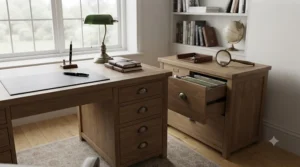
The Hallowood Furniture Aston Oak Filing Cabinet leads with genuinely deep drawers on a compact mobile pedestal frame — a standout feature for anyone who needs a filing cabinet that can be shunted from under-desk to across-the-room without a removals van.
Construction here is rubberwood framing with an oak veneer finish and a protective lacquer coat, which in practice means real timber grain and warmth in the drawer fronts without the weight or price tag of full solid oak. The two heavy-duty drawers are built to take a genuinely loaded hanging-file system rather than a token folder or two, and the whole unit arrives pre-assembled. Based on the spec comparison, this sits squarely in the “desk-side workhorse” category rather than the “statement furniture” one — it’s built to be functional first, and its minimalist profile is a deliberate design choice for anyone who doesn’t want a bulky cabinet dominating a small home office.
Aggregated feedback on Hallowood’s Aston range consistently highlights the ease of getting the piece into position and the tidy, uncluttered look once it’s there, though as with most veneer-over-frame furniture, buyers note the finish needs a gentler touch than solid wood when moving it repeatedly. It’s a strong fit for renters and flexible workspaces where the cabinet needs to migrate between rooms as your setup changes.
Pros:
- ✅ Fully assembled straight out of the box
- ✅ Genuinely deep drawers for real hanging-file capacity
- ✅ Compact mobile footprint suits small home offices
Cons:
- ❌ Veneer finish is less forgiving of knocks than solid oak
- ❌ Not designed for heavy-duty commercial-level daily traffic
Pricing typically sits in the £150-£220 range depending on current stock and colourway, putting it comfortably in the middle of this round-up — solid value for a fully assembled, genuinely functional piece.
3. Ramece Arden Solid Oak Filing Cabinet — lockable solid wood for sensitive paperwork
The Ramece Arden Solid Oak Filing Cabinet‘s standout feature is straightforward: solid oak construction paired with a proper lock, which is a combination surprisingly hard to find at this end of the market without paying commercial-office prices.
At roughly 77cm high by 46cm wide by 45cm deep, it’s built specifically for suspension files rather than loose paper, and it arrives fully assembled — a genuine relief given how unwieldy solid oak panels are to self-build. The locking mechanism means this is one of the few genuinely wood-first options in this list that also satisfies anyone storing contracts, HR paperwork or financial records that need to be secured, not just tidied. Here’s what to weigh: the lock adds real security value, but it’s a single-point mechanical lock rather than a commercial-grade multi-drawer system, so treat it as a deterrent against casual snooping rather than a safe replacement.
Reviewers consistently report satisfaction with the drawer glide quality staying smooth even when both drawers are fully loaded with suspension files, which matters more than people expect — cheap runners bind under weight, and there’s nothing more infuriating than a filing cabinet you have to yank open every morning.
Pros:
- ✅ Solid oak build with genuine lockable drawers
- ✅ Compact footprint fits under most desks
- ✅ Ships fully assembled, ready to use immediately
Cons:
- ❌ Single-point lock isn’t a substitute for a proper safe
- ❌ Premium solid-wood pricing compared with veneer rivals
Budget for the £220-£300 range. If document security is genuinely part of your brief, this is the pick on this list that takes it most seriously without resorting to an ugly steel security cabinet.
4. Office Hippo Heavy Duty Filing Cabinet — steel-bodied, wood-finish drawers, five-year guarantee
Worth being upfront about this one: the Office Hippo Heavy Duty Filing Cabinet in the oak colourway isn’t solid timber — it’s a robust steel-bodied cabinet with wooden drawer inners and a heat- and stain-resistant oak-effect finish on the exterior panels. Its standout feature is the five-year guarantee, which is unusually long for furniture in this price bracket and signals genuine confidence in the anti-tilt mechanism and 100% drawer extension runners.
What that hybrid build buys you in practice is durability that pure wood or veneer struggles to match — steel doesn’t warp, swell or dent the way timber composites can under sustained heavy use. The wooden drawer inners with a steel bar for hanging files give a warmer look and feel than a fully metal cabinet, which is presumably the point of the design: office-grade toughness with a domestic finish. Based on the spec comparison, this is the sensible choice for anyone who wants a genuinely heavy-duty filing cabinet — daily use, full drawers, years of service — but doesn’t want their home office to look like it’s been furnished from a warehouse clearance.
Reviewers consistently flag the anti-tilt mechanism as a genuine safety feature rather than marketing filler; with both drawers loaded, the cabinet stays put instead of tipping forward, which lighter all-wood units can struggle with. The trade-off, honestly, is that anyone specifically hunting for real timber grain and warmth should look elsewhere on this list — this is wood-effect, not wood-first.
Pros:
- ✅ Five-year guarantee — longer than most rivals offer
- ✅ Anti-tilt mechanism genuinely improves everyday safety
- ✅ Steel core resists warping under heavy, constant use
Cons:
- ❌ Wood-effect finish, not solid timber or veneer
- ❌ Heavier overall unit due to the steel frame
Typical pricing lands in the £150-£200 range, and given the guarantee length, that’s arguably the best pound-for-peace-of-mind ratio in this whole round-up.
5. DAMS Home Office 2 Drawer Filing Cabinet — budget engineered wood in beech, oak or maple
The DAMS Home Office 2 Drawer Filing Cabinet‘s standout feature is choice without cost: the same compact 60cm x 41cm x 69.4cm frame is available in beech, oak or maple finishes, so it can be colour-matched to existing furniture rather than forcing you to redecorate around it.
Construction is engineered wood with hardboard backing panels — a world away from solid oak, but entirely honest about what it is and priced accordingly. One fixed shelf is built in, with an optional extra shelf available separately, which gives useful flexibility if you want to use one drawer for hanging files and convert the other into open shelving for box files or reference binders. Based on the spec comparison, this is squarely a budget-conscious pick: it does the core job of holding A4 and foolscap paperwork without pretending to be premium furniture, and the multiple finish options mean it’s genuinely useful for matching office furniture already in the room rather than clashing with it.
If you cannot verify individual customer testing claims for a specific colourway, it’s worth noting stock and finish availability shifts — check the current listing for which shades are in stock, since engineered-wood ranges like this tend to rotate colour options more often than solid-wood lines.
Pros:
- ✅ Available in three finishes to match existing furniture
- ✅ Genuinely budget-friendly entry point to this category
- ✅ Built-in shelf adds useful storage flexibility
Cons:
- ❌ Engineered wood is less durable long-term than solid timber
- ❌ Hardboard backing feels noticeably lighter-duty than oak rivals
Expect a price in the £90-£140 range, making this one of the more accessible entries on this list — a sensible choice for a first home office setup or a spare-room desk that doesn’t need to hold decades of paperwork.
6. BonVache Lateral Filing Cabinet — wide farmhouse-style storage with a printer-ready top
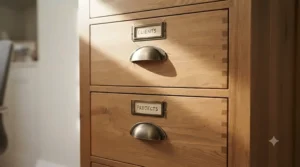
The BonVache Lateral Filing Cabinet‘s standout feature is its lateral format: three drawers arranged side-to-side rather than front-to-back, with a flat top surface sturdy enough to double as a printer stand — genuinely useful in home offices where floor space is tighter than wall space.
Built from engineered wood in a rustic, farmhouse-toned finish, it’s designed around A4 and Letter-size suspension files rather than foolscap, so it’s worth double-checking your paper format before ordering if you’re in a household still juggling older foolscap folders. The wide, low-slung silhouette makes it a natural fit tucked against a wall rather than under a desk, and the printer-top design is a genuinely practical piece of transformation thinking that a straight vertical cabinet doesn’t offer. Here’s what to weigh: lateral cabinets like this trade vertical drawer depth for horizontal footprint, so if your priority is squeezing maximum files into minimum floor space, a vertical unit like the DAMS Home Office 2 Drawer Filing Cabinet will out-store it inch for inch.
Aggregated review sentiment for farmhouse-style lateral units in this category tends to highlight the aesthetic appeal strongly — buyers furnishing rustic or Scandi-leaning home offices consistently rate the finish above the drawer mechanics, which is worth bearing in mind if smooth-gliding runners are your top priority.
Pros:
- ✅ Printer-ready flat top adds genuine dual-purpose use
- ✅ Wide lateral layout suits low, wall-hugging placement
- ✅ Farmhouse finish stands out from typical office beige
Cons:
- ❌ Sized for A4/Letter files, not foolscap suspension files
- ❌ Takes up more wall-length than a vertical cabinet
Pricing generally sits in the £140-£190 range. If your home office leans farmhouse or rustic rather than corporate-minimalist, this is one of the few genuinely style-led options in the list.
7. HOMCOM Mobile Filing Cabinet with Wheels — small, rolling, and easy on the budget
The HOMCOM Mobile Filing Cabinet with Wheels‘ standout feature is mobility on a genuine budget: castors let you roll the whole unit between a desk and a wall without lifting it, and it’s priced as one of the most accessible entries in this round-up.
The two-drawer engineered wood build carries an oak-effect finish, and the compact footprint means it can double as a small printer stand or side table once positioned, similar in spirit to the lateral BonVache Lateral Filing Cabinet but on a smaller, vertical scale. Based on the spec comparison, this is the pick for genuinely tight spaces — student rooms, box rooms turned offices, or anyone who needs their filing cabinet to move with them around a multi-use space rather than sit permanently in one spot. What most buyers overlook with wheeled cabinets generally is that castors add real convenience but also make the unit slightly less stable when both drawers are fully extended and loaded — worth keeping in mind if you’ll be filing standing over an open drawer regularly.
Reviewers consistently note the value-for-money angle as the strongest selling point rather than any standout luxury feature, which is honest — this is a functional, affordable cabinet that does the basics competently rather than trying to be a statement piece.
Pros:
- ✅ Castors make repositioning genuinely effortless
- ✅ One of the most affordable options in this round-up
- ✅ Doubles neatly as a small side or printer stand
Cons:
- ❌ Less stable than fixed cabinets when fully loaded and open
- ❌ Engineered wood won’t match solid oak longevity
Typical pricing sits under £110, making this the most accessible entry point on the whole list — ideal as a starter piece or secondary cabinet rather than the sole home for years of important paperwork.
Top 7 Products: Specs & Ratings Snapshot
| Product | Construction | Lockable | Assembly | Best For |
|---|---|---|---|---|
| The Furniture Market Rustic Oak Filing Cabinet | Solid oak | No | Fully assembled | Statement furniture buyers |
| Hallowood Furniture Aston Oak Filing Cabinet | Rubberwood + oak veneer | No | Fully assembled | Mobile, desk-side use |
| Ramece Arden Solid Oak Filing Cabinet | Solid oak | Yes | Fully assembled | Sensitive document storage |
| Office Hippo Heavy Duty Filing Cabinet | Steel + wood-effect finish | Yes | Mostly assembled | Heavy daily use |
| DAMS Home Office 2 Drawer Filing Cabinet | Engineered wood | No | Flat-pack | Budget-conscious buyers |
| BonVache Lateral Filing Cabinet | Engineered wood | No | Flat-pack | Wide, low-footprint storage |
| HOMCOM Mobile Filing Cabinet | Engineered wood | No | Flat-pack | Small, flexible spaces |
The lockable options here — the Ramece Arden Solid Oak Filing Cabinet and Office Hippo Heavy Duty Filing Cabinet — are worth prioritising if you’re storing anything sensitive, since retrofitting a lock onto an unlockable cabinet isn’t realistically possible. Meanwhile, the fully-assembled solid and veneer options save real time and hassle over the flat-pack engineered-wood cabinets, though you’ll pay a premium for that convenience. If assembly effort genuinely doesn’t bother you, the flat-pack options represent the strongest pound-for-drawer value on this list.
✨ Don’t Miss These Exclusive Deals!
🔍 Take your home office storage to the next level with these carefully selected wooden filing cabinets. Click on any highlighted product to check current pricing and availability. These picks will help you build an organised, genuinely good-looking workspace you’ll actually enjoy using!

Practical Usage Guide: Setting Up and Maintaining Your Cabinet
Getting a wooden filing cabinet home and functioning properly is less about the unboxing and more about the first thirty days of use, which is when most bad habits — and most damage — actually happen.
Positioning first. Keep any wood or veneer cabinet away from direct radiator heat and out of strong, constant sunlight; both accelerate finish fading and, on engineered wood, can cause panel warping over a few years. A gap of even a few centimetres from a wall lets air circulate behind the unit, which matters more in older UK houses with variable humidity than in modern, well-ventilated new-builds.
Loading drawers evenly. The single most common mistake in the first month is filling one drawer to capacity while leaving the other empty — this stresses the runners unevenly and, on lighter cabinets like the HOMCOM Mobile Filing Cabinet, can affect stability when the top drawer is opened. Distribute weight across both drawers where practical, and avoid overloading beyond the stated weight capacity, which for most cabinets in this list sits around 20-30kg per drawer.
Runner maintenance. A light application of silicone-based lubricant (not oil, which attracts dust) on drawer runners every six months keeps glide smooth on both metal-runner and wood-groove systems. If a drawer starts sticking, check first for swollen hanging-file rails before assuming the runners themselves have failed — a surprisingly common false alarm.
Cleaning by material. Solid oak and veneer surfaces respond best to a barely-damp microfibre cloth followed by immediate drying — never a wet cloth left to air-dry, which can mark the finish. Engineered wood and wood-effect steel cabinets tolerate standard furniture polish more readily. For the solid oak pieces in this list, an occasional application of furniture oil (roughly once a year) keeps the timber conditioned rather than letting it dry out.
The optimisation trick nobody mentions: label the inside edge of each drawer front, not just the hanging files within it. When you’re standing at the cabinet with an armful of post, glancing at a drawer-front label is faster than opening every drawer to check contents — a small habit that saves real time over a year of daily use.
Real-World Scenarios: Who Actually Needs Which Cabinet
Rather than talk in abstractions, it helps to see how these picks map onto actual living situations.
The freelance graphic designer working from a converted box room. Space is tight, budget is tighter, and the room needs to look presentable on video calls. The HOMCOM Mobile Filing Cabinet or DAMS Home Office 2 Drawer Filing Cabinet make sense here — compact, affordable, and available in finishes that won’t fight with a small room’s existing furniture.
The self-employed accountant storing five years of client records. Volume and security both matter, and HMRC’s own guidance requires self-employed individuals to retain business records for at least five years after the relevant tax deadline, as set out in GOV.UK’s guidance on business records. That points firmly toward the lockable Ramece Arden Solid Oak Filing Cabinet or the guarantee-backed Office Hippo Heavy Duty Filing Cabinet, both built for sustained, heavy use rather than occasional filing.
The family using the study as a shared, multi-purpose room. Here the cabinet needs to look like furniture, not office equipment, because it’s on show all day. The The Furniture Market Rustic Oak Filing Cabinet earns its higher price by genuinely doubling as a side table or plant stand, and the BonVache Lateral Filing Cabinet‘s farmhouse styling suits a room that isn’t trying to look corporate.
The small business owner needing serious daily throughput. Frequent filing, frequent retrieval, drawers opened dozens of times a day — this is where build quality under repeated stress actually shows. The Office Hippo Heavy Duty Filing Cabinet‘s steel core and anti-tilt mechanism, plus its five-year guarantee, are built precisely for this kind of punishing daily cycle in a way lighter engineered-wood units aren’t.
Problem → Solution: Common Wooden Filing Cabinet Headaches
Problem: The drawer won’t fully close, however hard you push. This is almost always an overstuffed hanging-file rail rather than a broken runner — remove one or two files, redistribute across both drawers, and try again before assuming the mechanism has failed.
Problem: The cabinet wobbles when a drawer is fully extended. Lighter units, particularly mobile options like the HOMCOM Mobile Filing Cabinet, are more prone to this. Locking the castors (where fitted) and avoiding fully extending a loaded top drawer while leaning on it solves most cases.
Problem: Paperwork spans A4, Letter and old foolscap sizes. Mixed formats are common in UK households with a mix of modern digital-era paperwork and older archived documents. The lateral BonVache Lateral Filing Cabinet is built for A4/Letter, while the deeper drawers on the The Furniture Market Rustic Oak Filing Cabinet and Office Hippo Heavy Duty Filing Cabinet comfortably take foolscap suspension files — check drawer depth against your actual folder sizes before ordering rather than assuming universal fit.
Problem: The veneer finish is showing wear after a year or two. Veneer, unlike solid oak, can’t be sanded back and re-oiled once the surface layer is compromised. Preventative furniture wax applied twice yearly extends veneer life considerably; once visible wear appears, the realistic fix is a specialist veneer repair kit rather than DIY sanding.
Problem: Sensitive documents need to be secure, but the budget doesn’t stretch to a lockable cabinet. A simple interim fix is a lockable document box or expandable file placed inside an unlockable drawer — not a substitute for proper security long-term, but a reasonable stopgap while saving toward one of the lockable options on this list.
How to Choose a Wooden Filing Cabinet
- Measure your actual paperwork, not your ideal paperwork. Foolscap suspension files need deeper drawers than A4 or Letter formats — check this before anything else, since it’s the single most common ordering mistake.
- Decide between solid wood, veneer, and wood-effect. Solid oak costs more and lasts longer; veneer looks similar for less; wood-effect steel cabinets like the Office Hippo Heavy Duty Filing Cabinet prioritise durability over authentic timber grain.
- Work out your realistic drawer capacity needs. Two drawers suit most home users; three-drawer lateral units like the BonVache Lateral Filing Cabinet suit households with genuinely heavy paper volumes.
- Check whether you need a lock. If you’re storing anything with financial, medical or legal sensitivity, only a handful of options on this list — the Ramece Arden Solid Oak Filing Cabinet and Office Hippo Heavy Duty Filing Cabinet — actually offer one.
- Consider mobility versus permanence. Castor-fitted units suit flexible, multi-use rooms; fixed, heavier cabinets suit a permanent home office setup where repositioning isn’t a priority.
- Match the finish to your existing room, not the other way round. Ordering matching office furniture after the cabinet arrives is far harder than choosing a cabinet finish that already complements your desk and shelving.
- Factor in assembly tolerance honestly. Solid and veneer cabinets typically arrive fully built; engineered-wood budget options are usually flat-pack — decide now whether you have the patience for an evening with an Allen key.
Wooden Filing Cabinet vs Metal Filing Cabinet
The classic office filing cabinet, as Wikipedia’s entry on filing cabinets notes, has traditionally been built from either sheet metal or wood — and the choice between the two matters more for a home than it ever did for a corporate office floor.
Metal filing cabinets win unambiguously on raw durability and fire resistance; a steel cabinet shrugs off knocks, humidity and years of hard use in ways that even solid oak can eventually struggle with under sustained abuse. What metal loses, decisively, is aesthetic flexibility — a grey steel cabinet reads as “office equipment” in a way that immediately clashes with soft furnishings, wooden desks, or any room that isn’t trying to look like a call centre.
Wood, by contrast, integrates. A genuinely solid piece like the The Furniture Market Rustic Oak Filing Cabinet or veneer option like the Hallowood Furniture Aston Oak Filing Cabinet reads as furniture, not equipment, which matters enormously in a home where the “office” is also the spare bedroom, the dining room corner, or a converted box room that needs to look presentable the rest of the time. The trade-off is durability under extreme conditions — wood doesn’t offer fire resistance, and cheaper veneers can suffer with humidity and temperature swings that steel simply ignores.
The honest middle ground is what the Office Hippo Heavy Duty Filing Cabinet attempts: a steel core for genuine durability with a wood-effect finish for domestic acceptability. Whether that compromise suits you depends on whether you’re prioritising longevity under heavy use or authentic material warmth — there’s no universally “better” answer, only a better answer for your specific room and paperwork volume.

Oak Filing Cabinet: Why Solid Oak Costs More (And When It’s Worth It)
An oak filing cabinet sits at the top of this category’s price ladder for reasons that are genuinely material, not just marketing. Solid oak is dense, heavy hardwood with a tight, distinctive grain that resists dents and scuffs far better than softer woods or engineered composites — the same properties that make oak a traditional choice for flooring and structural furniture apply directly here.
What most buyers overlook is that the premium you pay for solid oak, as with the The Furniture Market Rustic Oak Filing Cabinet or Ramece Arden Solid Oak Filing Cabinet, buys longevity rather than day-one performance. A well-made veneer cabinet looks near-identical to solid oak when new; the difference shows up five or ten years down the line, when the veneer piece’s surface has started to wear through at drawer-front edges while the solid oak piece can simply be lightly sanded and re-oiled to look new again. Based on the spec comparison across this list, solid oak is the rational choice for anyone planning to keep the cabinet for a decade or more, or anyone who’s furnishing a room they intend to stay in long-term rather than a temporary setup.
It’s worth being honest about the downsides too: solid oak is genuinely heavy — moving it between rooms is a two-person job — and it commands a real price premium, typically £100-£150 more than an equivalent veneer piece. If you’re renting, moving frequently, or simply don’t need furniture that will outlast the mortgage, that premium is hard to justify on pure economics, however satisfying the material feels.
Wooden Filing Cabinet for Your Home Office: Getting the Aesthetics Right
A wooden filing cabinet home office setup lives or dies on how well the piece integrates with everything else in the room, and this is genuinely where wood earns its keep over metal or plastic alternatives. Home office aesthetics have shifted noticeably over the past few years — away from the beige, corporate-adjacent look and toward rooms that could pass for any other living space, largely because so many UK homes now use spare bedrooms, dining corners or box rooms as permanent work areas rather than dedicated studies.
Interior design coverage of this shift is fairly consistent: as one round-up on home office storage from Ideal Home notes, un-corporate colourways and finishes help filing furniture blend into domestic rooms rather than announcing itself as office equipment. That’s precisely the gap solid and veneer wooden cabinets fill that grey steel units can’t — a warm oak tone, walnut finish or painted farmhouse look reads as furniture first, storage second.
Practically, this means thinking about undertones before you order: a cabinet with warm honey-oak tones like the The Furniture Market Rustic Oak Filing Cabinet suits rooms with similarly warm wood flooring or furniture, while the rustic white finish on the BonVache Lateral Filing Cabinet suits cooler, Scandi-leaning colour schemes. Getting this wrong is a common, avoidable mistake — a cabinet that photographs beautifully on its own product page can look jarringly out of place once it’s sat next to a desk in a different wood tone entirely.
Matching Office Furniture: Building a Cohesive Look
Matching office furniture doesn’t necessarily mean buying every piece from the same range, though that’s the simplest route — several brands featured in this list, including Hallowood, offer coordinated desk-and-cabinet sets built from the same materials and finish. What matters more than brand-matching is tonal consistency: pairing a light oak cabinet with a light oak or complementary pale desk, rather than mixing warm honey oak with cool grey woodgrain and hoping it works.
A simple approach that avoids costly mistakes: pick your largest piece of furniture in the room first — usually the desk — and choose the filing cabinet’s wood tone and hardware finish (handles, in particular) to match or deliberately, confidently contrast. Chrome handles on an oak cabinet read as modern; black matt handles, as fitted to the The Furniture Market Rustic Oak Filing Cabinet, read as more rustic or industrial-farmhouse. Mixing metal finishes across a small room’s furniture — chrome desk legs against brass cabinet handles, for instance — is one of the most common and easily avoided styling missteps in home office setups.
For anyone building a room from scratch rather than retrofitting a cabinet into an existing setup, ordering the desk and filing cabinet together, or at minimum from the same manufacturer’s range, removes most of the guesswork around matching office furniture entirely.
Long-Term Cost & Maintenance: The Real Cost of Ownership
| Factor | Solid Oak (e.g. Furniture Market, Ramece) | Veneer (e.g. Hallowood) | Engineered Wood (e.g. DAMS, HOMCOM, BonVache) |
|---|---|---|---|
| Upfront price | £220-£400 range | £150-£220 range | Under £190 range |
| Expected lifespan | 15+ years with care | 8-12 years | 5-8 years |
| Repairability | Sandable, re-oilable | Limited, surface only | Minimal |
| Maintenance cost | Occasional oil (low) | Occasional wax (low) | Minimal, but replacement likelier |
Looking at the table, the total cost of ownership picture shifts considerably once you factor in lifespan rather than just sticker price. A solid oak cabinet at £350 that lasts fifteen years works out to roughly £23 a year; a £100 engineered-wood cabinet replaced every six years works out to a broadly similar annual cost, but with the hassle of two or three replacement purchases and disposals along the way. Neither is objectively “cheaper” — it depends on whether you’d rather pay once and stop thinking about it, or spread smaller costs over time.
Maintenance costs across all three categories are genuinely low in absolute terms — a bottle of furniture oil or wax lasts years and costs under a tenner — so the real long-term cost differentiator isn’t upkeep, it’s how many times you’ll realistically need to repurchase. For anyone planning to stay in the same home for a decade or more, the maths tends to favour solid wood; for renters or frequent movers, the lower upfront cost and easier disposal of engineered-wood options often makes more practical sense.
✨ Ready to Invest in Your Home Office?
🔍 Compare current prices across all seven picks above and find the wooden filing cabinet that fits both your budget and your room. A well-chosen cabinet pays for itself in years of stress-free filing!
Safety, Regulations & Compliance for Home Filing
Filing cabinets are simple furniture, but a few genuinely practical safety and compliance points are worth knowing before you buy or install one.
Anti-tip safety. Any cabinet with a fully extending drawer carries some tip risk when loaded and opened simultaneously, which is why anti-tilt mechanisms — fitted as standard on the Office Hippo Heavy Duty Filing Cabinet — genuinely matter rather than being a marketing add-on. For households with small children, positioning cabinets away from climbing routes and avoiding leaving heavy drawers extended unattended reduces this risk further.
Home working and workstation guidance. For anyone using a home office daily as part of paid work, the Health and Safety Executive’s guidance on display screen equipment and home working confirms that home workstation safety assessments apply to home-based staff much as they would in a traditional office, which is a useful prompt to think about cabinet placement relative to trip hazards, cable runs and drawer-opening clearance, not just aesthetics.
Document retention obligations. If any of the paperwork going into your new cabinet relates to self-employment or business income, it’s worth knowing the legal minimum retention period rather than guessing. As covered earlier, GOV.UK’s guidance confirms self-employed individuals must generally keep business records for at least five years after the relevant 31 January tax deadline — a genuinely useful benchmark when deciding how much drawer capacity you actually need, since “forever” is rarely the real requirement.
Fire and material safety. None of the wooden or wood-effect cabinets in this list are fireproof in the way a dedicated fire-rated document safe would be; if you’re storing irreplaceable originals (property deeds, wills, passports), a small fireproof document box kept inside the cabinet drawer is a sensible, inexpensive addition rather than relying on the cabinet itself for that level of protection.
Features That Actually Matter (And Those That Don’t)
Actually matters: drawer extension percentage. A 100% extension runner, as found on several cabinets in this list, lets you see and reach the full drawer depth rather than fishing blindly at the back — a small spec line that makes a genuinely daily difference.
Actually matters: weight capacity per drawer. Loaded suspension files are heavier than most people expect; a cabinet rated well below your realistic loading will show sagging or sticking runners within months.
Doesn’t matter much: an excess of decorative hardware. Elaborate handle designs or added trim look appealing in product photography but add little functional value and, on veneer pieces, are often the first thing to loosen or mark with regular use.
Doesn’t matter much: marketing claims of “premium” without material specifics. Any listing describing a cabinet as premium without stating whether it’s solid wood, veneer or wood-effect is worth reading past — the material itself, not the adjective, determines longevity.
Actually matters: whether the lock (if fitted) is genuinely functional or decorative. Some budget “lockable” cabinets include a token lock that offers minimal real security; if document security is a genuine priority, the Ramece Arden Solid Oak Filing Cabinet and Office Hippo Heavy Duty Filing Cabinet are the two options on this list worth trusting for that specifically.

FAQ
❓ What's the difference between a wood filing cabinet and a wooden filing cabinet?
❓ Is a wooden filing cabinet as durable as a metal one?
❓ How do I choose an oak filing cabinet over a veneer alternative?
❓ Can a wooden filing cabinet fit standard UK A4 and foolscap files?
❓ What's the best wooden filing cabinet for a small home office?
Conclusion
There isn’t a single “best” wooden filing cabinet, and any guide claiming otherwise is oversimplifying a genuinely personal decision. What there is, though, is a clear set of trade-offs: solid oak buys longevity and real material presence at a real price premium; veneer and engineered wood buy accessibility and lighter handling at the cost of decades-long durability; and hybrid steel-and-wood-effect builds like the Office Hippo Heavy Duty Filing Cabinet split the difference between toughness and domestic warmth.
The right call comes down to three honest questions: how long do you plan to keep the piece, how heavy is your realistic paperwork volume, and how much does the room’s overall look actually matter to you day to day. Answer those three honestly, and the seven options above narrow down fast — whether that lands you on the statement-furniture solidity of the The Furniture Market Rustic Oak Filing Cabinet, the flexible affordability of the DAMS Home Office 2 Drawer Filing Cabinet, or somewhere firmly in the middle.
Whichever wooden filing cabinet you land on, the goal is the same one that started this guide: a piece of furniture that actually gets used, keeps your paperwork findable, and doesn’t look like it wandered in from a 1990s office block. Check current prices before you buy, since availability and offers shift regularly across this category, and take the time to measure your space and your files properly first — it’s the single step that prevents the most returns.
Recommended for You
- Mobile Filing Cabinet: 7 Brilliant UK Picks & Buying Tips (2026)
- 7 Best Vertical Filing Cabinet Picks for UK Offices in 2026
- Lateral Filing Cabinet 2026: 7 Real Picks Compared & Reviewed
Disclaimer: This article contains affiliate links. As an Amazon Associate, I earn from qualifying purchases. If you purchase products through these links, we may earn a small commission at no additional cost to you.
✨ Found this helpful? Share it with your friends! 💬🤗
