
In This Article
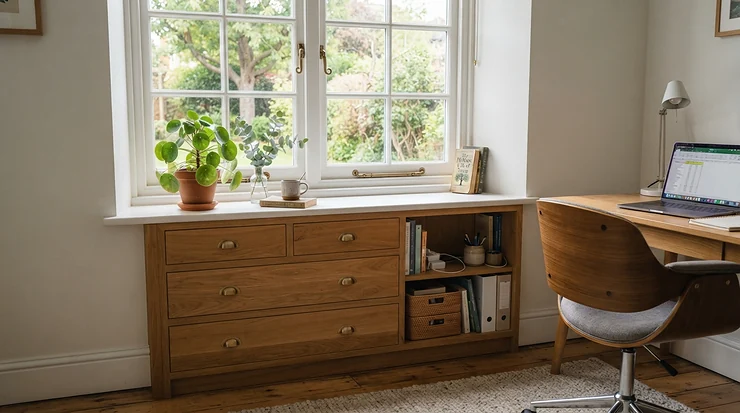
Credenza vs sideboard for office comes down to labels and proportions. Both are long, low, closed storage cabinets, but “credenza” usually means a desk-height unit placed behind or beside a workstation, while “sideboard” is the traditional British dining-room term. In practice, depth, height and intended load matter far more than the name.
Britannica describes a sideboard as a dining-room piece for holding plates, decanters and serving extras, usually with cupboards and drawers. The credenza has wandered out of the dining room and into executive suites, where it sits behind the desk looking important. Same species, different habitats. You, meanwhile, are standing in a spare room with a tape measure, wanting to know which one to buy.
Here’s the twist: the labels barely matter. Designers and retailers openly admit the terms overlap. The differences that affect your working day (height, depth, doors, load rating) live in the spec sheet, not the product title. So this guide does four things. It unpicks the vocabulary and compares seven real units available to UK buyers. It explains the storage depth differences that trip people up, then shows you how to match a cabinet to your desk, printer and paperwork pile.
One honest caveat: I haven’t tested any of these cabinets. Everything below rests on published specifications, retailer data and aggregated reviewer feedback, and I’ll flag where the evidence is thin.
Quick Comparison Table: 7 Credenza and Sideboard Options for the Office
Here’s the whole field at a glance. All seven are consumer-market cabinets that double well as home-office storage. Dimensions are in centimetres, so you can hold a tape measure against your wall. Price bands are indicative and move constantly.
| Product | Size (W × D × H, cm) | Doors | Price range | Best For |
|---|---|---|---|---|
| VASAGLE Sideboard LSC092B01 | 100 × 33 × 80 | 2 sliding | around £75–£110 | Box rooms and light paperwork |
| VASAGLE Sideboard LSC096B01 | 110 × 33 × 75 | 3 | under £150 | Desk-height storage with anti-tip kit |
| HOMCOM Mid-Century Tambour Sideboard | 90 × 40 × 75 | 2 sliding tambour | around £85–£125 | Compact printer station |
| HOMCOM 4-Door Adjustable Sideboard | 121 × 37 × 75 | 4 | around £90–£120 | Stationery and consumables |
| Tribesigns 59.4″ Sideboard Buffet | 151 × 36 × 86 | Doors | around £150–£250 | Stand-up working surface |
| Tribesigns 63″ Fluted Sideboard Buffet | 160 × 40 × 79.5 | Doors | around £200–£300 | Long walls and heavier loads |
| vidaXL HALDEN Sideboard | 80 × 40 × 80 | Sliding | around £170–£220 | Solid-wood longevity |
Looking at the table, the VASAGLE Sideboard LSC092B01 and VASAGLE Sideboard LSC096B01 are the slimmest at 33 cm deep, so they suit light paperwork rather than printers. If depth is your priority, the HOMCOM Mid-Century Tambour Sideboard, Tribesigns 63″ Fluted Sideboard Buffet and vidaXL HALDEN Sideboard all reach about 40 cm. The Tribesigns 59.4″ Sideboard Buffet is the only one whose top rises well above desk height.
💬 Just one click — help others make better buying decisions too!😊
Top 7 Credenza vs Sideboard for Office Picks: Expert Analysis
A word on sources. None of these seven is a purpose-built boardroom credenza, because those are mostly sold direct by commercial suppliers. These are the units UK buyers actually find on consumer marketplaces, and each can do credenza duty in a home office. Variants and availability on amazon.co.uk change, so check the listing. Review notes come from aggregated public feedback, and where I couldn’t verify a meaningful pool I say so.
1. VASAGLE Sideboard LSC092B01 — best sliding-door value for box rooms
Two sliding barn doors mean you never reserve a swing zone in front of the cabinet. That is gold dust in a box room where the chair already kisses the wall. The VASAGLE Sideboard LSC092B01 measures 100 × 33 × 80 cm and pairs a steel frame with particleboard. It offers six compartments built around three adjustable shelves, and one retailer listing quotes a 90 kg overall capacity. Translation: plenty of strength, modest depth.
Here’s what the spec sheet won’t shout. 33 cm is the outside measurement, and a sibling model in the same range lists just 27 cm inside a 30 cm shell. Expect to lose roughly 3 cm. An A4 sheet is 29.7 cm long, so this is a stationery, books and box-folder cabinet rather than a lever-arch-file vault or a printer plinth. At 80 cm tall the top rides slightly above desk height, which suits a stand-up landing strip for post.
Reviewers on retailer listings describe the build as sturdy and the doors as smooth. One buyer reported a missing part that the seller replaced quickly, and another tucked one under a TV.
Pros:
- ✅ Sliding doors need no swing clearance
- ✅ Steel frame with six adjustable compartments
- ✅ Slim footprint suits tight rooms
Cons:
- ❌ Shallow interior rules out lever-arch files
- ❌ Top sits above standard desk height
Around £75–£110. Strong value if your paperwork is lean.
2. VASAGLE Sideboard LSC096B01 — anti-tip kit included in the box
Most flat-pack cabinets leave stability to you. This one ships with an anti-tip kit alongside the assembly kit, according to its B&Q listing, which is a rare bit of foresight at this price. The VASAGLE Sideboard LSC096B01 measures 110 × 33 × 75 cm with three doors in a rustic brown and black finish.
At 75 cm tall it sits close to desk height. That makes it the neatest choice here if you want a continuous surface beside your workstation. The 110 cm width gives you three vertical zones, so you can dedicate one to stationery, one to consumables and one to the clutter you’d rather not look at. The depth is the same 33 cm as its sibling, so everything said above about interior space applies. Fine for books, magazine files and boxes, awkward for anything bulky.
The anti-tip kit only works if you use it. Fix it to a solid wall fixing, not just plasterboard. I couldn’t verify a sizeable review pool for this exact variant, so treat the specification as your main evidence and read current buyer comments before ordering.
Pros:
- ✅ Anti-tip kit included in the package
- ✅ Close to typical desk height
- ✅ Three doors allow tidy zoning
Cons:
- ❌ Only 33 cm deep externally
- ❌ Limited verifiable review evidence
Under £150 on most listings. Good value if stability matters to you.
3. HOMCOM Mid-Century Tambour Sideboard — roomier 40 cm depth with centre-leg support
Slatted tambour doors slide away like a roller shutter, so the front stays clear even when your chair is parked close. The HOMCOM Mid-Century Tambour Sideboard measures 90 × 40 × 75 cm. It has two internal compartments, steel legs and a listed capacity of 150 kg overall, 30 kg per compartment or top.
The unsung hero is the extra middle legs with adjustable foot pads. They help a wide top resist sagging under a printer, and they let you shim around an uneven floor. At 40 cm deep it is the roomiest of the budget trio, though still shy of a classic credenza. Many compact printers sit somewhere in the mid-30s to around 40 cm deep, so measure yours before assuming it fits with room for cables.
At 75 cm the top lines up closely with many desks. I couldn’t verify a meaningful review pool for this exact listing, so lean on the specification rather than star ratings.
Pros:
- ✅ 40 cm depth beats the slimmer budget picks
- ✅ Tambour doors save swing space
- ✅ Adjustable foot pads on centre legs
Cons:
- ❌ Only 90 cm wide
- ❌ MDF and particleboard, not solid wood
Around £85–£125. Decent value for a compact printer station.
4. HOMCOM 4-Door Adjustable Sideboard — widest budget run, light duty
A 121 cm run with four doors lets you zone a cabinet properly: printer paper, spare cables, reference books and the emergency biscuit tin. The HOMCOM 4-Door Adjustable Sideboard measures 121 × 37 × 75 cm in particleboard and pine, with adjustable shelves.
The headline spec is the weight rating of 50 kg overall and 10 kg per shelf. That per-shelf number is the whole story. A 500-sheet ream of 80gsm A4 weighs about 2.5 kg, so 10 kg is roughly four reams. That is fine for stationery, print paper and light supplies, and poor for archive boxes or heavy binders. The hinged doors also need swing clearance, so don’t place it where a chair or radiator interferes.
At 37 cm deep it sits between the slim VASAGLE pair and the 40 cm group. I couldn’t verify a robust review pool, so judge it as a light-duty supplies cabinet rather than a filing solution.
Pros:
- ✅ Generous 121 cm width for the price
- ✅ Four doors help organise supplies
- ✅ Desk-height 75 cm top
Cons:
- ❌ Only 10 kg per shelf
- ❌ Hinged doors need clearance
Around £90–£120. Good value for lighter loads.
5. Tribesigns 59.4″ Sideboard Buffet — stand-up height top
At 86 cm, the top of this cabinet sits about 11 cm above the 75 cm units already covered. That is exactly where a standing printer station or tea tray feels natural. The Tribesigns 59.4″ Sideboard Buffet measures 151 × 36 × 86 cm, weighs about 40 kg and is marketed with four tiers of shelving.
The weight is a double-edged sword. Once planted it feels substantial, but out of the box it’s a two-person job, so plan the delivery route and assembly space. The 36 cm depth is modest, so treat it as a paper-and-supplies cabinet. If you want to stand-print while you work, though, the height genuinely helps. On the brand’s own site the score is a high 4.7, but from only ten reviews, which is a hint rather than proof.
Pros:
- ✅ Stand-up height suits printing and coffee
- ✅ Wide 151 cm run
- ✅ Substantial, stable-feeling build
Cons:
- ❌ Only 36 cm deep
- ❌ Roughly 40 kg means two-person assembly
Around £150–£250. Worth it if you want standing-height utility.
6. Tribesigns 63″ Fluted Sideboard Buffet — longest run with 18 kg shelves
Fluted fronts and a 160 cm span make this the cabinet you buy when the wall itself is the project. The Tribesigns 63″ Fluted Sideboard Buffet measures 160 × 39.7 × 79.5 cm and weighs about 42 kg. Each interior shelf is rated for roughly 18 kg (40 lb). That is the best shelf rating in this round-up, and it works out to about seven reams of A4 per shelf, so stationery stores, spare kit and modest archives are all comfortable.
The near-40 cm depth edges you towards credenza territory, though interior depth will be a little less. The grooved fronts are handsome but do collect dust, so allow for a quick microfibre pass each month. At 79.5 cm tall the top sits a few centimetres above desk height, which is useful for a printer you’d rather not reach down to. I couldn’t verify a meaningful review pool for this listing.
Pros:
- ✅ Generous 160 cm width
- ✅ 18 kg shelf rating, strongest here
- ✅ Near-credenza 40 cm depth
Cons:
- ❌ Fluted fronts collect dust
- ❌ Around 42 kg to move and assemble
Around £200–£300. A premium for people who want it to look intentional.
7. vidaXL HALDEN Sideboard — solid wood for longevity
Solid wood is the quiet flex. The vidaXL HALDEN Sideboard measures 80 × 40 × 80 cm in black with a sliding door, and trades capacity for durability. Solid timber generally holds screws better than particleboard and tolerates being taken apart if you change offices. It can also be sanded and refinished, which particleboard cannot.
At 80 cm wide it suits a single-desk bay or alcove rather than a whole wall. The 40 cm depth matches the HOMCOM Mid-Century Tambour Sideboard, so a compact printer is plausible. The sliding door saves floor space, though you’ll want to confirm interior shelf layout on the listing. I couldn’t verify a meaningful review pool, so this is a spec-led recommendation.
Pros:
- ✅ Solid wood construction
- ✅ 40 cm depth for compact printers
- ✅ Sliding door saves floor space
Cons:
- ❌ Compact 80 cm width
- ❌ Highest price per centimetre of width
Around £170–£220. Worth it if you plan to keep it for a decade.
✨ Don’t Miss These Exclusive Deals!
🔍 Take your office storage setup to the next level with these carefully selected cabinets. Click on any highlighted item to check current pricing and availability. These picks will help you create a calm, clutter-free workspace you’ll actually enjoy sitting in!
How to Set Up and Maintain Your Office Cabinet: A 30-Day Practical Guide
Listings tell you what the cabinet is. They don’t tell you how to make it behave for the next five years. This is the practical layer.
Day 0–1: Build It Properly
Count the hardware against the manual before you touch a screwdriver. One reviewer of the VASAGLE Sideboard LSC092B01 reported a missing part, and finding that out at 9pm is miserable. Assemble on a blanket or flattened cardboard, and recruit a second person for anything near 40 kg, such as either Tribesigns cabinet. Level it with the foot pads where available (the HOMCOM Mid-Century Tambour Sideboard has them) and anchor it if an anti-tip kit is supplied.
Week 1: Load It Sensibly
Heavy items go low, everyday items go in the middle, and light things go on top. Keep paper to the shelf ratings, and remember that four reams already hit the 10 kg limit on the HOMCOM 4-Door Adjustable Sideboard. Leave a gap behind any printer for cables and airflow, and keep the cabinet away from radiators, which can warp MDF and veneer.
Day 30: The Re-Check
Flat-pack hardware commonly loosens as boards settle under load. Re-tighten fasteners, check that the cabinet is still level and test that doors still line up. Wipe the surfaces with a dry microfibre cloth, and avoid harsh cleaners on laminate edges. The common first-month mistakes are overloading one shelf, leaving doors ajar and shoving the cabinet flush against a radiator.
Real-World Scenarios: Three Offices, Three Winners
Specifications only get interesting when matched to a real room. Here are three typical profiles and the cabinet I’d shortlist for each, with the reasoning.
The Freelance Designer in a Box Room
Budget under £150, a room of roughly 2.4 × 2 metres, printing weekly. The priority is not blocking the door or the chair. I’d shortlist the VASAGLE Sideboard LSC092B01, because its sliding doors need no swing space. The HOMCOM Mid-Century Tambour Sideboard is the alternative if a compact printer must live on top, thanks to its 40 cm depth.
The Two-Person Accountancy Start-Up
Budget around £250, with client files accessed daily and a printer in constant use. Here the Tribesigns 63″ Fluted Sideboard Buffet makes sense, with its 160 cm run and 18 kg shelves. Be realistic about archives, though. If you store lots of A4 lever-arch files, price a commercial credenza at around 51.5 cm deep instead, because consumer cabinets lose interior depth to back panels and doors.
The Hybrid Worker in a Living-Room Corner
Budget around £100, used three days a week, and visual calm matters. The VASAGLE Sideboard LSC096B01 hides the clutter behind three doors and includes an anti-tip kit. If you want something that reads as furniture rather than office kit, the vidaXL HALDEN Sideboard in solid wood is the more elegant option.
Problem → Solution Guide: Five Office Storage Headaches, Fixed
1. The printer overhangs the shelf. Choose 40 cm or deeper, such as the HOMCOM Mid-Century Tambour Sideboard or the Tribesigns 63″ Fluted Sideboard Buffet. Otherwise add a slim printer stand to extend the surface.
2. Files won’t fit inside. Check interior depth, not exterior, and remember an A4 sheet is 29.7 cm long. Switch to magazine files or slim archive boxes, or move up to a deeper cabinet.
3. Cables dangle everywhere. Pull the cabinet forward by a couple of centimetres and use adhesive cable clips on the back panel. Check your warranty before drilling any grommet holes.
4. The cabinet wobbles. Uneven floors are the usual culprit. The adjustable foot pads on the HOMCOM Mid-Century Tambour Sideboard help, and thin shims work for the others.
5. A door collides with the chair. Swap hinged doors for sliding ones. The VASAGLE Sideboard LSC092B01, HOMCOM Mid-Century Tambour Sideboard and vidaXL HALDEN Sideboard all avoid the swing zone, whereas the hinged HOMCOM 4-Door Adjustable Sideboard needs clearance.
Origin of Each Furniture Term: From Poison Tasters to Executive Suites
The origin of each furniture term is a better story than most office furniture deserves. Start with the credenza. Wikipedia’s entry on the credenza notes that in Italian the word meant “belief” or “trust” and is related to the English “credence”. The entry also suggests the name may have passed from the act of testing food, to the place where it happened, and finally to the furniture itself.
Etymonline dates the English borrowing to 1883, as “an Italian sideboard”. The modern furniture piece only appears in domestic interiors from around 1920, perhaps because the Italian word sounded more elegant than the homely “sideboard”. The Oxford English Dictionary, as quoted by Wikipedia, defines credenza as a sideboard, free-standing cupboard or storage chest, originally Italian or of Italian style.
The sideboard is the humbler word. Etymonline traces it to around 1300 as a table placed at the side of a hall, where food was served. By the mid-15th century it meant a side table where food was set to be tasted before serving, and by the 1560s a cupboard for displaying plate. So the two words share the same tasting-ritual DNA. “Buffet” arrived later, entering English in 1718 from French bufet, meaning a bench, stool or sideboard.
Office Storage Furniture Terminology: A Plain-English Glossary
Office storage furniture terminology is a minefield because suppliers use the same words differently. Here’s a working translation:
- Credenza: in office speak, a closed, desk-height cabinet behind or beside the desk, traditionally matching an executive’s furniture.
- Sideboard: the dining-room original, now the default UK retail label for long, low storage in living rooms, halls and home offices.
- Buffet: mostly interchangeable with sideboard, though some designers say it is taller or deeper.
- Console or hall table: a slim table, often open, with little storage.
- Boardroom credenza or office sideboard: commercial suppliers use the terms interchangeably, typically with short or no legs and sliding doors.
- Tambour cupboard: storage with a slatted, roll-style sliding door.
- Pedestal or filing cabinet: drawers designed for suspended files.
My advice is to treat office storage furniture terminology as search keywords, not specifications. Search with both words, then filter by measurements.
Credenza Sideboard Comparison: What Actually Differs
Designers disagree with each other here. Some say height separates the two, others point to length or formality. A genuine credenza sideboard comparison therefore has to rely on patterns in real products rather than strict rules. This table uses published guide ranges, one UK commercial credenza range, and the cabinets reviewed above.
| Feature | Credenza (office sense) | Sideboard (UK home sense) | Real-world impact |
|---|---|---|---|
| Typical height | roughly 71–81 cm; commercial units around 62–74 cm | 75–86 cm in the picks above | Desk alignment vs standing-height top |
| Typical depth | roughly 41–51 cm; UK commercial around 51.5 cm | 30–40 cm in the picks above | What actually fits inside |
| Base | short or no legs; castors on mobile units | slim legs or plinth | Cleaning and floor clearance |
| Doors | sliding common in meeting rooms | hinged, tambour or sliding | Swing clearance |
| Best For | Printers, files, meeting rooms | Light stationery, display, living-room offices | Match to contents |
The pattern is clear. Commercial credenzas tend to be deeper and closer to desk height, while consumer sideboards run shallower and slightly taller. The Tribesigns 63″ Fluted Sideboard Buffet and vidaXL HALDEN Sideboard sit nearest the credenza end at about 40 cm deep. The slimmest VASAGLE models are classic sideboards, better for books and stationery than for printers.

Storage Depth Differences: Why Centimetres Beat Labels
The storage depth differences are where most buyers get caught. One popular guide puts standard credenza depth at 16–20 inches (about 41–51 cm). Another suggests 18–24 inches (46–61 cm) for office credenzas that must carry printers, and Danish mid-century pieces run shallower at 14–18 inches (36–46 cm). A UK-made commercial credenza range lists 515 mm deep. Consumer sideboards, by contrast, cluster at 30–40 cm.
Interior depth is the number that matters, and it is smaller than the exterior. A sibling of the VASAGLE Sideboard LSC092B01 lists 27 cm inside a 30 cm shell, so expect to lose roughly 3 cm.
| Depth band | Approx. depth | Realistically holds | Example in this guide | Best For |
|---|---|---|---|---|
| Slim | 30–33 cm | Stationery, books, slim boxes | VASAGLE Sideboard LSC092B01 | Light paperwork |
| Standard | 36–40 cm | Files stored sideways, compact printer on top | HOMCOM Mid-Century Tambour Sideboard | Small home offices |
| Classic credenza | 41–51 cm | Lever-arch files, larger printers | Closest: Tribesigns 63″ Fluted Sideboard Buffet | Heavier use |
| Commercial | around 51.5 cm | Deep archive, printers | Commercial supplier ranges, not an Amazon pick | Busy offices |
If you store lever-arch files, even the standard band is tight. Treat the Tribesigns 63″ Fluted Sideboard Buffet as the best consumer compromise here, and consider commercial units for serious archives. These storage depth differences explain why two cabinets with the same label can feel completely different at work.
Typical Office Use Case: Where Each Piece Earns Its Keep
A typical office use case helps you decide faster than any definition. Here’s how the two types usually divide the work:
- 🖨️ Home-office printer station: a deeper, desk-height cabinet wins. Choose 40 cm or more.
- 🪑 Executive return behind the desk: a credenza in the original sense, matched to desk height and finish.
- ☕ Meeting-room refreshments: commercial suppliers sell conference-room sideboards with sliding doors, so noise and swing space stay manageable.
- 🏢 Reception display: a sideboard, where looks matter more than depth.
- 🛋️ Living-room office: a closed-door sideboard hides clutter when work ends.
The most common typical office use case I’d flag for UK readers is the hybrid worker: a few days at home, one printer, and a need to hide it all by evening. That is a sideboard job, ideally with sliding doors.
How to Choose: Credenza vs Sideboard for Office in 7 Steps
- Measure the wall and the walkway. Guides range from about 76 cm of walkway to 91–107 cm if you need to push your chair back and open drawers. Aim for the upper end in a work zone.
- List the heaviest item. Printer, box files, or a stack of reams at 2.5 kg each.
- Pick depth from contents. Remember an A4 sheet is 29.7 cm and the interior is smaller than the outside.
- Choose your door type. Sliding or tambour saves floor space, while hinged doors need swing clearance.
- Match height to purpose. Around 75 cm for a continuous desk-height surface, 80–86 cm for standing tasks.
- Check stability and fixings. An anti-tip kit, as in the VASAGLE Sideboard LSC096B01 package, is a genuine plus.
- Read the weight rating carefully. Per-shelf and overall figures can differ hugely, as the HOMCOM 4-Door Adjustable Sideboard shows with 10 kg per shelf against 50 kg total.
Common Mistakes When Buying Office Storage Cabinets
- Buying the label, not the dimensions. A “credenza” can be 33 cm deep and a “sideboard” 40 cm. Measure everything.
- Ignoring interior depth. Back panels and doors steal centimetres, so check the interior figure.
- Forgetting door swing. Hinged doors collide with chairs, radiators and walls. Sliding doors dodge the problem.
- Skipping the anchor. Unanchored cabinets can tip, especially when loaded unevenly or when a child or colleague pulls on a door.
- Overloading with paper. Four reams already reach 10 kg. Check per-shelf ratings, and spread heavy loads across shelves.
Safety, Weight Limits and Workplace Rules
Weight ratings come from listings and manufacturers. The HOMCOM Mid-Century Tambour Sideboard lists 30 kg per compartment or top and 150 kg overall. The Tribesigns 63″ Fluted Sideboard Buffet lists roughly 18 kg per shelf, while the HOMCOM 4-Door Adjustable Sideboard lists 10 kg per shelf. These are ratings for sensibly spread loads, so don’t stack concentrated weights.
Workplace risk assessments commonly recommend loading cabinets from the bottom up, keeping drawers closed and avoiding storing heavy items high. If you employ people, include storage in your risk assessment. Flat-pack boxes of 40 kg or more also raise manual handling questions, so the HSE’s manual handling guidance is worth a read before you lift anything alone. Any electrical kit you stand on top, such as a printer, should carry UKCA or CE marking, and you should leave space around it for ventilation.

Frequently Asked Questions
❓ Is a credenza better than a sideboard for a home office?
❓ How deep should a credenza be if I want to store a printer?
❓ What height should an office credenza be?
❓ Do I need an anti-tip kit for an office sideboard?
❓ How much does a credenza or sideboard for office use cost in the UK?
Conclusion
The credenza vs sideboard for office debate is mostly a measuring exercise. The words share a poison-tasting heritage and overlap in modern catalogues, so ignore the label and read the numbers: depth, height, doors and load ratings. For tight rooms and light paperwork, the VASAGLE Sideboard LSC092B01 is hard to beat, and the VASAGLE Sideboard LSC096B01 adds an anti-tip kit.
If you need a printer on top, the HOMCOM Mid-Century Tambour Sideboard offers 40 cm of depth with sensible support. For stationery storage, the HOMCOM 4-Door Adjustable Sideboard gives you width on a budget, provided you respect its 10 kg shelves. If you want standing-height utility, the Tribesigns 59.4″ Sideboard Buffet stands tallest. For heavier loads and long walls, the Tribesigns 63″ Fluted Sideboard Buffet has the strongest shelves here. For longevity, the vidaXL HALDEN Sideboard in solid wood is the keeper.
Whichever you choose, measure twice, anchor it and spread the weight. Your future self, reaching for a stapler without an avalanche, will be grateful.
Recommended for You
- Modern Sideboard For Home Office: 7 Best Picks For UK Homes (2026)
- Executive Credenza For Office: 7 Best Premium Picks (2026)
- Office Credenza For Storage: 7 Best Picks For UK Offices (2026)
Disclaimer: This article contains affiliate links. As an Amazon Associate, I earn from qualifying purchases. If you purchase products through these links, we may earn a small commission at no additional cost to you.
✨ Found this helpful? Share it with your friends! 💬🤗
