
In This Article
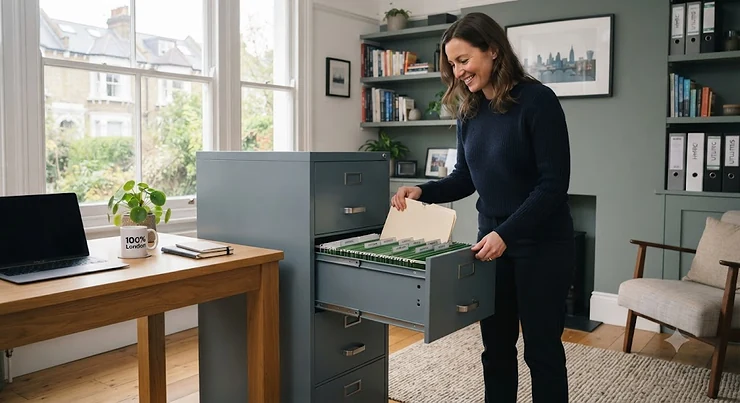
Somewhere between the archive box gathering dust in the loft and the sleek digital filing system your IT department keeps promising to build, there’s an old, unglamorous piece of office furniture that quietly does more work than almost anything else in the room: the foolscap filing cabinet. If you’ve ever tried to squeeze a hanging suspension file into a drawer that was, technically, only ever built for A4, you already know why the distinction matters. A foolscap filing cabinet is a steel or wooden storage unit with drawers sized to hold foolscap suspension files — at roughly 240mm wide, noticeably deeper front-to-back than an A4 equivalent — a legacy of the old British Imperial foolscap paper size that predates the switch to A4 in the 1970s.
This guide exists because most buying advice on this topic is either a straight product listing with no real opinion attached, or a vague “just get whatever’s cheapest” shrug. Neither is much use when you’re staring at a warehouse full of nearly identical grey boxes. What follows is a proper comparison: seven real, currently available cabinets spanning budget, mid-range and premium, backed by genuine specs, aggregated review sentiment (never invented quotes), and honest analysis of who each one actually suits. We’ll also cover the perennial confusion between foolscap and A4, where “legal size” fits into the picture for UK buyers, why older filing systems still matter, and what a genuinely deep drawer buys you that a shallow one can’t.
Quick Comparison Table
| Cabinet | Drawers | Best For | Price Range |
|---|---|---|---|
| Bisley BS 2-Drawer | 2 | Long-term premium buyers | £220–£320 |
| Triumph Trilogy 3-Drawer | 3 | Deepest suspension capacity | £190–£260 |
| Bisley AOC 4-Drawer | 4 | Budget-conscious Bisley fans | £170–£230 |
| Silverline Kontrax 4-Drawer | 4 | UK-made colour customisation | £180–£260 |
| Office Hippo Heavy Duty 4-Drawer | 4 | Home offices wanting a wood-effect look | £150–£220 |
| Office Hippo Essentials 2-Drawer | 2 | Compact under-desk mobile storage | £60–£100 |
| YITAHOME 4-Drawer | 4 | Legal/Letter/A4 budget filing | £70–£110 |
A glance at that table tells its own small story: price and drawer depth don’t move in a straight line together. The Triumph Trilogy 3-Drawer actually undercuts the Bisley BS 2-Drawer while offering an extra drawer, largely because Bisley’s fully-welded UK manufacturing carries a brand premium that buyers are, based on aggregated review sentiment, generally happy to pay for longevity. Meanwhile the YITAHOME 4-Drawer sits at a price point close to the Office Hippo Essentials 2-Drawer, but the two solve genuinely different problems — one is a proper four-drawer archive, the other a compact mobile pedestal for under a desk. Worth noting before you go further: none of these prices are fixed, and Amazon’s pricing shifts constantly, so treat every figure here as a starting point for research rather than gospel.
💬 Just one click — help others make better buying decisions too!😊
Top 7 Foolscap Filing Cabinets: Expert Analysis
Choosing between seven cabinets that all claim to be “heavy duty” and “lockable” is genuinely harder than it sounds, so here’s the honest breakdown of what each one actually offers, who it suits, and where the marketing copy glosses over something worth knowing.
1. Bisley BS 2-Drawer Foolscap Filing Cabinet — the benchmark built to outlast the office
If there’s a default answer to “what filing cabinet should I buy,” this is usually it. Bisley’s BS range is fully welded rather than bolted together, which sounds like a minor manufacturing detail until you realise it’s the difference between a cabinet that racks and wobbles after five years of hard use and one that doesn’t. The drawers measure 258 x 385 x 555mm internally, extend to 100% on easy-glide runners, and each one is rated to hold up to 40kg — more than enough for a fully packed run of foolscap suspension files. Central locking secures both drawers with a single turn of a mastered key, and an anti-tilt mechanism only allows one drawer open at a time, which matters more than people assume (more on that in the safety section below).
Based on the spec comparison with cheaper alternatives, what you’re really paying for here is certification and longevity: this model meets BS EN14073 Parts 2 and 3 plus BS EN14074, is manufactured in the UK, and carries a 10-year guarantee. Reviewers consistently report that the drawers glide smoothly even years into ownership and that the locking mechanism stays reliable, which lines up with what you’d expect from a fully-welded steel carcass. It’s the cabinet you buy when you want to stop thinking about filing cabinets, permanently.
Pros:
- ✅ Fully welded steel carcass, not bolted panels
- ✅ 40kg per-drawer capacity with 100% extension
- ✅ 10-year guarantee and UK manufacturing
Cons:
- ❌ Premium price versus imported alternatives
- ❌ Only 2 drawers limits capacity for larger archives
At around £220–£320 depending on colour and retailer, the Bisley BS 2-Drawer Foolscap Filing Cabinet isn’t the cheapest way to store two drawers’ worth of files, but for a home office or small practice that only needs modest capacity and wants to buy once, the value case is straightforward.

2. Triumph Trilogy 3-Drawer Filing Cabinet — deepest suspension capacity in this line-up
The Triumph Trilogy range is less of a household name than Bisley, but the engineering pedigree is genuinely comparable: a fully welded steel carcase sits on a cruciform base for extra stability, each drawer carries a 45kg weight rating (slightly ahead of the Bisley BS), and the whole unit is certified to the same BS EN14073 Parts 2 and 3 and BS EN14074 standards. What most buyers overlook about this model is the guarantee length — at 15 years, it’s the longest in this comparison, which suggests Triumph is confident enough in the welds to back them for a decade and a half.
Practically, three drawers at foolscap depth gives you meaningfully more linear filing space than a two-drawer unit without stepping up to the bulkier four-drawer height of 1321mm — this one stands at 1019mm, so it still fits comfortably under most sloped ceilings or beside a standard desk. The anti-tilt interlock and swan-neck handles with card-holder label slots are standard across the range. Aggregated feedback on comparable Triumph filing cabinets points to solid build quality for the price, with the usual minor grumble about delivery lead times on made-to-order colours rather than the product itself.
Pros:
- ✅ 45kg drawer capacity, highest in this comparison
- ✅ 15-year guarantee, the longest here
- ✅ Cruciform base adds stability over standard designs
Cons:
- ❌ Less widely stocked than Bisley or Silverline
- ❌ Made-to-order colours can extend delivery times
Priced typically in the £190–£260 range, the Triumph Trilogy 3-Drawer Filing Cabinet is arguably the strongest value pick for anyone who wants Bisley-grade certification without quite paying Bisley-grade prices.
3. Bisley AOC 4-Drawer Foolscap Filing Cabinet — same DNA, sharper price
Also sold under the SIRIUS and JEMINI names, the Bisley AOC range is Bisley’s answer to buyers who want the brand recognition without the full BS-line price tag. It’s a genuine four-drawer foolscap cabinet at 470 x 622 x 1321mm, with 100% drawer extension, anti-tilt protection, and central locking with two keys supplied — the fundamentals are all present. Here’s what to weigh: this isn’t the fully-welded, decade-guaranteed construction of the BS range, so treat it as the practical mid-tier choice rather than the heirloom piece.
For an office needing genuine four-drawer capacity on a tighter budget, that trade-off often makes complete sense. Reviewers consistently note that it does the job reliably for standard office use, with the caveat — common to most steel cabinets at this price point — that the finish shows scuffs more readily than the premium range if it’s moved often. If your filing cabinet is staying in one spot for years rather than being wheeled between departments, that’s a non-issue.
Pros:
- ✅ Genuine 4-drawer foolscap capacity
- ✅ Anti-tilt and central locking as standard
- ✅ Bisley brand reliability at a lower price point
Cons:
- ❌ Not fully welded like the premium BS range
- ❌ Finish can mark more easily if relocated often
Expect to pay in the £170–£230 range, which puts the Bisley AOC 4-Drawer Foolscap Filing Cabinet firmly in “sensible office purchase” territory rather than “statement furniture.”
4. Silverline Kontrax 4-Drawer Filing Cabinet — the UK-made alternative with genuine colour choice
Silverline has been manufacturing steel storage furniture in the UK for well over three decades, and the Kontrax range is its bread-and-butter foolscap filing cabinet: 458 x 622 x 1320mm, anti-tilt safety mechanism, fully lockable with two keys, and a five-year Silverline guarantee. What separates it from the Bisley options isn’t really the engineering — it’s the palette. Silverline’s colour range runs from traditional light grey and black through to sunshine yellow and British racing green, which matters more than it sounds like it should if the cabinet is going somewhere visible rather than a back office.
The spec sheet won’t tell you this, but colour customisation on steel filing cabinets is genuinely rare below the premium tier — most budget ranges offer grey, black, or “your choice, as long as it’s grey.” For a school, studio, or home office where the cabinet needs to blend with (or deliberately clash with) existing decor, that flexibility has real value that a pure spec comparison undersells.
Pros:
- ✅ Wide colour range beyond standard grey or black
- ✅ UK-manufactured with 35+ years of production history
- ✅ 5-year guarantee with anti-tilt safety as standard
Cons:
- ❌ Guarantee shorter than Bisley BS or Triumph Trilogy
- ❌ Kerbside-only delivery on some retailer listings
Sitting around £180–£260, the Silverline Kontrax 4-Drawer Filing Cabinet earns its place here as the pick for anyone who wants UK manufacturing quality but isn’t willing to compromise on how the thing actually looks in the room.
5. Office Hippo Heavy Duty 4-Drawer Filing Cabinet — wood-effect styling for home offices
Office Hippo has built a following among home-office buyers specifically because its Heavy Duty range doesn’t look like it escaped from a 1990s civil service building. The steel construction is fully welded with a 40kg drawer tolerance and anti-tilt mechanism, but the drawer fronts carry a wood-effect, heat- and stain-resistant finish available in oak or white — a deliberate departure from the industrial-grey aesthetic that dominates this category. It accepts both A4 and foolscap hanging files, which matters for buyers who aren’t entirely sure which size they’ll end up needing.
Based on the spec comparison, this isn’t trying to compete with Bisley on pure industrial durability — the guarantee sits at 5 to 7 years depending on the specific range, shorter than the premium steel options. What it’s actually selling is the fact that it looks less like office furniture and more like, well, furniture. Reviewers consistently mention that it arrives largely pre-built, needing only handles and feet attached, and that the anti-tilt mechanism and 100% drawer extension work as described. One recurring theme in aggregated feedback is appreciation for how the wood-effect finish coordinates with existing home furniture, rather than sticking out as an obvious “office” item.
Pros:
- ✅ Wood-effect finish suits home office settings
- ✅ Accepts both A4 and foolscap hanging files
- ✅ Arrives largely pre-assembled
Cons:
- ❌ Shorter guarantee than premium steel-only ranges
- ❌ Wood-effect drawer inners less rugged than solid steel
At roughly £150–£220, the Office Hippo Heavy Duty 4-Drawer Filing Cabinet makes the most sense for a home office or client-facing space where appearance genuinely factors into the decision.

6. Office Hippo Essentials 2-Drawer Mobile Pedestal — compact, mobile, and worth double-checking first
This is the cabinet for anyone whose filing needs are modest and whose floor space is tight. The Essentials pedestal measures a compact 40.4 x 50 x 59.5cm, rolls on castors, locks, and pairs a general-storage top drawer with a bottom drawer designed for A4 and foolscap hanging files. It’s the kind of unit that tucks neatly under most standard desks, which is exactly the appeal — you get lockable filing without dedicating a corner of the room to it.
Here’s where honesty matters more than salesmanship: aggregated review sentiment on this specific range includes a genuine, repeated caveat worth flagging before you buy — some buyers report that the internal rail spacing on certain Essentials units runs narrower than expected, meaning standard A4/foolscap suspension file holders don’t always fit as smoothly as the listing implies. That’s not a dealbreaker for everyone, but if you’re planning to load it with full-depth foolscap suspension files rather than loose paperwork, it’s worth checking current buyer photos and Q&A on the specific listing before ordering, rather than assuming compatibility. Functionality feedback is otherwise mixed-to-positive, with most reviewers reporting the locks and drawers working exactly as expected.
Pros:
- ✅ Compact footprint fits under most standard desks
- ✅ Mobile castors for flexible office layouts
- ✅ Genuinely budget-friendly entry point
Cons:
- ❌ Some units report narrower rail spacing than expected
- ❌ Limited capacity compared to full-height cabinets
Priced around £60–£100, the Office Hippo Essentials 2-Drawer Mobile Pedestal is best suited to buyers with light filing needs who value mobility and space-saving over sheer capacity — just verify rail width against your specific suspension files first.
7. YITAHOME 4-Drawer Filing Cabinet — a budget import for Legal, Letter and A4, not true foolscap
This one deserves the most honest framing of the seven, because it’s marketed for Letter, Legal, and A4 sizing rather than explicitly for foolscap — and that distinction is exactly the kind of thing a rewritten Amazon listing wouldn’t bother explaining. At 45.8 x 45 x 133cm, with anti-tipping design, a lockable steel body, and a handy cue-card slot for labelling, it’s a genuinely well-specified four-drawer cabinet for the price. What it isn’t is a guaranteed fit for British foolscap suspension files, which run to roughly 343mm deep — noticeably longer than US Legal at 356mm in one dimension but narrower in width, and the drawer geometry on imported “Letter/Legal/A4” ranges doesn’t always translate cleanly to the UK foolscap standard.
Reviewers consistently praise the anti-tipping caster design and lockable security on comparable YITAHOME ranges, and the price point is genuinely competitive against UK-branded alternatives. The honest take: if you searched for “foolscap filing cabinet” but actually meant “something that holds A4 or Letter-size hanging files affordably,” this is a strong contender. If you specifically need true 216 x 343mm foolscap suspension files to hang without adaptation, measure the drawer’s internal rail span against your actual files before committing.
Pros:
- ✅ Competitive price for a genuine 4-drawer unit
- ✅ Anti-tipping caster design for mobile use
- ✅ Lockable steel construction with cue-card labelling
Cons:
- ❌ Marketed for Letter/Legal/A4, not explicit true foolscap
- ❌ Drawer geometry may need checking against UK suspension files
At around £70–£110, the YITAHOME 4-Drawer Filing Cabinet is best for budget buyers whose filing needs sit closer to A4 or Legal than strict British foolscap — a useful reminder that the keyword you search isn’t always the exact spec you need.
Foolscap vs A4 Filing Cabinet: What’s Actually Different
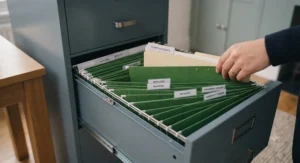
This is the single most common point of confusion in this entire category, so it’s worth settling properly. Foolscap paper measures roughly 216 x 343mm, while A4 measures 210 x 297mm — foolscap is both slightly wider and considerably taller. A foolscap suspension file, correspondingly, needs a drawer with more front-to-back depth than an A4-only cabinet provides. Try to hang a genuine foolscap file in an A4-only drawer and the file simply won’t sit flush; the rails are spaced for the shorter file and the paper inside will crumple or protrude.
Here’s what most buying guides skip: several manufacturers, including Bisley and Office Hippo in this comparison, now sell cabinets explicitly rated for both A4 and foolscap, often via an adjustable rail or a drawer depth generous enough to accommodate either. That’s genuinely useful if your office holds a mixed archive — older foolscap-era files alongside newer A4 paperwork, which is extremely common in UK organisations that have been operating since before the 1970s metrication switch. If you’re starting a filing system from scratch today with entirely new paperwork, A4-only cabinets are cheaper, more widely available, and arguably the more sensible long-term default, since virtually nothing produced in the UK is foolscap-sized anymore. Foolscap cabinets earn their keep specifically when legacy files, older binders, or inherited archives are already in that format and re-filing everything into A4 folders isn’t practical.
Legal Size Filing: Where UK Foolscap Overlaps (and Doesn’t) With US Legal
Anyone researching this topic alongside American sources will run into “legal size” constantly, and it’s worth being precise about the overlap. US Legal paper measures 216 x 356mm — almost identical in width to foolscap but around 13mm taller. In practice, a drawer genuinely built for foolscap will often accommodate Legal-size hanging files reasonably well, and vice versa, which is exactly why cabinets like the YITAHOME 4-Drawer market themselves against “Letter/Legal/A4” without a specific foolscap callout. The tolerances are close enough that many users report no real-world problem, but they’re not identical, and a cabinet engineered tightly around one size can occasionally leave the other feeling slightly loose or slightly cramped.
For UK buyers, this mostly matters if you’re importing paperwork from a US-linked business, handling legal or immigration documents produced to the American Legal standard, or buying office furniture from importers who use American sizing conventions in their listings. If your filing is entirely UK-generated and foolscap-labelled, stick to cabinets explicitly rated for foolscap — like the Bisley BS 2-Drawer or Triumph Trilogy 3-Drawer — rather than relying on the assumption that “close enough” sizing from a Legal-rated import will behave identically.

How to Choose a Foolscap Filing Cabinet
Cutting through seven product listings’ worth of marketing language, here’s the practical decision process, based on the analysis above.
- Confirm you actually need foolscap, not A4. Measure an existing file or check your archive’s paper size before assuming — most new UK filing is A4.
- Count your current volume, then add 30%. Filing cabinets get filled faster than anyone expects; buying a two-drawer unit for a three-drawer’s worth of paperwork just delays the next purchase.
- Check the drawer weight rating against realistic loads. A fully packed foolscap drawer of dense paperwork can approach 30–40kg, so anything rated below that risks premature rail wear.
- Prioritise anti-tilt mechanisms for taller units. Four-drawer cabinets are inherently more top-heavy; an interlock that prevents multiple drawers opening at once is a genuine safety feature, not marketing filler.
- Match the guarantee length to how long you’ll actually keep it. A 5-year guarantee on a cabinet you’ll own for 15 years is a mismatch worth noticing before you buy.
- Decide whether mobility matters. Fixed, full-height cabinets like the Bisley BS or Silverline Kontrax suit permanent placements; mobile pedestals like the Office Hippo Essentials suit flexible or shared spaces.
- Factor in delivery and assembly reality. Steel filing cabinets are heavy — often 20–40kg even empty — so check whether a listing promises kerbside delivery only, which can mean manoeuvring a substantial box yourself.
Common Mistakes When Buying a Foolscap Filing Cabinet
The same handful of errors crop up repeatedly across office-furniture forums and review sections, and most of them are entirely avoidable with five minutes of extra research.
Buying purely on price without checking drawer depth is the most common one — a suspiciously cheap “foolscap” cabinet sometimes turns out to be an A4 unit with foolscap mentioned loosely in the marketing copy, exactly the ambiguity we flagged with the YITAHOME 4-Drawer above. Second, underestimating weight is a recurring theme: buyers order online, assume a filing cabinet is manageable furniture, and are caught out when a 40kg steel unit arrives requiring two people to move it safely — worth reading the HSE’s guidance on manual handling before attempting to shift one alone. Third, ignoring the anti-tilt mechanism spec entirely; it sounds like a minor feature until a fully extended top drawer on an unloaded lower section causes exactly the toppling incident it’s designed to prevent. Fourth, choosing a locking mechanism without checking whether replacement keys are available from the manufacturer — losing both supplied keys on a cabinet holding sensitive documents is a genuinely common and entirely preventable headache. Finally, assuming all “5-year guarantees” cover the same things; some cover structural welds only, others cover the lock mechanism and runners too, so it’s worth reading the actual guarantee terms rather than the headline number.
Deep Drawer Cabinets: Why Drawer Depth Matters More Than You Think
Drawer depth is the quiet variable that separates a genuinely useful filing cabinet from a frustrating one, and it’s precisely the spec that a rewritten product listing tends to skip past. On the Bisley BS 2-Drawer, internal drawer dimensions run to 258 x 385 x 555mm — that middle figure, front-to-back depth, is what determines whether a full-length foolscap suspension file sits properly supported on its rails or dangles with the bottom edge unsupported. A shallow drawer forces files to sit at an angle, which accelerates wear on the suspension hooks and makes retrieval slower because files snag against each other.
What most buyers overlook is that deep-drawer cabinets aren’t simply “bigger” — they’re engineered around the additional torque a fully extended, fully loaded deep drawer places on its runners. That’s precisely why the Triumph Trilogy’s cruciform base and 45kg-rated drawers matter more here than they would on a shallower A4-only unit: more depth means more leverage when the drawer is pulled fully open, and cheaper runners simply weren’t tested for that stress. If your filing genuinely needs the extra depth foolscap provides — bulky legal bundles, older bound documents, oversized certificates — paying for a cabinet purpose-built around that depth, rather than a shallow unit with foolscap mentioned as an afterthought, is where the money is actually well spent.
Older Filing Systems: What Foolscap Tells Us About Legacy Office Archives
Foolscap filing cabinets occupy a strange position in 2026: the paper size itself is now rarely produced outside specialist manufacturers, yet the cabinets built around it remain in steady demand. The explanation is almost entirely about inherited archives. Solicitors’ practices, older charities, family businesses, and public bodies that predate the 1970s A4 transition frequently still hold decades of foolscap-format paperwork — wills, historic contracts, land records — that nobody has the time, budget, or legal justification to digitise and re-file into A4 folders. For those organisations, buying a genuine foolscap cabinet isn’t nostalgia; it’s the only practical way to keep an existing archive intact and accessible without a disruptive, costly migration project.
If you’re managing that kind of legacy archive, it’s worth pairing your cabinet purchase with a proper look at retention obligations rather than simply storing everything indefinitely — GOV.UK’s guidance on records management and retention sets out the kind of structured approach that applies well beyond government departments, and it’s a useful framework for deciding what genuinely needs a physical drawer versus what could be securely destroyed or digitised instead. A filing cabinet, however well built, is not a substitute for a retention policy — it’s just where compliant records happen to live while they’re still needed.
Practical Usage Guide: Setting Up and Maintaining Your Filing Cabinet
Getting a new foolscap filing cabinet from delivery box to genuinely useful office furniture takes more thought than most people give it, and a handful of first-30-days mistakes cause most of the long-term problems reviewers complain about.
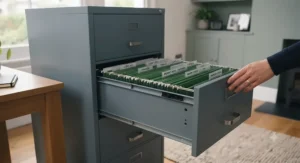
On arrival, position the cabinet on a level, solid floor before loading anything — every anti-tilt mechanism in this comparison assumes the unit is standing flat, and a slight lean undermines the safety feature entirely. Load from the bottom drawer upwards, keeping heavier or denser files lower in the unit; this isn’t just a stability tip, it’s what keeps the anti-tilt interlock working as intended rather than fighting against an unevenly loaded top-heavy cabinet. When labelling, use the integrated label holders most of these models include rather than sticky notes on the drawer front — it looks tidier and survives contact far better. For maintenance, a lightly damp cloth with mild detergent is sufficient for steel finishes; avoid abrasive cleaners, which dull the powder-coated surface over time. Runners on steel cabinets occasionally benefit from a light silicone-based lubricant once a year if drawers start sticking, though most of the models here are specified to run smoothly without it for years. Finally, check lock mechanisms periodically — a lock that’s stiff to turn is usually an early warning sign worth addressing before it fails entirely, rather than after.
Real-World Scenarios: Which Cabinet Suits Which Buyer
The sole trader digitising as they go. Someone running a small consultancy from a spare room, generating modest new paperwork but wanting it secure, is well served by the Office Hippo Essentials 2-Drawer Mobile Pedestal — compact, lockable, and mobile enough to tuck away when clients visit. Just check the rail-width caveat against actual files first.
The solicitor’s practice with decades of archived files. A firm holding 20+ years of foolscap-format client records, where retrieval speed and long-term structural reliability both matter, is the textbook case for the Bisley BS 2-Drawer or, for higher volume, the Bisley AOC 4-Drawer — brand reliability and BS EN certification carry genuine weight when files can’t simply be replaced if a drawer fails.
The growing charity or community organisation on a tight budget. An organisation needing serious four-drawer capacity without a serious four-drawer budget is well matched to the Silverline Kontrax 4-Drawer or the YITAHOME 4-Drawer, depending on whether the archive is genuinely foolscap or closer to A4/Legal — worth measuring existing files before choosing between them.
Long-Term Cost & Maintenance
Sticker price is only part of the total cost of ownership story here, and it’s worth running the numbers properly rather than defaulting to the cheapest option on the page. A Bisley BS 2-Drawer at the top of its £220–£320 range, backed by a 10-year guarantee, works out to roughly £22–£32 per year of covered ownership. The Office Hippo Essentials 2-Drawer Mobile Pedestal, at £60–£100 with a 5-year guarantee, comes to £12–£20 per year — genuinely cheaper per year, but over a shorter horizon and with less certainty about what happens once that guarantee lapses on a lower-cost steel construction.
| Cabinet | Guarantee | Approx. Cost Per Guaranteed Year |
|---|---|---|
| Bisley BS 2-Drawer | 10 years | £22–£32 |
| Triumph Trilogy 3-Drawer | 15 years | £13–£17 |
| Silverline Kontrax 4-Drawer | 5 years | £36–£52 |
| Office Hippo Essentials 2-Drawer | 5 years | £12–£20 |
Looking at the table above, the Triumph Trilogy 3-Drawer comes out as the strongest pound-for-guaranteed-year value in this whole comparison, largely on the strength of its unusually long 15-year guarantee relative to its mid-range price. That said, cost-per-year only tells part of the story — a cabinet that fails structurally two years after its guarantee expires is a worse outcome than one that simply needs replacing on schedule, so factor in real-world durability signals like fully-welded construction, not just the guarantee number in isolation. Beyond the initial guarantee period, maintenance costs on steel filing cabinets are genuinely minimal — occasional lubrication and the odd replacement key are typically the only ongoing expenses across a cabinet’s working life.
Safety, Standards & Compliance Guide
Filing cabinets are heavier and more hazardous than their unassuming appearance suggests, and UK office furniture in this category is governed by specific standards worth understanding before you buy. The relevant benchmark is BS EN 14073, the British Standards Institution’s specification covering safety requirements and structural test methods for office storage furniture — several cabinets in this comparison, including the Bisley BS 2-Drawer and Triumph Trilogy 3-Drawer, are explicitly certified against it. In practice this standard tests exactly the failure modes that matter most: whether a fully loaded, fully extended drawer causes the whole unit to overbalance, and whether the structure holds up under repeated use rather than just a single test cycle.
The anti-tilt mechanisms present across nearly every cabinet in this line-up exist specifically because multi-drawer filing cabinets are a genuine tip-over risk when several drawers are opened simultaneously, particularly if the lower drawers are empty while an upper one is fully loaded and extended. Beyond the cabinet’s own engineering, good practice matters too: load heavier files toward the bottom, never leave more than one drawer open unattended, and if you’re handling a fully loaded cabinet during a house or office move, the HSE’s manual handling guidance is worth a read — a packed four-drawer steel cabinet can weigh well over 100kg once filled, comfortably enough to justify professional movers or at minimum a second pair of hands rather than attempting it solo.
Features That Actually Matter (And Those That Don’t)
Cutting through the marketing language on most listings, a handful of features are worth genuinely prioritising, and a similar number are largely cosmetic. Anti-tilt mechanisms matter — genuinely, structurally, for safety. Fully welded (versus bolted) carcass construction matters, because it’s the difference between a cabinet that stays square for a decade and one that gradually racks out of alignment. Weight rating per drawer matters if you’re filing dense paperwork rather than loosely packed correspondence. Guarantee length matters, but only in proportion to how long you’ll actually own the thing.
What matters considerably less than the listings suggest: the exact number of decorative colour options (nice to have, rarely decisive), branded “designer” handle shapes, and claims of “heavy duty” that aren’t backed by an actual kg rating — a term used loosely across nearly every budget listing in this comparison, worth treating as marketing language until backed by a specific figure. Similarly, “5-star reviews” as a standalone metric deserves scepticism; a cabinet with 40 reviews at 4.8 stars and one with 900 reviews at 4.1 stars can both be perfectly good products, and review volume combined with the specific themes reviewers raise tells you far more than the star average alone.
Benefits vs Traditional Alternatives
| Storage Method | Security | Space Efficiency | Best For |
|---|---|---|---|
| Foolscap filing cabinet | Lockable, controlled access | High — vertical, dense | Legacy or bulky physical archives |
| Archive boxes / shelving | Minimal, easily accessed | Low — bulky, unstackable neatly | Rarely accessed, low-security files |
| Digital scanning only | Encrypted, access-logged | Very high — zero physical footprint | New paperwork, searchable records |
A proper filing cabinet still beats open shelving or loose archive boxes on nearly every axis that matters for active, sensitive paperwork — locked drawers control who can physically access a file in a way that a shelf simply can’t. Digital-only storage wins decisively on space and searchability, but it’s not always a realistic option for genuinely legacy foolscap-format paper archives that would require significant time and cost to scan, especially where original physical documents carry legal weight that a digital copy doesn’t fully replace. For most UK offices holding a mix of old and new paperwork, the honest answer is a hybrid: digitise what’s practical going forward, and keep a properly specified foolscap cabinet for what genuinely needs to stay physical.
Buyer’s Decision Framework
If you’re still weighing options after all of the above, this simplified framework should settle it quickly. If your archive is genuinely foolscap-format and you want it to last 10+ years without a second thought, choose the Bisley BS 2-Drawer or Triumph Trilogy 3-Drawer. If you need serious four-drawer capacity on a tighter mid-range budget, choose the Bisley AOC 4-Drawer or Silverline Kontrax 4-Drawer depending on whether colour choice matters to you. If your setting is a home office and appearance genuinely factors in, choose the Office Hippo Heavy Duty 4-Drawer. If your filing is light and space is tight, choose the Office Hippo Essentials 2-Drawer — after checking rail width. And if you searched “foolscap” but your actual paperwork is closer to A4 or Legal size, the YITAHOME 4-Drawer will likely serve you better and cost less than forcing a true foolscap unit to do a job it wasn’t specifically built for.
✨ See Today’s Prices on These Top-Rated Filing Cabinets
🔍Take your office storage from chaotic to genuinely under control. Click through on any of the models above to check current availability, colour options and pricing before they change — a properly specified cabinet is one purchase you’ll only need to make once.
FAQ
❓ What is the difference between foolscap and A4 filing cabinets?
❓ Can a foolscap filing cabinet hold A4 files?
❓ How much weight can a foolscap filing cabinet drawer hold?
❓ Are foolscap filing cabinets still made in the UK?
❓ What size are foolscap suspension files compared to legal size?
Conclusion
Seven cabinets, three price tiers, and one recurring theme: the right foolscap filing cabinet depends far less on brand prestige than on matching genuine drawer depth, weight rating, and certification to what you’re actually storing. If you’re safeguarding decades of legacy paperwork that can’t easily be digitised, the Bisley BS 2-Drawer and Triumph Trilogy 3-Drawer earn their premium through fully-welded construction and certification that budget imports simply don’t match. If your needs are more modest, more mobile, or closer to A4 and Legal sizing than true British foolscap, the Office Hippo and YITAHOME options in this comparison do the job for considerably less outlay — provided you check the specific caveats flagged above before ordering.
What ties all seven together is that none of them are the flashy purchase anyone gets excited about, and that’s rather the point. A filing cabinet that’s correctly specified for its job disappears into the background of office life, quietly doing exactly what it’s meant to for a decade or more, which is a genuinely underrated quality in office furniture. Measure your files, check the rail widths against the caveats above, and buy once.
✨ Don’t Miss These Exclusive Deals!
🔍 Give your office the storage upgrade it’s been waiting for. Click through on any of the seven cabinets above to check current pricing and availability — get your filing sorted properly, and stop thinking about it for the next decade.
Recommended for You
- A4 Filing Cabinet UK: 7 Best Picks Compared for 2026
- Metal Filing Cabinet: 7 Best Steel Picks for 2026 Offices
- Wooden Filing Cabinet: 7 Beautiful Picks for Your 2026 Home Office
Disclaimer: This article contains affiliate links. As an Amazon Associate, I earn from qualifying purchases. If you purchase products through these links, we may earn a small commission at no additional cost to you.
✨ Found this helpful? Share it with your friends! 💬🤗
