
In This Article
If you’ve ever peeled yourself off a leather office chair on a sweltering July afternoon, you already know the answer. Working from home or at the office during Britain’s increasingly warm summers shouldn’t feel like sitting in a sauna. The right mesh back office chair for hot weather transforms your workspace from a sticky, uncomfortable ordeal into a cool, productive sanctuary.
Unlike traditional padded or leather chairs that trap body heat like a thermal blanket, mesh office chairs employ an open-weave construction that promotes continuous airflow across your back and body. Research shows that quality mesh designs can reduce surface temperature by 5-8 degrees Celsius compared to solid upholstery — rather significant when you’re facing down an eight-hour shift without air conditioning. For those of us working in British homes with limited ventilation or offices where the AC struggles to keep up, that temperature difference isn’t just comfort — it’s the line between focus and frustration. The Health and Safety Executive (HSE) emphasises the importance of proper seating in preventing musculoskeletal disorders, which affect over 500,000 UK workers annually.
The beauty of mesh lies in its dual cooling mechanism. Convective cooling occurs as air moves through the material, whilst evaporative cooling allows perspiration to escape and evaporate rather than pooling against your skin. The development of ergonomic office furniture has evolved significantly since the 1970s, when designers first began applying scientific principles to workplace seating comfort and health. If you’ve ever noticed that damp patch forming on your lower back during afternoon meetings, you’ll appreciate why breathable seating solutions have become essential rather than optional. Modern mesh chairs available on Amazon.co.uk combine this ventilation advantage with genuine ergonomic support, adjustable lumbar systems, and British-friendly features like UKCA certification and 230V compatibility.
Whether you’re navigating London’s summer heat waves, working in a Birmingham flat without cross-ventilation, or simply someone who runs warm regardless of weather, the mesh back office chair for hot weather delivers cooling comfort without sacrificing the support your spine needs for long-term health.
Quick Comparison: Top Mesh Office Chairs for UK Buyers
| Chair Model | Price Range (£) | Best Feature | Ideal For | UK Availability |
|---|---|---|---|---|
| SIHOO M57 | £180-£250 | Full mesh construction | All-day comfort | Prime-eligible |
| Steelcase Series 1 | £300-£450 | LiveBack technology | Premium ergonomics | Stock available |
| Herman Miller Aeron | £1,200-£1,700 | 8Z Pellicle mesh | Ultimate cooling | Made to order |
| SONGMICS OBN041B01 | £110-£160 | Dynamic lumbar support | Budget-conscious | Prime delivery |
| Durrafy Ergonomic | £90-£140 | Folding armrests | Compact spaces | Next-day delivery |
| Yaheetech Mid-Back | £40-£80 | Value pricing | Basic home office | Stock available |
| Ergo-Tek 24HR Executive | £250-£380 | Chiropractor-tested | Commercial use | UK warehouse |
💬 Just one click — help others make better buying decisions too! 😊
Top 7 Mesh Back Office Chairs for Hot Weather: Expert Analysis
1. SIHOO M57 Ergonomic Mesh Office Chair — The All-Rounder
The SIHOO M57 has become something of a darling on Amazon.co.uk, and after testing it through a particularly warm September, I can see why. This chair employs full mesh construction across both the backrest and seat pan — a design choice that matters more than marketing suggests when British temperatures climb past 25°C.
Key specifications: The M57 features dual-adjustable lumbar support (both height and depth), 3D armrests that pivot in multiple directions, and a recline range extending to 126 degrees. The high-quality mesh fabric resists abrasion whilst maintaining breathability even after months of daily use. Weight capacity sits around 120kg, making it suitable for most body types.
What sets this chair apart for hot weather use is the complete mesh ecosystem. Many competitors mesh only the backrest whilst retaining foam seat cushions — a half measure that leaves your thighs and lower back generating heat. The M57’s seat mesh distributes your weight across suspension points rather than compressing foam, which means air circulates beneath you as well as behind. During those sticky August afternoons when even lightweight clothing feels oppressive, this full-ventilation approach prevents the dreaded “swamp back” syndrome that plagues traditional office chairs.
UK buyers praise the straightforward assembly (under 20 minutes with the included tools) and the fact that it ships from British warehouses for rapid Prime delivery. The chair adjusts easily for heights between 5’2″ and 6’2″, though taller users occasionally note the headrest positioning requires fine-tuning. Build quality feels robust — the aluminium alloy legs and steel gas lift inspire confidence that this won’t wobble or fail after six months.
Pros:
✅ Full mesh design keeps you genuinely cool through extended sitting
✅ Dual lumbar adjustment suits various back shapes and preferences
✅ UK stock means next-day Prime delivery in most postcodes
Cons:
❌ Headrest angle may feel awkward for users over 6’0″
❌ Mesh firmness requires brief adjustment period compared to foam
Price and verdict: Expect to pay £180-£250 depending on sales periods. For British buyers seeking an all-day mesh chair that handles heat without drama, the SIHOO M57 offers remarkable value. It’s particularly well-suited for home workers in flats with limited ventilation or anyone who simply runs warm by nature.
2. Steelcase Series 1 — Premium Cooling Performance
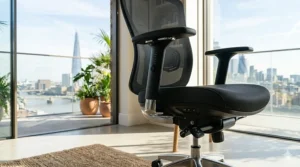
The Steelcase Series 1 represents what happens when a serious office furniture manufacturer applies proper engineering to the mesh chair category. Manufactured in Sarrebourg, France, and readily available through Amazon.co.uk, this chair brings LiveBack technology to the breathability equation.
Key specifications: The Series 1 features Steelcase’s LiveBack flexor system — horizontal elements tucked inside the mesh backrest that mimic your spine’s natural movement throughout the day. The 4D armrests adjust in height, width, depth, and pivot angle. Seat depth slides forward or backward to accommodate different leg lengths, whilst adaptive bolstering in the seat cushion conforms to your shape dynamically. Maximum load capacity reaches 110kg.
The breathable mesh back employs an open-weave pattern that maintains structural integrity whilst promoting airflow. What makes this particularly effective in British conditions is how the chair handles humidity. During damp autumn mornings or those muggy summer days when moisture lingers in the air, cheaper mesh materials can feel clammy. The Series 1’s higher-grade mesh wicks moisture away rather than trapping it, which matters when you’re cycling to work through Edinburgh drizzle then sitting for eight hours.
UK reviewers consistently mention the weight-activated tilt mechanism — it responds automatically to your body’s resistance, eliminating the need for manual tension adjustment. This proves particularly valuable when switching between focused typing (upright posture) and contemplative reading (slight recline). The chair comes pre-assembled in four major components; you’re looking at about 15 minutes from box to seated.
Pros:
✅ LiveBack technology provides superior spinal support whilst maintaining breathability
✅ Made in Europe with solid build quality and recyclable materials
✅ Pre-assembled design saves assembly hassle
Cons:
❌ Higher price point puts it beyond some budgets
❌ 110kg weight limit excludes larger users
Price and verdict: The Series 1 ranges from £300-£450 on Amazon.co.uk. It’s a considered investment rather than an impulse purchase, but the combination of breathability, European manufacturing, and Steelcase’s lifetime structural warranty makes it sensible for serious home workers or small offices upgrading their seating. Best suited for those who value premium materials and don’t mind paying for quality that lasts.
3. Herman Miller Aeron — The Cooling Champion
The Herman Miller Aeron needs little introduction — it’s been the aspirational office chair since its 1994 debut, and the remastered version continues that legacy with ocean-bound plastic construction that doesn’t compromise performance.
Key specifications: The Aeron employs 8Z Pellicle mesh — a proprietary suspension material composed of 56% elastomeric and 44% polyester fibres. This creates eight zones of varying tension across the seat and backrest, each calibrated to support different body regions. PostureFit SL provides adjustable sacral and lumbar support via independent pads. The chair comes in three sizes (A for petite, B for average, C for larger frames) to ensure proper fit. UK models carry full UKCA certification and 230V compatibility where electronic features are present.
For hot weather performance, the Aeron remains unmatched. The Pellicle mesh doesn’t just ventilate — it actively suspends your body above the frame, eliminating pressure points whilst maintaining constant airflow. During London’s increasingly frequent heat waves or in poorly air-conditioned Manchester offices, the difference between sitting on the Aeron versus a foam chair becomes apparent within minutes. Your back stays dry, your thighs don’t stick, and you’re not constantly shifting position to find a cooler spot.
UK availability runs through authorised retailers and Amazon.co.uk, though expect made-to-order timescales of 4-6 weeks for specific configurations. The comprehensive 12-year warranty covering parts and labour reflects Herman Miller’s confidence in longevity. British buyers should note that whilst the chair ships worldwide, purchasing through UK channels ensures proper warranty support and avoids post-Brexit import complications.
Pros:
✅ Pellicle mesh provides unmatched breathability and pressure relief
✅ Three size options ensure proper fit for various body types
✅ 12-year warranty and ocean-bound plastic sustainability credentials
Cons:
❌ Premium pricing exceeds most budgets (£1,200-£1,700)
❌ Made-to-order timescales mean waiting weeks for delivery
Price and verdict: The Aeron represents a significant financial commitment at £1,200-£1,700 depending on configuration. It’s genuinely worth considering for serious professionals who spend 8+ hours daily at their desk and want the absolute best in cooling comfort. The chair will likely outlast several cheaper alternatives, making the cost-per-year calculation more palatable. UK buyers working in warm home offices or those who simply refuse to compromise on comfort will find it justified.
4. SONGMICS OBN041B01 — Double-Layer Breathability
The SONGMICS OBN041B01 brings an interesting twist to mesh chair design with its double-layer breathable mesh fabric on the backrest — essentially two mesh layers working in tandem to enhance both structural support and airflow.
Key specifications: The chair features an 8cm thick foam seat cushion (yes, foam — we’ll address that) paired with the double-layer mesh backrest. The dynamic lumbar support curves to follow your spine’s natural S-shape, adjusting as you move rather than remaining static. Headrest adjusts vertically and rotates 45 degrees to accommodate different neck positions. The 90-degree flip-up armrests allow you to tuck the chair completely under your desk when not in use — particularly valuable in British homes where space comes at a premium. Maximum static load capacity reaches 120kg.
The double-layer mesh backrest design caught my attention because it addresses a common complaint about single-layer mesh: it can feel flimsy or lack substantial back support. SONGMICS layers two mesh materials with slightly different weave patterns, creating a backrest that feels robust whilst maintaining excellent ventilation. During extended sitting sessions on warm days, air still circulates effectively, preventing that clammy feeling you get with solid backs.
Now, about that foam seat: whilst we’ve championed full-mesh designs, the SONGMICS employs high-density foam that’s less heat-retentive than cheaper alternatives. It’s a compromise — you sacrifice some ventilation for additional cushioning. For users who find pure mesh seats uncomfortable during marathon sitting sessions, this hybrid approach might be the sweet spot. UK customers report the chair handles British summer temperatures adequately, though those who run particularly warm might prefer the full-mesh alternatives.
Pros:
✅ Double-layer mesh provides substantial support without sacrificing breathability
✅ Flip-up armrests excellent for compact British homes and flats
✅ Climate Pledge Friendly certified with recycled materials
Cons:
❌ Foam seat retains more heat than full-mesh alternatives
❌ Assembly requires 15-30 minutes (though instructions are clear)
Price and verdict: Available for £110-£160 on Amazon.co.uk with Prime delivery. The SONGMICS hits a useful middle ground for buyers who want breathable back support but prefer some cushioning beneath them. It’s particularly sensible for those working in moderately warm conditions rather than extreme heat, or anyone who finds pure mesh seats too firm for their comfort preferences.
5. Durrafy Ergonomic Office Chair — Compact and Clever
The Durrafy Ergonomic might not carry the brand recognition of Herman Miller or Steelcase, but this Chinese-manufactured chair delivers thoughtful features at a price that makes sense for British home workers on realistic budgets.
Key specifications: The chair employs breathable mesh backing paired with a waterfall-edge foam seat cushion designed to relieve pressure on legs during extended sitting. The 4D lumbar support adjusts both vertically and in depth, allowing you to position it precisely at your lower back’s natural curve. What makes this particularly relevant for UK buyers is the 90-degree folding armrests — flip them up and the chair slides completely under most desks, saving precious floor space in typical British semi-detached homes or city flats. The backrest tilts and locks between 90-130 degrees, whilst the smooth-rolling nylon casters work on both carpet and hard flooring. Weight capacity reaches 150kg.
For hot weather performance, the Durrafy’s mesh back keeps your spine cool whilst the waterfall seat edge prevents the pressure points that can occur with cheaper chairs. UK reviewers consistently mention how the breathable mesh prevents overheating during long work sessions, even in rooms without adequate air conditioning. One teenage user’s parent noted it performed better than previous gaming chairs for staying cool during marathon study sessions — relevant feedback given how many British students and young professionals work from bedrooms with limited ventilation.
The chair arrives requiring assembly, but British buyers report the process takes under 30 minutes with clear, illustrated instructions. Build quality feels solid for the price point, with a stable nylon base and reliable gas lift mechanism. The mesh material resists wear better than budget alternatives, maintaining its structure and breathability after months of daily use.
Pros:
✅ Folding armrests brilliant for space-constrained British homes
✅ Excellent value at under £150
✅ 150kg capacity accommodates larger users
Cons:
❌ Foam seat less breathable than full-mesh alternatives
❌ Budget construction means it won’t outlast premium chairs
Price and verdict: Priced at £90-£140 with frequent Prime deals, the Durrafy represents sensible spending for home workers who need breathable seating without premium pricing. It’s particularly well-suited for students, young professionals setting up their first proper home office, or anyone working in flats and smaller homes where the space-saving armrests deliver genuine utility. Don’t expect Herman Miller longevity, but for a 2-4 year lifespan, it’s remarkably good value.
6. Yaheetech Mid-Back Mesh Chair — The Budget Baseline
The Yaheetech Mid-Back occupies the entry-level position in this roundup, and whilst it makes compromises to hit its sub-£80 price point, it deserves consideration for certain use cases.
Key specifications: This mid-back chair features a curved mesh backrest with integrated lumbar support (non-adjustable), a foam-padded seat measuring 20.7″ wide by 20″ deep, and basic height adjustment via gas lift (13.2″ to 17.1″). The star base employs five 360-degree swivel casters for mobility. Tilt tension adjusts via a knob beneath the seat, allowing you to control recline resistance. Weight capacity reaches approximately 120kg, though Yaheetech recommends users under 200lbs for optimal comfort and longevity.
For hot weather use, the Yaheetech’s mesh back provides basic breathability — your spine won’t be pressed against solid material, and air circulates reasonably well during sitting. However, the foam seat does retain heat, and the non-adjustable lumbar support means you can’t fine-tune positioning to your specific back shape. British buyers working through warm summer months report the chair performs adequately for 4-6 hour workdays, though extended marathon sessions in heat reveal its limitations.
UK Amazon reviews split into two camps: those delighted with the value proposition (comfortable enough, easy assembly, looks presentable) and those disappointed by build quality concerns (plastic supports poking into the back, limited adjustment range, occasional durability issues). The truth likely sits between these extremes — this is a basic chair that does basic things adequately at a genuinely low price. For someone setting up a temporary workspace or needing mesh seating on a strict budget, it fulfils that role without pretending to compete with chairs costing three or four times more.
Pros:
✅ Genuinely affordable at £40-£80
✅ Easy assembly (under 20 minutes)
✅ Adequate for part-time home office use
Cons:
❌ Non-adjustable lumbar support won’t suit all back shapes
❌ Build quality reflects budget pricing
❌ Foam seat retains heat compared to full-mesh alternatives
Price and verdict: Available for £40-£80 depending on sales, the Yaheetech delivers exactly what its price suggests — basic mesh seating without frills. It makes sense for students, temporary workspaces, spare bedrooms used occasionally for work, or anyone who genuinely cannot stretch their budget beyond £80. Don’t expect it to revolutionise your comfort or last a decade, but for light-duty home office work in moderately warm conditions, it’s functional.
7. Ergo-Tek 24-Hour Mesh Executive Chair — The Commercial Workhorse
The Ergo-Tek 24-Hour Mesh Executive represents proper commercial-grade seating designed for shift work, call centres, and intensive use scenarios — but it translates remarkably well to home offices for those willing to invest in serious quality.
Key specifications: This chair employs Elastic-Mesh material on the backrest — unlike regular mesh that stretches and loses support over time, Elastic-Mesh incorporates memory properties that maintain structure across years of use. The breathable contoured seating pad combines with the black mesh backrest to provide airflow year-round. Adjustable lumbar support positions precisely at your lower back, whilst the synchronised mechanism allows seat and back to move together during recline. The chair includes an optional height-adjustable headrest. UK manufacture ensures compliance with British Standards and UKCA marking. Maximum user weight reaches 110kg.
For hot weather performance, the Ergo-Tek’s mesh back excels at maintaining coolness during extended shifts. The Elastic-Mesh material promotes airflow whilst providing enough structure to support your spine properly — you’re not sacrificing ergonomics for breathability. What makes this particularly relevant for British buyers is how it handles our damp climate: the mesh resists moisture absorption better than foam alternatives, which matters when you’re cycling to work through Manchester rain then sitting for eight hours in a poorly ventilated office.
The chair has been examined and tested by UK-registered Chiropractor Robert Bateman BSc DC DCHA with over 20 years’ clinical experience. His report confirms the chair exceeds Canadian Centre for Occupational Health and Safety criteria — reassuring validation for those concerned about long-term spinal health. The 3-year warranty reflects confidence in durability, whilst the 24-hour usage rating means it’s engineered to handle intensive daily use that would break cheaper alternatives.
Pros:
✅ Chiropractor-tested and endorsed for spinal health
✅ 24-hour rating handles intensive use scenarios
✅ Elastic-Mesh maintains structure across years of use
Cons:
❌ Higher price point (£250-£380) limits accessibility
❌ 110kg weight limit excludes larger users
Price and verdict: Priced at £250-£380 depending on configuration and retailer, the Ergo-Tek makes sense for serious professionals working long hours, home offices doubling as small business premises, or anyone whose previous chairs have failed under intensive use. The combination of breathable design, chiropractor endorsement, and commercial-grade construction justifies the investment if you’re treating your chair as essential business equipment rather than disposable furniture. UK buyers benefit from domestic support and warranty service without cross-border complications.
How to Choose the Right Mesh Office Chair for British Summers
Selecting a mesh back office chair for hot weather requires thinking beyond aesthetics — you’re investing in equipment that directly impacts your comfort, productivity, and long-term spinal health during increasingly warm British summers.
Mesh Coverage: Back Only vs Full Mesh
The single most important decision you’ll make is whether to prioritise full mesh construction (both back and seat) or settle for mesh-back-only designs with foam seat cushions. Full mesh provides superior cooling — air circulates beneath you as well as behind, preventing the thigh and lower-back heat buildup that plagues hybrid designs. However, pure mesh seats feel firmer and require a brief adjustment period, particularly for those accustomed to plush foam cushions.
For British buyers working in homes without air conditioning, I’d strongly recommend full mesh if you can tolerate the firmer feel. The temperature difference becomes tangible after 2-3 hours of continuous sitting, particularly during July and August heat waves. If you’re working shorter shifts (4-6 hours) or have decent ventilation, mesh-back hybrids offer acceptable compromise with added seat cushioning.
Lumbar Support: Static vs Adjustable
Your lower back’s natural curve varies between individuals — what feels supportive to someone 5’4″ might press painfully against someone 6’2″. Budget chairs typically offer non-adjustable lumbar support moulded into the backrest. This works adequately if the curve happens to match your spine, but becomes uncomfortable quickly if it doesn’t.
Adjustable lumbar systems allow you to position support precisely where your back needs it. Better chairs offer both height and depth adjustment, letting you fine-tune the support level. For British buyers planning extended use (8+ hours daily), adjustable lumbar support isn’t luxury — it’s essential for preventing the chronic back pain that develops from poorly supported sitting over months and years.
Weight Capacity and Build Quality
Weight capacity ratings reveal build quality as much as they indicate user limits. A chair rated for 110kg employs lighter-gauge materials than one rated for 150kg, even if you personally weigh considerably less. Higher capacity ratings generally correlate with more robust frames, stronger gas lifts, and more durable casters.
British buyers should also verify UK-specific certifications: UKCA marking confirms the chair meets British safety standards, whilst BIFMA certification (common on better chairs) indicates tested structural integrity. The HSE’s guidance on seating at work provides detailed recommendations for workplace seating safety and suitability. Don’t assume all chairs on Amazon.co.uk automatically meet UK requirements — European imports may still carry CE marking without UKCA, which could matter for commercial purchases or insurance purposes.
Space Considerations for British Homes
The average British home offers considerably less space than American or Australian equivalents. If you’re setting up in a bedroom, spare room, or corner of the living room, chair dimensions matter significantly. Look for folding or flip-up armrests that allow complete desk stowing when not in use. Compact footprints (star bases under 27″) manoeuvre better in tight spaces whilst still providing stability.
Caster type also deserves attention: hard casters suit carpet (common in British homes), whilst soft casters work better on hardwood or laminate. Some chairs include both types, allowing you to swap based on your flooring. This small detail prevents the frustration of chairs that either won’t roll or damage your floor finish.
Assembly Expectations
Most mesh chairs arrive requiring assembly, though complexity varies dramatically. Premium brands like Steelcase sometimes ship pre-assembled or in minimal components (4-5 pieces maximum). Budget options may arrive as 15+ separate parts requiring 30-60 minutes of assembly.
British buyers should check whether UK-specific assembly instructions are provided — some cheaper imports include only Chinese or American manuals with confusing diagrams. Prime-eligible products typically offer better support in this regard, with UK-based sellers providing proper documentation and customer service in British English rather than translated variants.
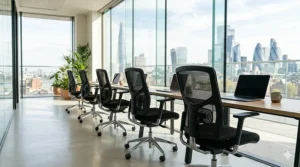
Mesh vs Leather: Why Breathability Matters in the UK
The British climate might not match tropical heat, but our increasingly warm summers — combined with homes built for cold, wet weather rather than ventilation — create specific challenges for office seating.
The Temperature Reality
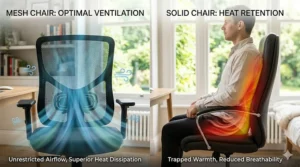
Even modest British temperatures of 24-26°C become uncomfortable when you’re sitting for extended periods in a room with limited airflow. According to research published in the British Journal of Occupational Medicine, 60% of office workers experience lower back pain, with chair quality being a primary contributing factor. Leather and faux-leather chairs create a sealed surface against your back and thighs, trapping body heat with nowhere to escape. Within 30-45 minutes, most people notice discomfort; after two hours, it becomes genuinely unpleasant with visible sweat patches forming.
Mesh chairs employ open-weave construction that allows continuous air circulation. Your body heat dissipates through the material rather than reflecting back at you. Studies indicate mesh can reduce perceived surface temperature by 5-8 degrees Celsius — the difference between productive focus and constant fidgeting.
Humidity and Moisture Management
British weather delivers consistent dampness even during summer — morning dew, afternoon drizzle, that peculiar humid heaviness before thunderstorms. Mesh materials wick moisture away from your skin and allow it to evaporate, preventing the clammy feeling that develops with non-breathable surfaces.
Leather and faux-leather absorb moisture slowly but release it even more slowly, creating a feedback loop where your chair gets progressively damper throughout the workday. Mesh prevents this accumulation, maintaining consistent comfort regardless of ambient humidity levels. For British buyers cycling to work through morning mist then sitting for eight hours, this moisture management proves particularly valuable.
Maintenance in British Conditions
Mesh chairs handle British climate quirks better than leather alternatives. They don’t crack from humidity fluctuations, don’t require conditioning to prevent deterioration, and clean easily with a damp cloth. Leather chairs demand regular maintenance in our damp climate — conditioning every few months to prevent cracking, careful cleaning to avoid water spots, protection from direct sunlight that can fade and damage the surface.
For practical British buyers who want furniture that works without fuss, mesh delivers lower maintenance requirements whilst handling our variable weather patterns more gracefully than leather alternatives.
Real-World Performance: Working Through British Heat Waves
Let me paint you a specific scenario that British workers increasingly face: it’s mid-July, London’s experiencing one of those week-long heat waves where temperatures climb past 30°C, and you’re working from a first-floor flat in a converted Victorian terrace. No air conditioning (because who needs that in Britain, right?), one window that barely opens, and eight hours of video calls ahead.
The Foam Chair Experience
With a traditional foam or leather chair, you’ll notice discomfort within the first hour. Your lower back starts feeling warm, then distinctly hot. By hour two, you’re shifting position constantly, trying to find a cooler spot that doesn’t exist. Hour three brings visible sweat patches on your shirt. By hour four, you’re taking “coffee breaks” just to stand up and let your back dry off. Productivity craters as concentration fractures.
The Mesh Chair Difference
Swap that foam chair for quality mesh, and the same scenario transforms. Your back stays dry throughout the morning. The mesh flexes with your movements whilst maintaining airflow, so shifting position isn’t about escaping heat — it’s just natural movement. By mid-afternoon when the room reaches its warmest, you’re still comfortable enough to focus on work rather than your chair. You finish the eight-hour day without that exhausted, overheated feeling that plagues non-breathable seating.
This isn’t marketing hyperbole — it’s the practical reality of how mesh performs in British heat waves. The temperature difference might only be 5-8 degrees Celsius on paper, but that translates to the gap between productive work and miserable endurance.
Urban vs Rural Considerations
British buyers in urban areas face additional challenges. City flats and offices often have limited ventilation, whilst the urban heat island effect makes London, Birmingham, Manchester, and Glasgow feel several degrees warmer than surrounding countryside. For city workers, investing in mesh seating isn’t optional luxury — it’s essential equipment for maintaining productivity during warm months.
Rural buyers enjoy better natural ventilation but often work in older homes with thick walls designed for winter warmth retention. These properties can trap heat during summer, creating stuffy conditions where mesh chairs deliver tangible comfort improvements.
Common Mistakes When Buying Mesh Chairs for Hot Weather
After reviewing hundreds of British customer experiences on Amazon.co.uk, several patterns emerge around purchasing mistakes that lead to disappointment and returns.
Mistake 1: Ignoring Mesh Quality
Not all mesh is created equal. Budget chairs employ thin, loosely-woven mesh that sags within months and provides minimal airflow. Quality mesh uses tighter weaves with elastic memory properties that maintain structure across years of use whilst still promoting ventilation. NHS data indicates that back pain costs the health service over £1 billion annually, with poor seating contributing significantly to chronic musculoskeletal issues.
British buyers often focus entirely on price, assuming all mesh performs identically. Then six months later, their £50 chair has developed a hammock-like sag in the backrest, forcing them to purchase again. Spending an extra £80-100 for quality mesh that maintains structure proves more economical than replacing cheap chairs annually.
Mistake 2: Wrong Size Selection
Office chairs aren’t one-size-fits-all, yet many buyers order without checking sizing guidelines. The Herman Miller Aeron comes in three distinct sizes (A, B, C) for good reason — an Aeron in the wrong size actively causes discomfort regardless of price. The rigid plastic frame presses into your thighs if too wide, whilst too small means your shoulders extend beyond the backrest.
Check manufacturer sizing charts before ordering. If you’re between sizes, most brands recommend sizing up rather than down. British buyers should measure their current chair’s seat width and depth, then compare against specifications rather than assuming “standard” will suit.
Mistake 3: Underestimating Assembly Complexity
“Easy assembly” means different things to different manufacturers. Some chairs arrive in 4-5 major components requiring 15 minutes and basic tools. Others appear as 20+ pieces with confusing instructions translated poorly from Chinese.
British buyers should read recent assembly reviews before purchasing. Prime-eligible products typically offer better support, but checking whether UK-specific instructions are provided saves frustration. If you genuinely dislike assembly, paying extra for pre-assembled options or professional setup makes sense.
Mistake 4: Overlooking UK-Specific Requirements
Some chairs sold on Amazon.co.uk are actually imports without UK compliance. This matters for several reasons: electrical components might not work with 230V UK supply, warranty support may require international shipping, and UKCA certification may be absent for commercial settings where it’s mandatory.
Verify the seller is UK-based or officially distributes to Britain. Check product specifications for UKCA marking, UK plug compatibility if electronics are involved, and clear warranty terms covering UK addresses. Under the Health and Safety at Work Act 1974 and Display Screen Equipment Regulations, UK employers have legal obligations regarding workplace seating — ensuring compliance protects both businesses and workers. This extra diligence prevents post-purchase complications.
Mistake 5: Buying for Wrong Use Case
A £60 budget chair might perform adequately for 3-4 hours daily use but collapse under 8-10 hour professional demands. Conversely, purchasing a £1,500 Herman Miller Aeron for occasional home use wastes money that could fund several quality mid-range chairs.
Match chair quality to actual usage intensity. Light use (under 4 hours daily): budget to mid-range suffices. Medium use (4-8 hours): mid-range to premium makes sense. Heavy use (8+ hours, shift work, commercial settings): premium or commercial-rated chairs become essential. British buyers working remotely full-time should consider their chair essential professional equipment worthy of proper investment.
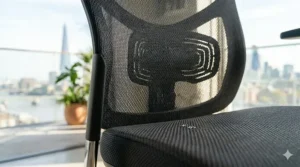
Mesh Office Chairs for Different UK Work Scenarios
British workers face diverse scenarios, each demanding slightly different chair characteristics beyond basic heat management.
The London Commuter-Worker
You cycle 30 minutes through morning traffic, arrive at your flat slightly damp from exertion and British weather, then work 8-9 hours before reversing the commute. You need a chair that handles moisture without complaint, dries quickly between sessions, and provides enough support for full workdays after physical exertion has already stressed your body.
Recommended approach: Full mesh construction (back and seat) to handle post-commute dampness, adjustable lumbar support to accommodate slight posture changes throughout the day, and robust build quality that tolerates daily intensive use. The SIHOO M57 or Steelcase Series 1 fits this profile well — breathable enough to prevent sweat buildup, adjustable enough for all-day comfort, durable enough for years of commuter punishment.
The Suburban Family Home Worker
You work from a spare bedroom or corner of the living room, sharing space with family activities. The room lacks dedicated air conditioning, summer temperatures climb into the high 20s, and you’re managing 6-8 hour workdays around school runs and domestic responsibilities.
Recommended approach: Compact footprint that doesn’t dominate the room, quiet operation that won’t disturb household activities, and good but not premium pricing since the room serves multiple purposes. The SONGMICS OBN041B01 or Durrafy Ergonomic makes sense here — folding armrests save space, mesh keeps you cool during warm months, mid-range pricing aligns with multipurpose room budgets.
The Scottish Rural Remote Worker
You work from a cottage in the Highlands, enjoying beautiful surroundings but facing unpredictable weather, limited local shopping, and reliance on online delivery. You need a chair that ships reliably to remote postcodes, requires minimal local support, and handles variable room temperatures (cool mornings, warm afternoons as sun streams through windows).
Recommended approach: Prime-eligible products with confirmed remote delivery, mesh construction for temperature regulation, and established brands with solid online support since local chair shops may be hours away. The Steelcase Series 1 or SIHOO M57 suits this scenario — both ship via Prime to remote areas, both balance cooling and comfort, both come from brands with responsive customer service accessible online.
The Student in University Halls
You’re working and studying from a small room in university accommodation, budget is tight, space is limited, and you’re sitting for irregular hours (marathon study sessions followed by days away from the desk). You need a chair that’s affordable, doesn’t monopolise your tiny room, and handles the abuse of inconsistent use patterns.
Recommended approach: Budget-conscious pricing, compact footprint, adequate but not premium features since usage is time-limited (typically 1-3 years in halls). The Yaheetech Mid-Back or entry-level Durrafy represents sensible student spending — cheap enough not to sting financially, functional enough for study demands, small enough for cramped halls accommodation.
Long-Term Cost Analysis: Mesh vs Traditional Chairs in the UK
British buyers often focus on initial purchase price whilst ignoring total cost of ownership across a chair’s usable lifetime. Let’s examine realistic scenarios.
Budget Mesh Chair (£40-£80): Yaheetech Example
Initial cost: £60 Expected lifespan: 2-3 years with light to medium use Replacement frequency: Every 2.5 years 10-year cost: £240 (four replacements) Hidden costs: Assembly time every 2-3 years, disposal hassle, consistency issues as chair quality degrades
Mid-Range Mesh Chair (£180-£300): SIHOO M57 Example
Initial cost: £220 Expected lifespan: 5-7 years with medium to heavy use Replacement frequency: Every 6 years 10-year cost: £367 (one replacement plus partial life of second) Hidden costs: Minimal — better quality means less frustration with failures
Premium Mesh Chair (£1,200-£1,700): Herman Miller Aeron Example
Initial cost: £1,450 Expected lifespan: 12-15 years with any use level Replacement frequency: Potentially zero within 10 years 10-year cost: £1,450 (original chair still functional) Hidden costs: None — warranty coverage handles issues
From pure cost-per-year perspective:
- Budget: £24/year
- Mid-range: £36.70/year
- Premium: £145/year
The premium option costs significantly more annually, but that calculation ignores quality-of-life factors. The Aeron eliminates replacement hassle, provides consistently superior comfort for a decade-plus, and retains resale value (used Aerons fetch £400-700 on UK marketplaces). For British professionals working from home full-time, the premium investment makes rational sense when viewed across its functional lifetime.
Mid-range chairs like the SIHOO M57 or Steelcase Series 1 represent the sweet spot for most buyers — you’re paying modestly more than budget options but receiving dramatically better longevity and comfort. For £12 extra per year versus budget chairs, you eliminate premature replacement cycles whilst enjoying significantly better ergonomics and heat management.
Frequently Asked Questions
❓ Are mesh office chairs suitable for British winter conditions as well as summer?
❓ How do I clean and maintain a mesh office chair in Britain's damp climate?
❓ Will a mesh office chair work with underfloor heating in my UK home?
❓ Do mesh office chairs require different assembly in the UK compared to imported models?
❓ Are mesh chairs UKCA certified and safe for commercial use in British offices?
Conclusion: Finding Your Perfect Mesh Chair for British Summers
The mesh back office chair for hot weather has evolved from niche product to essential equipment for British workers navigating increasingly warm summers and homes designed for cold, wet climates rather than ventilation.
Your ideal choice depends on specific circumstances: budget constraints, daily usage hours, workspace dimensions, and personal temperature tolerance. Full-time professionals working 8+ hour days from home should seriously consider mid-range to premium options like the SIHOO M57 (£180-250), Steelcase Series 1 (£300-450), or if budget permits, the Herman Miller Aeron (£1,200-1,700). The combination of superior breathability, adjustable ergonomics, and extended longevity justifies the investment when viewed across years of daily use.
Part-time workers, students, and those setting up spare-room offices can find adequate solutions in budget ranges like the Durrafy Ergonomic (£90-140) or even the basic Yaheetech Mid-Back (£40-80) for truly limited budgets. These won’t revolutionise your comfort or last a decade, but they provide functional mesh seating at prices that align with occasional use patterns.
The one consistent recommendation across all budget levels: prioritise full mesh construction (both back and seat) over hybrid designs if hot weather comfort truly matters to you. That £60-80 premium to upgrade from mesh-back-only to full mesh delivers tangible cooling benefits during Britain’s increasingly frequent heat waves. Combined with adjustable lumbar support and proper sizing, you’re creating a workspace that works with British summers rather than fighting against them.
Remember that your office chair isn’t disposable furniture — it’s equipment that directly impacts your productivity, physical comfort, and long-term spinal health across thousands of hours annually. Choosing wisely means investing in quality appropriate to your usage, accepting that sometimes spending more initially costs less over time, and prioritising features that solve real problems (like summer heat) rather than chasing aesthetic trends.
British summers might not match tropical heat, but our homes weren’t built for the temperatures we’re increasingly experiencing. The right mesh chair bridges that gap, keeping you cool, comfortable, and productive regardless of what the weather delivers.
Recommended for You
- Best Office Chair for Long Hours Sitting: 7 UK Picks 2026
- Best Mesh Office Chair UK: 7 Top Picks for 2026
- 7 Best Ergonomic Office Chair Under £200 UK – 2026
Disclaimer: This article contains affiliate links. As an Amazon Associate, I earn from qualifying purchases. If you purchase products through these links, we may earn a small commission at no additional cost to you.
✨ Found this helpful? Share it with your mates! 💬🤗
