
In This Article
A stationery cupboard is a door-fronted, shelved unit built to hold bulk supplies, ring binders and boxes. A stationery cabinet is, in everyday use, a more specialised unit, often with drawers, locks and fixed fittings, designed for filing and controlled access. The two words overlap so heavily that stationery cupboard vs stationery cabinet trips up even seasoned office managers. Even Wikipedia’s entry on the cupboard concedes that the word gets stretched to cover cabinets and enclosed bookcases.

Here’s the twist: the label often depends on who’s selling. UK suppliers such as UK Educational Furniture list steel “stationery cupboards” in one category and “filing cabinets” and “multidrawer cabinets” in another. Australian supplier Verdex files near-identical door-and-shelf steel units under “stationery cabinets”. Same steel box, different postcode.
So this guide ignores the label and compares what changes your working day: door style differences, internal shelving depth, lock quality and the typical use case per format. You’ll get a quick stationery storage comparison, seven real products from under £100 to the high-£600s, and decision tools for everything from a cramped copier alcove to a spare-room home office.
One honest note up front: I haven’t tested any of these units. Everything below is analysis of published specifications and the review data I could verify. Prices are ranges at the time of research, so check current price and availability before you buy.
Stationery Storage Comparison: The Quick View
Before the product deep-dives, here’s the format-level view of cupboard vs cabinet office storage. Choosing the right format matters more than choosing the right brand.
| Format | Front style | Typical external depth | Main trade-off | Example in this guide | Best For |
|---|---|---|---|---|---|
| Hinged two-door cupboard | Swing doors | 400-505mm | Needs door-swing clearance | Bisley 2 Door Stationery Cupboard, RS PRO 2 Door Steel Cupboard | Shared supply stores |
| Tambour cupboard | Sliding shutters | Around 470mm | Costs more than hinged | Bisley Essentials Tambour Cupboard | Tight corridors and copier alcoves |
| Drawer filing cabinet | Pull-out drawers | Around 400mm | Poor for bulky stock | HOMCOM 4 Drawer Filing Cabinet | A4 client or HR files |
| Low shallow cabinet | Small double doors | Around 350mm | Tiny shelf loads | HOMCOM 2 Tier Metal Modern Filing Cabinet | Home offices and desk-side storage |
The pattern is clear. For volume, a hinged or tambour cupboard such as the Bisley 2 Door Stationery Cupboard wins on shelf space per pound, while drawer units like the HOMCOM 4 Drawer Filing Cabinet win on retrieval speed for paper files. Space-starved offices should read the tambour row twice, because the extra outlay on the Bisley Essentials Tambour Cupboard buys back the floor a swinging door would waste. Home users can often go low and shallow, as with the HOMCOM 2 Tier Metal Modern Filing Cabinet, and skip heavy steel altogether.
💬 Just one click — help others make better buying decisions too!😊
Top 7 Picks for Stationery Cupboard vs Stationery Cabinet Shoppers: Expert Analysis
I’ve deliberately mixed formats, budgets and build quality so you can see how the stationery cupboard vs stationery cabinet question plays out in practice. Here’s the at-a-glance table, then the detail.
| Product | Format | Size (H × W × D) | Price range (check current price) | Rating data | Best For |
|---|---|---|---|---|---|
| Bisley 2 Door Stationery Cupboard | Welded hinged cupboard | 1806 × 914 × 400mm | Around £280-£310 inc VAT | Not verified | Shared offices |
| Talos Double Door Stationery Cupboard | Welded hinged cupboard | 1950 × 920 × 420mm | Price not verified | Not verified | Tall file storage |
| Bisley Essentials Tambour Cupboard | Sliding-shutter cupboard | 1000 × 1000 × 470mm | Mid-£300s to low £500s | Not verified | Tight corridors |
| RS PRO 2 Door Steel Cupboard | Heavy-duty hinged cupboard | 1820 × 915 × 505mm | Around £650-£700 inc VAT | Not verified | Secure shared stores |
| HOMCOM 5-Tier Metal Office Storage Cupboard | Flat-pack steel cupboard | 1800 × 800 × 400mm | Around £145-£150 | 4.2/5 from 25 ratings | Budget home offices |
| HOMCOM 2 Tier Metal Modern Filing Cabinet | Low steel cabinet | 910 × 800 × 350mm | £70-£80 range | Not verified | Desk-side storage |
| HOMCOM 4 Drawer Filing Cabinet | MDF drawer cabinet | 1310 × 400 × 400mm | £80-£90 range | Not verified | Home A4 filing |
Notice how few products have a verified rating. Trade-grade steel units are sold through B2B retailers that publish specifications, not review pools, so the HOMCOM 5-Tier Metal Office Storage Cupboard is the only one where I could cite aggregated ratings. That gap says something useful: for the welded units, the warranty and standards paperwork are your evidence, while for the flat-pack units, read recent buyer feedback before committing.
1. Bisley 2 Door Stationery Cupboard — the welded-steel benchmark
Its standout trick is structural: a fully welded carcass that treats years of door-slamming as a rounding error.
The tall version measures 1806 × 914 × 400mm and ships with three shelves. Trade listings describe a body with no bolts or rivets, which matters because bolted joints are where wobble tends to start. Factory-fitted levelling feet give up to 24mm of adjustment, so a sloping office floor stops being your problem. It also arrives assembled, saving an afternoon of Allen-key penance.
Based on the spec comparison, the 400mm depth is tuned for A4 box files and ring binders rather than bulky kit. That makes it a natural fit for school offices, admin teams and anyone running a shared supply store. It’s the sort of unit that outlives the team using it, so choose its final position carefully, because it’s heavy.
On reviews, trade retailers publish specifications rather than consumer review pools for this model, so I couldn’t verify aggregated customer sentiment. What can be verified is the paper trail. One listing cites BS EN 14073 parts 2 and 3 plus BS EN 14074, and warranties are quoted at five to seven years depending on the seller.
Pros:
- ✅ Fully welded body resists wobble over time
- ✅ Delivered assembled with levelling feet
- ✅ Long warranty and British-standards credentials
Cons:
- ❌ Heavy, so awkward to relocate
- ❌ Trade lead times quoted at several working days
Expect around £280-£310 including VAT at the time of research (check current price); for a welded, warrantied unit, that’s strong long-term value.
2. Talos Double Door Stationery Cupboard — extra height and file-friendly shelves
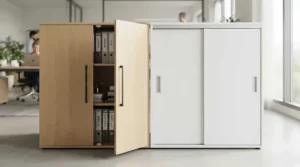
Where most tall cupboards stop around 1.8 metres, this model (listed as KF78756) stretches to 1950mm, adding roughly another shelf’s worth of storage without widening the footprint.
The 920 × 420 × 1950mm body is fully welded, with reinforced lockable doors that open wide and close against rubber stops. In a hushed open-plan office, a clanging cupboard door is socially expensive, so that detail earns its keep. Shelves adjust in 36mm steps, are listed at 50kg capacity and suit suspension files, so one cupboard can swap between stationery and hanging folders as needs change. At around 54kg empty, it isn’t going anywhere.
Here’s what to weigh: the extra 20mm of depth over the Bisley 2 Door Stationery Cupboard is modest, but the finer shelf adjustment is the real difference. It suits offices with mixed storage needs or generous ceilings. However, the top shelf sits above comfortable reach for many people, so reserve it for light, rarely needed items.
I couldn’t find a verified pool of consumer reviews for this model, and the listings I found are trade specification pages. Treat the shelf rating and construction notes as the evidence, and check current price across retailers, because I couldn’t confirm a live figure.
Pros:
- ✅ Tall 1950mm height adds shelf capacity
- ✅ Shelves adjust in fine 36mm steps
- ✅ Rubber door stops keep closing quiet
Cons:
- ❌ Top shelf sits above comfortable reach
- ❌ Current price unverified, so compare sellers
Price: not verified at the time of research; compare it against the Bisley 2 Door Stationery Cupboard before deciding.
3. Bisley Essentials Tambour Cupboard — doors that never swing into the aisle
Two independent shutter doors glide sideways within the cupboard’s own footprint, which sounds minor until you’ve watched a hinged door pin someone against a photocopier.
The 1000mm-high version measures 1000 × 1000 × 470mm, with taller 1570mm and 1970mm options. It’s designed for A4 binders, lateral and suspension filing, with a central lock (two keys) and levelling feet giving up to 24mm of adjustment. The 470mm depth is around 70mm more than the hinged Bisley 2 Door Stationery Cupboard, which helps with boxes and lateral files. Listings vary on whether shelves are included, and some supply the unit empty, so check the variant before ordering.
Because the shutters move independently, you can open one half and leave the rest closed, which suits shared stores where different people need different things. The premium over a hinged unit works out at roughly £100-£200, which is basically the cost of reclaiming the door-swing zone. If a swung-open door would block a walkway, that’s cheap; otherwise stay hinged.
No verified consumer review pool turned up for this range, so I can’t report review sentiment. A trade listing quotes a five-year manufacturer’s warranty.
Pros:
- ✅ Sliding doors need no swing clearance
- ✅ Doors open independently for partial access
- ✅ Deeper 470mm interior than standard cupboards
Cons:
- ❌ Costs noticeably more than hinged equivalents
- ❌ Shelves may be extra on some variants
Price: mid-£300s to low £500s including VAT depending on height, finish and seller (check current price); worth it only where space is tight.
4. RS PRO 2 Door Steel Cupboard — three-point locking for serious security
This is the one you buy when the contents are worth more than the cupboard.
At 1820 × 915 × 505mm, it’s the deepest unit in this guide. The listing highlights an enhanced three-point locking system, doors stiffened with a vertical reinforcement, and semi-concealed hinges. A three-point lock engages at several places along the door edge rather than only in the middle, which makes the doors much harder to flex open. The 505mm depth takes bulkier boxes, laminated stock or equipment that would sit awkwardly in a 400mm unit.
For plain stationery, this is overkill. For a shared store holding toner, spare laptops or confidential HR boxes, it’s sensible. Workshops, labs and mixed commercial stores are the natural home, and the sheer depth demands generous floor space in front.
I found no verified customer review pool, so I’m not going to invent sentiment. What the listing does give you is the engineering detail above, and the retailer flags its price as indicative, so confirm before ordering.
Pros:
- ✅ Three-point lock for stronger security
- ✅ Reinforced doors resist flexing
- ✅ Deep 505mm interior takes bulky items
Cons:
- ❌ Premium price for plain stationery
- ❌ Size and depth need generous floor space
Price: around £650-£700 including VAT per an indicative listing (check current price); justified only if security is the priority.
5. HOMCOM 5-Tier Metal Office Storage Cupboard — budget steel at 1.8 metres
It’s the cheapest route to a full-height, lockable steel cupboard in this guide.
Outside it measures 80 × 40 × 180cm, with an interior of about 80 × 36 × 171.5cm. The powder-coated steel body has five shelf levels, four of them adjustable, rated at 150kg overall and 30kg per shelf, plus anti-slip feet and two keys. It’s self-assembly and weighs roughly 33kg. In practical terms, a ream of A4 weighs around 2.5kg, so each shelf handles about a dozen reams. That’s fine for stationery but tight for archive boxes of files.
Based on the spec comparison, this suits home offices, small businesses and studios where the doors aren’t yanked daily. The retailer’s safety notes advise wall-fixing, so budget a few minutes with a drill. Don’t treat that as optional.
On reviews, the Amazon UK listing showed 4.2 out of 5 from 25 ratings at the time of research. That’s a modest sample, so read it as a rough indicator rather than a verdict.
Pros:
- ✅ Lowest cost for full-height lockable steel
- ✅ Four adjustable shelves flex around bulky items
- ✅ Anti-slip feet protect floors
Cons:
- ❌ 30kg shelf limit rules out heavy archive boxes
- ❌ Self-assembly takes time and wall-fixing is advisable
Price: around £145-£150 at the time of research (check current price); good value for light-to-moderate use.

6. HOMCOM 2 Tier Metal Modern Filing Cabinet — low, shallow and desk-friendly
This is the sideboard-style steel cabinet that tucks beside a desk without devouring the room.
It measures 91 × 80 × 35cm, with an interior of roughly 73 × 80 × 33cm. The lockable double doors come with two keys, anti-tip straps and non-slip pads are included, and it stands on legs about 11cm high. It weighs 18.6kg and is rated at 10kg per shelf and 30kg overall. That 10kg per-shelf limit is the number to respect: it’s roughly four reams of paper per shelf, so this is for stationery, folders and lightweight files, not bulk stock. The raised legs also make floor cleaning easier, a small joy.
This is the cabinet end of the stationery cupboard vs stationery cabinet debate at its most compact. It suits home offices, reception desks and anywhere you need lockable storage without industrial styling. Check bulky box files against the 33cm interior depth before buying.
I couldn’t verify a meaningful pool of customer reviews for this model, so I won’t characterise buyer opinion.
Pros:
- ✅ Compact footprint suits home offices
- ✅ Lockable doors with anti-tip straps included
- ✅ Raised legs make floor cleaning easier
Cons:
- ❌ Only 10kg per shelf
- ❌ Shallow interior limits bulky box files
Price: £70-£80 range at the time of research (check current price); fair value for light use.
7. HOMCOM 4 Drawer Filing Cabinet — adjustable hanging bars for A4 files
It’s the only true drawer format here, with adjustable rails in each drawer for hanging files.
The MDF cabinet measures 131 × 40 × 40cm and is rated at 75kg overall. Each drawer’s interior is about 24cm high, 34cm long and 34cm wide. Two of the four drawers lock, each with its own keys, and an anti-tip kit is included, with wall-fixing recommended. A 24cm interior height suits hanging folders but not ring binders, so this is a filing cabinet, not a stationery store. Because only two drawers lock, put anything sensitive in those.
Its 40cm-square footprint is genuinely slim, and the listing even pitches it as a printer stand. In the cupboard vs cabinet debate, this is the cabinet’s strongest argument: you retrieve papers by label, not by rummaging. The trade-off is material. MDF is less forgiving than steel if it gets knocked or damp.
No verified consumer review pool turned up for this specific model, so I’m leaving sentiment out rather than guessing.
Pros:
- ✅ Adjustable hanging bars suit A4 files
- ✅ Anti-tip kit included in the box
- ✅ Slim 40cm footprint doubles as printer stand
Cons:
- ❌ Only two of four drawers lock
- ❌ MDF is less robust than steel
Price: £80-£90 range at the time of research (check current price); sensible for a home filing system.
✨ Don’t Miss These Standout Picks!
🔍 Take your stationery storage to the next level with these carefully selected units. Click any highlighted product name to check current pricing and availability. They’ll help you build a tidy, secure setup your whole team will actually respect!
Door Style Differences: Hinged, Tambour and Drawer Fronts
Door style differences look cosmetic, but they decide how much floor you lose and who can get inside.
Hinged doors
A 914mm-wide two-door unit like the Bisley 2 Door Stationery Cupboard swings each door roughly half the cupboard’s width. Plan for about 46cm of clear floor in front of each door. Hinged fronts give you full-width access to every shelf, which is why they dominate shared stores.
Tambour shutters
The Bisley Essentials Tambour Cupboard slides its shutters sideways inside the footprint, which solves the swing problem and lets you open one half while the other stays secured.
Drawer fronts
Drawers need their full depth in clear space. A 40cm-deep unit like the HOMCOM 4 Drawer Filing Cabinet needs roughly that much room in front, plus anti-tip care, because opening several drawers shifts the centre of gravity forward.
Locks and catches
Locking quality varies more than most buyers expect. The RS PRO 2 Door Steel Cupboard uses three-point locking, the Talos Double Door Stationery Cupboard pairs reinforced doors with rubber stops, and the tambour uses a central lock. Match the lock to what’s inside, not to what looks impressive.
Internal Shelving Depth: Why 400mm and 470mm Behave Differently
Internal shelving depth is the spec most buyers skip and most regret. External depth always runs ahead of usable depth, because steel walls, door thickness and lock mechanisms steal space. The HOMCOM 5-Tier Metal Office Storage Cupboard is 40cm deep outside but about 36cm inside, and the HOMCOM 2 Tier Metal Modern Filing Cabinet manages roughly 33cm. A4 lever arch files need a little over 30cm of clear depth, so these just clear them while anything bulkier won’t.
The Bisley 2 Door Stationery Cupboard at 400mm and the Talos Double Door Stationery Cupboard at 420mm leave comfortable breathing room. The Bisley Essentials Tambour Cupboard at 470mm and the RS PRO 2 Door Steel Cupboard at 505mm take bulkier boxes or lateral filing.
Deeper isn’t automatically better, though. Items pushed to the back become archaeology, and long reaches punish backs. Official UK business guidance on shelving safety recommends storing the heaviest items lowest and keeping regularly needed materials below head height. My rule of thumb is to choose a depth about 5-10cm more than your largest regular item. Then check shelf ratings: 50kg on the Talos Double Door Stationery Cupboard, 30kg on the HOMCOM 5-Tier Metal Office Storage Cupboard and just 10kg on the HOMCOM 2 Tier Metal Modern Filing Cabinet.
Typical Use Case Per Format: Which Unit Suits Which Setting
The typical use case per format is where the stationery cupboard vs stationery cabinet question usually resolves itself.
Shared supply store (school office, charity, admin team)
A welded hinged cupboard like the Bisley 2 Door Stationery Cupboard handles daily traffic, bulk reams and box files. It’s the default for a reason.
Copier room or corridor alcove
Choose sliding shutters. The Bisley Essentials Tambour Cupboard earns its premium by keeping walkways clear.
Confidential or high-value storage
The RS PRO 2 Door Steel Cupboard and its three-point lock suit mixed stores where theft or tampering is a genuine concern.
Home office stationery
The HOMCOM 5-Tier Metal Office Storage Cupboard gives full height cheaply, while the HOMCOM 2 Tier Metal Modern Filing Cabinet suits tighter rooms.
Paper filing
For hanging folders, the HOMCOM 4 Drawer Filing Cabinet beats any shelf for retrieval speed. Pair it with a cupboard if you also stock supplies.
Cupboard vs Cabinet Office Storage: Benefits Against Traditional Alternatives
How do these formats stack up against the old stalwarts? This cupboard vs cabinet office storage view includes open shelving, which many offices still use by default.
| Option | Strength | Weakness | Best For |
|---|---|---|---|
| Open shelving | Cheap, instant access | No security, dust, visual clutter | Low-value, high-turnover items |
| Hinged cupboard (Bisley 2 Door Stationery Cupboard) | Secure, tidy, high capacity | Door-swing clearance needed | Shared supply stores |
| Tambour cupboard (Bisley Essentials Tambour Cupboard) | Secure, no swing | Higher cost | Tight spaces |
| Drawer cabinet (HOMCOM 4 Drawer Filing Cabinet) | Fast file retrieval | Poor for bulky items | Paper filing |
Open shelving wins only on price and speed; once pens, toner and anything pilfer-worthy are involved, a lockable unit pays for itself. A cupboard such as the Bisley 2 Door Stationery Cupboard hides clutter and controls access in one move. If paper files dominate, the HOMCOM 4 Drawer Filing Cabinet is the smarter format, and many offices end up needing one of each.
How to Choose Between a Stationery Cupboard vs Stationery Cabinet in 6 Steps
- List what you’re storing. Bulk supplies and boxes point to a cupboard; hanging files point to a drawer cabinet.
- Measure the swing. A hinged 914mm unit needs about 46cm of clear floor per door; if you don’t have it, consider a tambour.
- Check usable depth. Subtract roughly 3-4cm from external depth to estimate the real interior, then match it to your largest item.
- Read the shelf rating. Ten kilograms per shelf and fifty are different universes.
- Match lock to risk. A central lock suits stationery; three-point locking suits valuables.
- Decide on build quality. Welded steel with a multi-year warranty suits daily shared use, while flat-pack suits light personal use.
Common Mistakes When Buying Office Storage
The most common error is buying on height and width alone while ignoring internal shelving depth, then discovering that bulky files hang over the shelf edge. Close behind is ignoring door style differences until the delivery driver leaves and the door hits a radiator.
Another classic is underestimating weight. Paper is deceptively heavy, and a shelf rated at 10kg, like those on the HOMCOM 2 Tier Metal Modern Filing Cabinet, fills fast. Buyers also assume every drawer locks; on the HOMCOM 4 Drawer Filing Cabinet, only two of the four do.
Finally, many people skip wall-fixing. The listings for the HOMCOM 5-Tier Metal Office Storage Cupboard and the HOMCOM 4 Drawer Filing Cabinet both recommend it, and a tall, top-heavy unit is exactly the sort that tips when a child or colleague leans on an open door. Last, don’t pay for security you don’t need: the RS PRO 2 Door Steel Cupboard is magnificent, but not for a stack of Post-its.
Long-Term Cost & Maintenance
Sticker price tells only half the story in any stationery storage comparison. Here’s the value view across tiers.
| Tier | Product | Price range | Value verdict | Best For |
|---|---|---|---|---|
| Budget | HOMCOM 2 Tier Metal Modern Filing Cabinet | £70-£80 | Fair for light use | Desk-side storage |
| Budget | HOMCOM 4 Drawer Filing Cabinet | £80-£90 | Sensible for filing | Home A4 files |
| Budget | HOMCOM 5-Tier Metal Office Storage Cupboard | £145-£150 | Good value, light duty | Home offices |
| Mid-range | Bisley 2 Door Stationery Cupboard | £280-£310 | Strong long-term value | Shared stores |
| Mid-range | Bisley Essentials Tambour Cupboard | £380-£520 | Pay only for space-saving | Tight corridors |
| Premium | RS PRO 2 Door Steel Cupboard | £650-£700 | Justified by security | Valuables |
Here’s illustrative arithmetic, not data: if a unit costing around £145 lasted four years, it would work out at about £36 a year. A unit around £300 lasting twelve years comes to roughly £25 a year. Actual lifespans depend on handling, and only the warranties (five to seven years on the Bisley listings) are verifiable. Still, welded construction tends to favour the long game, while the Talos Double Door Stationery Cupboard deserves a price check before you rule it in or out.
Maintenance is cheap. Wipe surfaces monthly, re-tighten fasteners on flat-pack units after the first quarter, check levelling feet, and add a drop of lock lubricant annually.
Safety, Tipping and Compliance Guide
Storage furniture is boring until it falls over. Fix anything tall to the wall. Both the HOMCOM 5-Tier Metal Office Storage Cupboard and the HOMCOM 4 Drawer Filing Cabinet carry wall-fixing advice, and the HOMCOM 2 Tier Metal Modern Filing Cabinet ships with anti-tip straps.
Load limits matter just as much. Heavy items go low, shelves must never exceed their rating, and nobody should climb to reach the top shelf. HSE’s storage and warehousing guidance links through to its manual-handling resources, which apply to offices as much as warehouses.
For standards, ask the seller for documentation. One trade listing cites BS EN 14073 parts 2 and 3 and BS EN 14074 for a Bisley cupboard, which covers storage strength and stability testing. Budget flat-pack sellers may not publish the same evidence, so lean on the stated weight ratings and assemble carefully. Employers should also remember that a lockable cupboard is a security measure, not a fire-protection one. If you store irreplaceable records, look into fire-rated storage separately.
Real-World Scenarios: Three Offices, Three Choices
The six-person charity office
Budget: about £300. Environment: a shared supplies corner. Frequency: daily. The Bisley 2 Door Stationery Cupboard fits because welded steel survives shared use. Label shelves, keep one key with the office manager, and store the heaviest items lowest.
The copier alcove in a 20-person agency
Budget: £400-£500. Environment: an open-plan walkway, with the unit used weekly by everyone. A hinged door would block traffic, so the Bisley Essentials Tambour Cupboard is the pick. Check whether shelves are included in the variant, because that changes the total.
The freelancer’s spare room
Budget: about £150-£250. Environment: a small room, with client files used daily and supplies used less often. The HOMCOM 5-Tier Metal Office Storage Cupboard handles supplies, while the HOMCOM 4 Drawer Filing Cabinet takes client paperwork; together they come to around £225-£240. If space is tighter still, the HOMCOM 2 Tier Metal Modern Filing Cabinet alone covers the basics.
In each case, the typical use case per format drives the answer more than brand loyalty does.
First 30 Days: Setup and Maintenance Guide
Day one: position and level. Choose the spot before you load anything, then use the levelling feet (up to 24mm on the Bisley listings) so doors close squarely.
Day one: fix it down. Anchor tall units to a wall with suitable fixings; flat-pack units like the HOMCOM 5-Tier Metal Office Storage Cupboard need this most.
Week one: load smartly. Heaviest items go low, light rarely used items go high, and daily-use items live between knee and shoulder height. If anyone will lift heavy boxes regularly, HSE’s Manual Handling Assessment Chart is a free tool for spotting risky tasks.
Week two: label and key-manage. Label every shelf and record who holds the two keys. Store the spare away from the unit.
Day 30: re-check. Re-tighten fasteners, check door alignment, and confirm no shelf is bowing. Common first-month mistakes include overloading shelves, ignoring door swing and forgetting that internal shelving depth limits what actually fits.

FAQ
❓ Is a stationery cupboard cheaper than a stationery cabinet?
❓ How deep should a stationery cupboard be for lever arch files?
❓ Do I need a locking stationery cabinet in a home office?
❓ Can a stationery cupboard fit in a narrow corridor?
❓ Is a steel stationery cupboard worth paying more than flat-pack?
Conclusion
The stationery cupboard vs stationery cabinet decision comes down to three questions: what you’re storing, how much floor you can spare, and how much abuse the unit will take. For bulk supplies in a busy shared space, the Bisley 2 Door Stationery Cupboard is the benchmark, with the Talos Double Door Stationery Cupboard worth a price check if you want extra height. For tight corridors, the Bisley Essentials Tambour Cupboard pays its premium in reclaimed floor space, and for valuables the RS PRO 2 Door Steel Cupboard brings three-point security.
On a budget, the HOMCOM 5-Tier Metal Office Storage Cupboard delivers full height for light use. The HOMCOM 2 Tier Metal Modern Filing Cabinet and HOMCOM 4 Drawer Filing Cabinet cover compact and filing-focused needs. Whichever you choose, respect shelf ratings, fix tall units to the wall, and let door style differences and internal shelving depth guide the final call, since those two specs decide whether a unit works in your room.
Recommended for You
- Cupboard For Small Office Space: 7 Brilliant Picks (2026)
- Lockable Office Cupboard: 7 Best Secure Picks For 2026
- Tambour Cupboard For Office: 7 Best Picks For UK Workplaces (2026)
Disclaimer: This article contains affiliate links. As an Amazon Associate, I earn from qualifying purchases. If you purchase products through these links, we may earn a small commission at no additional cost to you.
✨ Found this helpful? Share it with your friends! 💬🤗
