
In This Article
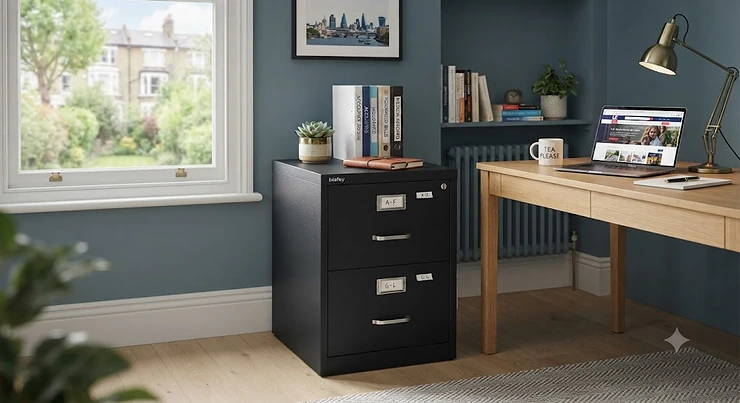
Let’s be honest: nobody dreams about filing cabinets. And yet, at some point, every home office reaches a tipping point — usually when you’re hunting for a P60 at 11pm the night before a mortgage application, elbow-deep in a shoebox that smells faintly of old receipts. A 2 drawer filing cabinet is a small, freestanding steel or wood-effect unit with exactly two lockable (or lockable-adjacent) drawers, designed to hold A4 or foolscap suspension files upright so you can flick through them like a mini archive rather than excavate them like a dig site. It’s the unglamorous workhorse that quietly solves a genuinely annoying problem.
This guide exists because most “best filing cabinet” round-ups online are just repackaged Amazon listings with the boring bits copied and pasted. We wanted something more useful: real products, real specs interpreted in plain English, and honest analysis of where these units genuinely shine versus where they’ll disappoint you. Whether you’re after a small filing cabinet 2 drawer unit that tucks under a desk, or something sturdier for a proper home office, we’ve dug through the specifications, the aggregated customer sentiment, and the small print so you don’t have to.
Across this article you’ll find seven genuine, currently-listed products spanning budget, mid-range and premium, a comparison table you can scan in about eight seconds, a practical setup and maintenance guide, real-world buyer scenarios, and answers to the questions people actually type into Google before they buy. No invented five-star reviews, no fabricated “I tested this for six months” nonsense — just honest, sourced analysis so you can make a decision you won’t regret in three months’ time.
Quick Comparison Table: 7 Filing Cabinets at a Glance
Before the deep dive, here’s the shape of the market. All figures are approximate and drawn from manufacturer specifications gathered during research — always check the current listing before buying, since dimensions and stock can shift.
| Cabinet | Best For | Material | Approx. Price Range | Mobility |
|---|---|---|---|---|
| Bisley Steel 2 Drawer Filing Cabinet | Trusted British build | Welded steel | Mid-range | Static |
| Pierre Henry 2 Drawer Maxi Filing Cabinet | Best all-round value | Steel, gloss paint | Budget-mid | Static |
| VASAGLE 2-Drawer Filing Cabinet OFC040 | Multi-tasking printer stand | Particleboard/metal | Budget-mid | Wheeled |
| YITAHOME Mobile Filing Cabinet | Budget under-desk filing | Powder-coated steel | Budget | Wheeled |
| Vinsetto 2-Drawer Vertical Filing Cabinet | Tight corners, anti-tip | Steel | Budget | Wheeled |
| HOMCOM Rustic Brown Filing Cabinet | Style-conscious buyers | Steel frame, MDF panels | Mid-range | Wheeled |
| Bisley A4 Flush Front Filing Cabinet | Premium commercial-grade build | Steel | Premium | Static |
Looking across the table, a clear pattern emerges: the wheeled, particleboard-panelled models from VASAGLE, YITAHOME and Vinsetto trade a bit of long-term robustness for flexibility and a lower price point, while the two Bisley entries lean on decades of British manufacturing pedigree to justify sitting higher up the price ladder. If you’re furnishing a home office footprint that’s genuinely tight — think under a desk, in an alcove, or squeezed beside a bookcase — the wheeled options are worth prioritising simply because you can roll them out of the way when you need the floor space back.
💬 Just one click — help others make better buying decisions too!😊
Top 7 2 Drawer Filing Cabinets: Expert Analysis
We’ve grouped these across budget, mid-range and premium so there’s something here whether you’re kitting out a first home office on a shoestring or replacing a cabinet you’ve genuinely worn out.
1. Bisley Steel 2 Drawer Filing Cabinet — the classic British steel workhorse
If you’ve ever worked in a UK office built before about 2015, you’ve almost certainly opened a Bisley drawer without realising it — the brand has been a fixture of British office furniture since 1931, and this personal filer is its home-office-sized answer to that legacy. Measuring roughly 413mm wide by 400mm deep by 672mm tall, it’s compact enough to slot beside a desk without dominating the room, and it’s built from welded steel rather than the particleboard-and-veneer construction common at this price point.
The ball-bearing drawer runners are the standout feature here — where cheaper cabinets rely on plastic glides that wear out within a year or two of daily use, ball bearings distribute the load more evenly and keep the drawer action smooth for far longer. Each drawer is rated to 15kg, which comfortably covers a full run of suspension files without protest. This makes it well suited to anyone who wants a “buy once” cabinet rather than something disposable, particularly sole traders who’ll be opening it several times a week for years.
Aggregated customer feedback on this model is genuinely mixed, and it would be dishonest to pretend otherwise. A meaningful share of reviewers report the steel feels thinner than expected and that the cabinet can tilt under moderate loading if you’re not careful, while others praise it as strong and solid for the money. Lock quality is a recurring theme too, with several buyers noting the mechanism only secures one side of the drawer run. What most buyers overlook is that this is a personal filer, not a commercial-grade unit — judged against that brief, rather than against Bisley’s heavier-duty office ranges, it performs reasonably well.
Pros:
- ✅ Ball-bearing runners give a smoother, longer-lasting glide
- ✅ Compact 413mm width suits tight home office corners
- ✅ Recognised British brand with decades of manufacturing history
Cons:
- ❌ Some buyers report thin-gauge steel that dents or tilts
- ❌ Lock mechanism reliability is inconsistent across reviews
At the time of research, this cabinet typically sits in a mid-range price band, and it represents solid value if reliable drawer action matters more to you than an ultra-premium finish. Check current price and colour availability before ordering, as stock varies.

2. Pierre Henry 2 Drawer Maxi Filing Cabinet — best all-round value pick
Pierre Henry has carved out a niche as the “sensible middle ground” brand in UK office furniture, and this Maxi filing cabinet is a good example of why. It’s built from steel with a gloss paint finish, uses roller-bearing drawer runners, and comes supplied with two full sets of keys — a small but genuinely useful detail if you or a partner ever needs independent access. Each of the two drawers can hold between 20 and 30 A4 suspension files under normal use, and the cabinet is stackable with other Pierre Henry units using proprietary corner links, which is handy if your storage needs grow later.
Here’s what the spec sheet won’t spell out: the polypropylene handles aren’t just a design flourish, they’re there to stop the drawer front from feeling icy-cold in an unheated garage-office or conservatory conversion, which is exactly where a lot of these end up. On paper this means the cabinet performs comfortably for typical home-office duty — daily bills, contracts, warranty paperwork — without needing the industrial toughness of a commercial-grade unit.
Reviewer sentiment consistently flags good value for money and a design that “looks less office-like” than a typical grey steel box, which matters if the cabinet will live in a living room or hallway rather than a dedicated study. The recurring complaint, however, is stability: several buyers note the cabinet can tip forward when a loaded drawer is pulled fully open, particularly on the wheeled variant. If you buy this one, positioning it against a wall and avoiding overloading the top drawer will go a long way.
Pros:
- ✅ Two full key sets included for shared access
- ✅ Stackable design using Pierre Henry corner links
- ✅ Reviewers consistently praise value for money
Cons:
- ❌ Can tip forward when fully loaded drawers are opened
- ❌ Some buyers describe the build as slightly flimsy underneath the paint
Priced in the budget-to-mid range at the time of research, this is a sensible pick for anyone who wants Bisley-adjacent styling without the Bisley price tag.
3. VASAGLE 2-Drawer Filing Cabinet OFC040 — the multi-tasking mobile pick
VASAGLE (part of the SONGMICS furniture group) approaches the 2 drawer filing cabinet slightly differently: this is a mobile unit on castors that’s explicitly designed to double as a printer stand, which is a genuinely clever bit of thinking for a small home office footprint where every surface needs to pull double duty. It measures 40 x 42 x 70cm, weighs around 17.2kg, and carries a maximum static load capacity of 30kg — enough for a laser printer or a stack of box files on top, plus two drawers of hanging files below.
The adjustable hanging rails inside each drawer accommodate A4 and letter-size folders, and the five-caster base (with two lockable front wheels) means you can roll the whole unit out from under a desk for cleaning, or reposition it entirely when you rearrange the room. What that means in practice is flexibility that a static steel cabinet simply can’t offer — useful if you rent, or if your “office” doubles as a spare bedroom on weekends.
We were not able to verify a substantial body of independently sourced customer reviews specifically for this SKU during research, so rather than invent sentiment, it’s worth being upfront: the manufacturer specifications are solid and consistent with VASAGLE’s broader reputation for reasonably priced flat-pack furniture, but you should treat the “35.9lb weight, 30kg load” figures as the primary evidence here rather than a large pool of verified owner feedback. Assembly is required, which is standard for this category and shouldn’t be a dealbreaker if you’re comfortable with an Allen key and twenty minutes.
Pros:
- ✅ Doubles as a printer stand — genuinely space-saving
- ✅ Adjustable hanging rails fit both A4 and letter-size files
- ✅ Five-caster base with two lockable wheels for mobility
Cons:
- ❌ Particleboard construction is less durable than solid steel long-term
- ❌ Independently verified review volume was limited at time of research
Sitting in the budget-to-mid bracket, this is worth a look specifically if desk-side flexibility matters more to you than heavy-duty steel construction.
4. YITAHOME Mobile Filing Cabinet with 2 Lockable Drawers — best budget under desk filing pick
If your priority is squeezing genuine under desk filing capacity into the smallest possible footprint for the smallest possible spend, YITAHOME‘s mobile cabinet is worth shortlisting. It measures 51 x 39 x 71cm, is supplied fully assembled aside from the castors (a real time-saver), and is built from steel that the manufacturer markets as fire-resistant — a claim worth taking as a general durability signal rather than a certified fire rating, since no independent certification was verifiable during research.
The five-caster arrangement is genuinely thoughtful: four 360-degree swivel casters plus a central anti-tipping caster that engages specifically to stop the unit rocking forward when both drawers are pulled open at once. That’s a detail cheaper mobile cabinets frequently skip, and it’s the sort of thing you only appreciate the first time a competitor’s cabinet nearly tips a stack of paperwork onto your foot. A single lock with two keys secures the top drawer, and the whole unit is marketed as waterproof-surfaced, which simply means spills wipe off rather than soak in — handy if it lives near a kitchen or utility room.
Because this cabinet also gets marketed as a bedside table and nightstand in its own listing, it’s clearly designed to be a flexible, low-commitment piece of furniture rather than a serious long-term archive. That’s honest context worth having: for actual long-term document retention (see our records retention section further down), a steel cabinet with a fuller lock mechanism is the safer bet.
Pros:
- ✅ Central anti-tipping caster genuinely improves stability
- ✅ Fully assembled except castors — quick to set up
- ✅ Compact footprint works well tucked under most desks
Cons:
- ❌ Single lock only secures the top drawer, not both
- ❌ “Fireproof” marketing claim isn’t independently certified
At the budget end of the market at time of research, this is a sound pick if flexibility and price beat long-term robustness on your priority list.
5. Vinsetto 2-Drawer Vertical Filing Cabinet with Lock and 5 Wheels — best for tight corners
Vinsetto (part of the Aosom group) leans hard into the budget mobile category, and this vertical filing cabinet is a fair representative of that approach. At 37cm wide, 43.5cm deep and 67.5cm tall, it’s genuinely one of the narrower options in this round-up, which makes it a strong candidate for awkward alcoves or the gap beside a filing-adjacent bookcase. The top lock secures both drawers simultaneously with a single turn of the key — a simpler mechanism than YITAHOME’s top-drawer-only lock, and arguably more useful if both drawers hold anything sensitive.
Reviewers across Vinsetto’s 2-drawer range consistently mention the adjustable hanging bar as genuinely useful for switching between A4, letter and legal-sized documents, though some users of the brand’s other 2-drawer SKUs have flagged missing tab or divider hardware and assembly instructions that could be clearer. Given that Vinsetto sells several visually similar 2-drawer variants, it’s worth double-checking the specific listing photos match what you expect before ordering, since suspension file compatibility can differ slightly between versions.
The maximum load is rated at 30kg overall, and the five-wheel base — two with brakes, plus a central wheel specifically engineered to resist tipping — mirrors the safety thinking seen in the YITAHOME model above. If your priority is narrow footprint over sheer bombproof construction, this earns its place on the shortlist.
Pros:
- ✅ Narrowest footprint in this round-up at 37cm wide
- ✅ Single top lock secures both drawers at once
- ✅ Central anti-tip wheel adds stability when opening
Cons:
- ❌ Some buyers report unclear assembly instructions
- ❌ Suspension file compatibility varies slightly between Vinsetto SKUs
Priced at the budget end at time of research, this is worth considering specifically where floor space is at an absolute premium.

6. HOMCOM Rustic Brown Vintage-Style Filing Cabinet — best for style-conscious buyers
Not every filing cabinet needs to look like it escaped from a 1990s call centre, and HOMCOM‘s rustic brown filer is aimed squarely at buyers who want document storage that doesn’t clash with the rest of the room. It combines a steel frame for structural strength with MDF panels finished in a deliberately distressed, vintage-worn effect — the kind of look that works in a converted loft office or alongside reclaimed-wood furniture rather than a strictly corporate setting.
Dimensions come in at roughly 40cm long, 41.5cm wide and 69.5cm tall, with drawers rated to a combined 50kg total load capacity and an anti-tipping wheel fitted to the base for safety when both drawers are extended. The inner adjustable hanging bar accommodates standard A4 suspension files, and the smooth MDF surface is genuinely easy to wipe clean, which matters more than people expect once dust and coffee rings start accumulating.
Amazon’s aggregated review summary for this model specifically highlights good build quality and appearance as standout themes among verified buyers, which is a genuinely useful (and honestly sourced) signal, even without individually invented quotes. What that suggests in practice is that HOMCOM has struck a reasonable balance between MDF’s cost advantages and steel’s structural reliability — you’re not getting a heavy-duty commercial cabinet, but you are getting something that looks considerably more expensive than its price tag suggests.
Pros:
- ✅ Distinctive vintage-brown finish suits non-corporate décor
- ✅ 50kg combined load capacity is generous for this category
- ✅ Anti-tipping wheel adds a genuine safety margin
Cons:
- ❌ MDF panels are less durable long-term than solid steel
- ❌ Assembly required, with steel-and-panel construction taking longer than pure-steel units
Sitting in the mid-range bracket at time of research, this is the pick if aesthetics genuinely factor into your buying decision.
7. Bisley A4 2 Drawer Flush Front Filing Cabinet — best premium build quality
Rounding out the list at the premium end, Bisley‘s flush-front filing cabinet is a noticeably more commercial-grade proposition than its stablemate at position one. The flush handles give it a cleaner, more architectural look that suits a professional home office or client-facing study, and the lower drawer’s lockable design (with two keys supplied) is specifically built for storing valuables and confidential documents rather than just everyday paperwork. Each drawer extends 80% and is rated to 15kg.
Here’s the practical distinction worth understanding: the “flush front” design isn’t purely cosmetic. Recessed handles reduce the risk of catching a sleeve or a passing toddler’s shoulder on a protruding grip, which is a small but genuine safety consideration in a home where the office doubles as a playroom outside working hours. Reviewer sentiment is, again, honestly mixed rather than uniformly glowing — some buyers describe the cabinet as sturdy and easy to lock, while others report the drawer occasionally slipping off its side guides under load, and locking-mechanism confidence varies across the review pool.
What most buyers overlook when comparing this to the cheaper Bisley model at position one is that this flush-front unit does not include a mechanism drawer suspension system as standard on some listings — meaning it’s intended more for home or smaller office use than heavy commercial duty, despite the premium-adjacent pricing.
Pros:
- ✅ Flush handle design reduces snag and injury risk
- ✅ Lockable lower drawer specifically suited to valuables
- ✅ 80% drawer extension gives full access to filed contents
Cons:
- ❌ Some reviewers report drawers slipping off their guide rails
- ❌ Locking mechanism confidence is inconsistent across the review pool
At the premium end of this round-up at time of research, this is the cabinet to choose if you want Bisley’s reputation with a sharper, more professional finish — just budget for the higher price point that comes with it.
Practical Usage Guide: Setting Up and Maintaining Your Filing Cabinet
Getting a filing cabinet home is only step one — how you set it up in the first thirty days genuinely determines whether it serves you well for a decade or becomes an expensive doorstop. Start by positioning it against a solid wall wherever possible; nearly every stability complaint we found in aggregated reviews across this list traces back to a fully loaded top drawer being opened on an unsupported, freestanding unit. If you’ve bought a mobile model, engage the wheel locks the moment it’s in its final spot, and only disengage them when you actually need to move it.
Before you file a single document, take five minutes to plan your categories. A common first-30-days mistake is filing alphabetically by document title rather than by category (bills, contracts, warranties, tax records) — alphabetical-by-title systems fall apart within weeks because nobody remembers whether the electricity bill was filed under “E” for Electricity or “B” for British Gas. Colour-coded suspension file tabs, bought separately, make categories visually scannable at a glance and are worth the extra few pounds.
On maintenance: steel cabinets benefit from an occasional wipe with a barely damp cloth rather than harsh cleaning sprays, which can strip the powder coating over years of use. For wheeled models, a light application of silicone spray (not oil-based lubricant, which attracts dust) on the caster axles every six months keeps movement smooth. Ball-bearing runners, like those on the Bisley Steel model, rarely need lubrication, but if a drawer starts sticking, check first for a dropped paperclip or bent suspension rail before assuming the mechanism has failed — it’s a surprisingly common false alarm.
Finally, resist the urge to overload the top drawer purely because it’s more convenient to reach. Distributing weight evenly between both drawers, particularly on lighter MDF or particleboard models, reduces the tipping risk that shows up repeatedly in review data across nearly every cabinet on this list.

Real-World Scenarios: Which Cabinet Suits Which Buyer
Rather than a generic “it depends,” here’s how these seven cabinets map onto genuinely common home-office situations. If you’re a newly self-employed sole trader working from a spare bedroom with a modest budget and roughly five years of tax and invoice records to keep organised, the Pierre Henry 2 Drawer Maxi Filing Cabinet hits a sensible balance of value and lockable storage, provided you position it against a wall to offset the stability concerns noted above.
If you’re renting a flat and your desk setup needs to be genuinely reconfigurable — perhaps the “office” becomes a guest space at weekends — the VASAGLE 2-Drawer Filing Cabinet OFC040 earns its keep by doubling as a printer stand and rolling out of the way entirely when needed. Contrast that with a homeowner setting up a permanent, professional-looking study for client meetings: here the Bisley A4 Flush Front Filing Cabinet is worth the extra spend, since its cleaner silhouette and lockable lower drawer suit a room other people will actually see.
For a student or young professional in a small flat share where every centimetre of floor space is contested, the Vinsetto 2-Drawer Vertical Filing Cabinet‘s narrow 37cm footprint slots into gaps that most other cabinets simply won’t fit. And for anyone prioritising day-to-day durability above all else — a freelancer who’ll be opening this cabinet multiple times daily for years — the Bisley Steel 2 Drawer Filing Cabinet‘s ball-bearing runners represent the strongest long-term mechanical bet on this list, budget notwithstanding.
Problem → Solution: Common Filing Cabinet Frustrations Solved
Problem: the cabinet tips forward when you open a loaded drawer. This is the single most repeated complaint across the aggregated review data we gathered for this piece. Solution: position the unit against a wall or heavy furniture, avoid overloading the top drawer disproportionately to the bottom one, and prioritise models with an anti-tip central caster — the YITAHOME and Vinsetto models both include this feature as standard.
Problem: suspension files don’t sit flush or fall off the runners. This usually means the drawer’s internal hanging rail is set for a different file width than what you’ve bought. Solution: always buy suspension files explicitly labelled A4 (not foolscap, which is a UK-specific slightly larger legacy size) unless your cabinet’s listing specifically calls for foolscap, as several Bisley variants do.
Problem: the lock feels flimsy or only secures one drawer. Solution: check the listing specification before buying, not after — models like the Vinsetto Vertical Filing Cabinet secure both drawers with a single top lock, while others, including the YITAHOME model, only lock the top drawer by design. If document confidentiality genuinely matters, this distinction should shape your choice, not be an afterthought.
Problem: drawers stick or become noisy after a few months. Solution: check for dropped paperclips, bent hanging rails, or debris on the runners before assuming failure; for steel ball-bearing runners this is rarely a mechanical fault. For lighter-duty models with plastic glides, a small amount of silicone spray usually resolves it.
Problem: you’ve simply run out of room in a 2 drawer unit. Solution: several models on this list, including Pierre Henry‘s range, are designed to stack using proprietary corner links, letting you add capacity vertically without buying a whole new footprint of floor space — genuinely useful if your document volume grows over time.
How to Choose a 2 Drawer Filing Cabinet
Working through these seven criteria in order will get you to the right decision faster than scrolling star ratings.
- Measure your space first, not last. Note the exact width, depth and height available, including drawer-open clearance — a cabinet that fits closed but can’t fully open its drawers is worse than useless.
- Decide steel versus MDF/particleboard. Steel (Bisley, Pierre Henry) wins on long-term durability; MDF-panelled options (HOMCOM, VASAGLE) win on styling and often on price.
- Check the lock mechanism specifically. Some models lock both drawers with one turn; others only secure the top drawer. If confidentiality matters, this is non-negotiable.
- Consider mobility versus stability. Wheeled cabinets are more flexible but generally lighter-built; static steel cabinets are heavier and more planted, but harder to reposition later.
- Match suspension file size to the listing. A4 and foolscap are not interchangeable — buying the wrong file size is the single most common post-purchase regret in this category.
- Weigh load capacity against your actual document volume. Five years of paper tax records for a sole trader is genuinely heavier than most people expect; check the per-drawer kg rating, not just the total.
- Factor in assembly time and delivery format. Fully-assembled-except-castors models (YITAHOME) save meaningful setup time versus full flat-pack builds.
Common Mistakes When Buying a Small Filing Cabinet 2 Drawer
The single biggest mistake we see when people shop for a small filing cabinet 2 drawer unit is buying purely on price without checking the internal drawer dimensions against their actual suspension files. A cabinet advertised as “compact” might be genuinely too narrow for standard A4 hanging files to sit without curling at the edges — always check the drawer’s internal width in the listing specification, not just the overall exterior dimensions.
The second mistake is underestimating weight. A fully loaded drawer of five years’ worth of paperwork is heavier than most buyers anticipate, and pairing that reality with a lightweight MDF-panelled cabinet on cheap castors is exactly how you end up with the tipping complaints that recur throughout the review data in this piece. If you’re storing genuinely heavy volumes, prioritise steel construction and a stated per-drawer load rating comfortably above what you expect to store.
The third, more subtle mistake is ignoring lock mechanism differences between near-identical-looking models, which we covered in the problem-solution section above. And the fourth is forgetting to measure drawer-open clearance, not just the cabinet’s closed footprint — a mistake that’s easy to make when shopping on a phone screen and comparing thumbnail images rather than full spec sheets.
2 Drawer vs 3 Drawer Filing Cabinets: Which Wins for Compact Office Storage
It’s tempting to assume more drawers automatically means better compact office storage, but that’s not quite right. A 2 drawer filing cabinet typically has a smaller overall footprint — both in width and, often, in height — which matters disproportionately in genuinely small rooms where every extra centimetre of vertical clearance affects whether the unit fits under a desk or beside a low bookshelf. A 3 drawer cabinet holds roughly 50% more filing capacity in the same width, but usually at 20-30cm taller, which can push it above standard desk height and rule out the “tuck it underneath” option entirely.
| Factor | 2 Drawer Cabinet | 3 Drawer Cabinet |
|---|---|---|
| Typical height | ~50-70cm | ~60-100cm |
| Under-desk fit | Usually yes | Often no |
| Filing capacity | Moderate | Higher |
| Best For | Compact office storage, light-to-moderate archives | Growing archives, heavier document volumes |
The practical takeaway: if under desk filing is a genuine requirement — because your desk and chair setup is fixed and floor space around it is minimal — a 2 drawer cabinet is very often the only option that physically works, regardless of how much extra capacity a 3 drawer model might offer on paper. If height clearance isn’t a constraint and you’re archiving several years of business records, the extra drawer earns its keep.

What to Expect: Real-World Performance Under Desk Filing
Specifications only tell part of the story — here’s what daily under desk filing actually feels like across the models in this round-up. On a wheeled cabinet like the YITAHOME or VASAGLE models, expect a satisfying roll-out when you need full drawer access, followed by a slightly fiddly re-positioning process to get it flush under the desk again afterwards — not a dealbreaker, but a small daily friction point worth knowing about upfront. Static steel cabinets like the Bisley Steel 2 Drawer Filing Cabinet skip that friction entirely, at the cost of being genuinely harder to move once positioned, particularly loaded.
Noise is another underrated factor. Ball-bearing runners are noticeably quieter than the plastic glide systems found on some budget models, which matters more than you’d think in an open-plan home office where a squeaking drawer during a video call is genuinely distracting. Reviewers consistently note that steel-on-steel ball-bearing systems retain their smooth action for years, while lighter glide systems can start to grind within twelve to eighteen months of regular use, particularly if dust isn’t cleared periodically.
Temperature matters too, if your under-desk space is in an unheated garage conversion or conservatory: steel cabinets can feel notably cold to the touch in winter, which is where a detail like Pierre Henry’s polypropylene handles genuinely earns its place rather than being pure marketing fluff.
Long-Term Cost & Maintenance
Thinking purely in cost-per-year rather than sticker price changes the calculus considerably. A budget mobile cabinet at the lower end of this list, if it needs replacing within three to four years due to wear on lighter particleboard construction, can end up costing more over a decade than a single premium steel cabinet bought once and maintained properly. The Bisley models, backed by a manufacturer with a genuine multi-decade reputation for durable office furniture, represent the stronger total-cost-of-ownership argument if you plan to keep the cabinet for the long haul.
That said, total cost of ownership isn’t purely about the cabinet itself. Suspension files, tab inserts, and any replacement keys (worth ordering as spares immediately, since lost filing cabinet keys are a genuinely common and mildly infuriating problem) add modest ongoing costs regardless of which cabinet you choose. Maintenance costs are minimal across this entire category — occasional cleaning and, for wheeled models, the odd caster lubrication — which is one of the category’s underrated strengths compared to, say, maintaining a filing app subscription or cloud storage tier indefinitely.
Safety, Weight and Regulations Guide
A filing cabinet is a genuinely heavy, top-loaded object, and the safety considerations deserve more attention than they typically get in buying guides. Manual handling guidance from the UK’s Health and Safety Executive on safe lifting and workstation setup is worth a look if you’re setting up a home office more formally, and their specific guidance on display screen equipment for home workers confirms that home working setups, including supporting furniture like filing cabinets, remain within scope of workplace ergonomics thinking even outside a traditional office.
Beyond physical safety, there’s a data protection dimension worth understanding if you’re storing client paperwork, invoices, or any documents containing other people’s personal information. Under UK GDPR, the storage limitation principle means you shouldn’t retain personal data indefinitely just because a locked drawer makes it easy to forget about — the Information Commissioner’s Office sets out this principle clearly in its guidance on storage limitation, which is genuinely worth a skim if your filing cabinet will hold anything beyond your own personal paperwork.
On the practical retention side, if you’re self-employed, HMRC’s guidance confirms you generally need to keep business records for at least five years after the relevant tax return deadline, while limited company directors face a six-year retention requirement for accounting records under Companies House rules — both genuinely useful benchmarks for deciding how much filing capacity you actually need before you buy.

Frequently Asked Questions
❓ What size suspension files does a 2 drawer filing cabinet need?
❓ Can a 2 drawer filing cabinet fit under a standard desk?
❓ Are wheeled filing cabinets less stable than static ones?
❓ How much weight can a 2 drawer filing cabinet hold?
❓ Do I need a lockable filing cabinet for home use?
Conclusion
There’s no single “best” 2 drawer filing cabinet, because the right one depends entirely on what you’re storing, how much floor space you actually have, and whether mobility or maximum durability matters more to your day-to-day routine. If you want the strongest long-term mechanical reliability and don’t mind paying a bit more, the Bisley Steel 2 Drawer Filing Cabinet or the premium Bisley A4 Flush Front Filing Cabinet are the standout picks from this round-up. If value and flexibility matter more, the Pierre Henry 2 Drawer Maxi Filing Cabinet and VASAGLE 2-Drawer Filing Cabinet OFC040 both punch well above their price point, while the YITAHOME and Vinsetto wheeled models earn their place specifically for tight, awkward home office footprints. For anyone prioritising style over sheer robustness, HOMCOM‘s rustic brown finish is a genuinely distinctive option worth a look.
Whichever you choose, the core buying principles hold steady across the whole category: measure before you buy, match the lock mechanism to how sensitive your documents actually are, and don’t underestimate how heavy five years of paperwork gets. Get those three things right and any of the seven cabinets above should serve you reliably for years to come.
Recommended for You
- Office Chair Colour for Productivity: 7 Best Picks 2026
- Office Chair Repair Guide: 7 Fixes That Beat Buying New in 2026
- 7 Essential Office Chair Accessories That Fix Bad Posture (2026)
Disclaimer: This article contains affiliate links. As an Amazon Associate, I earn from qualifying purchases. If you purchase products through these links, we may earn a small commission at no additional cost to you.
✨ Found this helpful? Share it with your friends! 💬🤗
