
In This Article
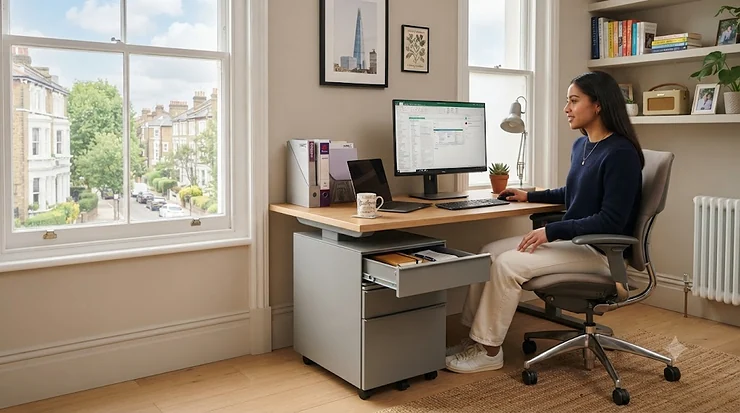
There’s a particular kind of chaos that builds up under a desk. It starts with one stray charging cable. Then a notepad. Then, three weeks later, you’re fishing for a stapler underneath a pile of unopened post while your video call waits patiently on mute. Office pedestal drawers exist to solve exactly this problem, and if you’ve never given them much thought beyond “box with drawers,” you’re about to discover there’s more nuance here than you’d expect.
Office pedestal drawers are the small, wheeled or fixed storage units that slot under or beside a desk, giving you dedicated space for files, stationery and the general debris of a working life. They range from flimsy fabric-and-wood boxes under £70 to steel, lockable units built for decades of daily abuse. Choosing the right one depends on how much you’re storing, whether it needs to lock, and whether it needs to roll with you between rooms.
This guide walks through seven real, currently available options from budget to premium, explains what the specs actually mean day-to-day, and digs into the practical side — setup, maintenance, and matching a pedestal to how you actually work. According to the Health and Safety Executive’s guidance on display screen equipment, a well-organised, uncluttered workstation isn’t just tidier — it’s part of working safely and comfortably for long stretches at a screen. So this isn’t just about aesthetics. Let’s get into it.
Quick Comparison Table
| Product | Type | Drawers | Best For |
|---|---|---|---|
| SONGMICS Mobile File Cabinet OFC030B01 | Metal, on castors | 3 | Best budget all-rounder |
| VASAGLE CUSTOS 2-Drawer File Cabinet | Wood-effect, on castors | 2 | Best for a softer, homely look |
| DEVAISE 2 Drawer Metal File Cabinet | Metal, fully assembled | 2 | Best for buyers who hate flat-pack |
| HOOBRO 2-Drawer Vertical Office Cabinet | Metal, rustic finish | 2 | Best for style-conscious home offices |
| The Workplace Depot Desk High Pedestal | Steel, lockable | 3 | Best commercial-grade budget pick |
| Viking Realspace Pedestal | Steel, lockable | 3 | Best for shared or hot-desk offices |
| Bisley Note Mobile Pedestal | Steel, lockable, UK-made | 2 | Best premium, built-to-last option |
Looking at the spread above, there’s a clear line between “home office” pedestals — lighter, cheaper, often flat-pack — and “commercial” pedestals like the Viking Realspace Pedestal and Bisley Note Mobile Pedestal, which are built to the sort of daily-use standards you’d find in a proper office block. If you’re working from a spare bedroom a few days a week, the lighter options will likely suit you fine; if you’re kitting out a small business or want something that will genuinely outlast your desk, lean commercial.
💬 Just one click — help others make better buying decisions too!😊
Top 7 Office Pedestal Drawers: Expert Analysis
Right, let’s get into the units themselves. Each one below has been picked to represent a genuine, distinct option — not seven versions of the same drawer with different paint jobs.
1. SONGMICS Mobile File Cabinet OFC030B01 — best budget all-rounder
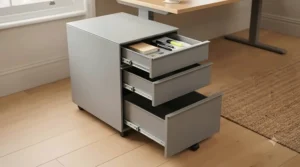
The SONGMICS Mobile File Cabinet is the sort of unit that quietly does its job without asking for applause, which is precisely why it’s such a popular starting point for home offices. It comes with three drawers — a stationery tray up top, then a hanging-file drawer beneath — mounted on five castors, two of which lock.
That five-wheel, two-brake setup matters more than it sounds. A three-wheel pedestal on carpet has a habit of drifting when you lean on it; five points of contact with brakes keep it planted while you’re rifling through files. The steel construction means this isn’t one of those units that flexes alarmingly when you pull a loaded drawer fully open — a common complaint with cheaper MDF alternatives.
Who should buy it: anyone setting up a first home office who wants proper hanging-file storage without committing serious money. It’s a sensible pick for freelancers, students, or a second desk in the house that doesn’t need commercial-grade toughness. Reviewers consistently report that assembly is straightforward and the lock, while basic, works reliably — though a handful mention the drawer runners feeling a touch lightweight under heavier legal-size files.
Pros:
- ✅ Five castors with two brakes for real stability
- ✅ Hanging-file drawer included as standard
- ✅ Straightforward flat-pack assembly, clear instructions
Cons:
- ❌ Runners feel less robust under heavy legal files
- ❌ Basic lock, not a serious security measure
Pricing sits in the under-£100 range at the time of research, making it one of the more accessible entries here — genuinely good value if you check current price and stock before ordering, since availability on colours shifts often.
2. VASAGLE CUSTOS 2-Drawer File Cabinet — best for a softer, homely look
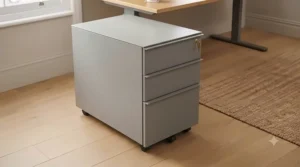
Where the SONGMICS Mobile File Cabinet goes for straightforward metal utility, the VASAGLE CUSTOS 2-Drawer File Cabinet leans into interior design. It’s finished in a wood-effect particleboard — rustic brown, walnut, or matte black depending on the variant — with two lockable drawers sized for A4 and letter-size hanging folders.
Specs-wise, it’s rated for a static load of around 35kg total, split across the drawers and the flat top surface, which doubles nicely as a printer stand. That top-surface load rating matters if you’re planning to stack a laser printer on there — check the individual drawer limit too, since it’s lower than the total figure and easy to overshoot with a heavy inkjet.
This one’s for anyone who wants their storage to actually look like furniture rather than warehouse equipment. Based on the spec comparison with the SONGMICS unit, you’re trading a bit of drawer-runner smoothness for a considerably nicer finish — a fair swap if the pedestal sits somewhere visible, like an open-plan living-room office. Aggregated review sentiment is largely positive on the assembly experience, with several buyers noting the labelled parts make it genuinely beginner-friendly, though a few flag that the particleboard can mark if knocked hard.
Pros:
- ✅ Genuinely attractive wood-effect finish options
- ✅ Doubles as a stable printer stand on top
- ✅ Lockable drawers, adjustable hanging rail position
Cons:
- ❌ Particleboard can chip or mark on hard impact
- ❌ Lower load capacity than steel alternatives
Expect a price in the £70-100 range depending on finish, sitting comfortably in the budget-to-mid bracket.
3. DEVAISE 2 Drawer Metal File Cabinet — best for buyers who hate flat-pack
If the phrase “assembly required” makes your shoulders tense up, the DEVAISE 2 Drawer Metal File Cabinet is worth a look — it typically arrives fully assembled except for the castors, which is about as close to plug-and-play as filing furniture gets. It’s an all-metal build with a lockable drawer, sized to take A4, letter, and legal hanging files.
The fully-assembled body isn’t just a convenience feature — it also tends to mean tighter tolerances and less wobble than cabinets you’ve bolted together yourself on a Sunday afternoon. What most buyers overlook about this model is that the metal gauge is noticeably thicker than budget wood-effect units, which translates to less drawer sag over years of use, even when they’re loaded with hanging files.
This is a strong pick for anyone who’s been burned by a wonky flat-pack unit before, or who simply doesn’t have an evening spare to build furniture. It suits home offices and small business back-rooms alike. Reviewers frequently mention the drawers glide smoothly even when full, and the black finish resists scuffing better than expected — though a small number note the supplied key feels flimsy compared with the lock mechanism itself.
Pros:
- ✅ Arrives essentially pre-built, minimal setup
- ✅ Thicker metal gauge resists drawer sag
- ✅ Fits A4, letter and legal hanging files
Cons:
- ❌ Supplied key feels cheaper than the lock deserves
- ❌ Only two drawers limits total capacity
Pricing typically falls in the £90-120 range, positioning it as a solid mid-tier choice for anyone prioritising convenience.
4. HOOBRO 2-Drawer Vertical Office Cabinet — best for style-conscious home offices
The HOOBRO 2-Drawer Vertical Office Cabinet takes the same rustic-industrial aesthetic that’s been popular in home decor for a few years now and applies it to filing storage — a rustic brown wood-effect top and drawer fronts paired with a black metal frame. It also functions as a rolling printer stand, with drawers sized for A4/letter documents.
Here’s what the spec sheet won’t tell you, but the design choices suggest: HOOBRO clearly built this to sit in view rather than hide under a desk, which is why the frame and leg design get more visual attention than on purely functional pedestals. If your home office doubles as a room guests actually see, that’s a genuinely useful distinction.
Best suited to anyone furnishing a home office where matching aesthetics matter as much as function — think open-plan flats, converted box rooms, or anywhere the desk setup is on permanent display. Aggregated customer sentiment highlights the visual appeal repeatedly, alongside decent stability from the four-caster base; the recurring gripe is that the particleboard drawer bottoms can bow slightly under a genuinely heavy load of files, so it’s better suited to moderate storage than dense legal archiving.
Pros:
- ✅ Distinctive rustic-industrial look, not generic office grey
- ✅ Works well as a printer stand and storage combined
- ✅ Rolls easily on four smooth castors
Cons:
- ❌ Drawer bottoms can bow under very heavy loads
- ❌ Style-first design trades off some raw durability
At around £80-110, it sits alongside the VASAGLE unit as a design-led mid-range option rather than a heavy-duty workhorse.
5. The Workplace Depot Desk High Pedestal — best commercial-grade budget pick
Step up into commercial territory and you meet The Workplace Depot Desk High Pedestal, a lockable, alloy steel unit with three drawers designed explicitly for office environments rather than the home-decor market. It’s built to desk height, meaning it’s designed to sit alongside a desk as a supporting element as much as tucked beneath it.
The alloy steel carcase and central locking system are the giveaway details here — this is furniture designed to a commercial specification, built to the kind of stability and strength standards (BS EN 14073) that govern office storage furniture rather than domestic cabinets. In practice, that means thicker steel, tighter drawer tolerances, and a lock that secures every drawer with a single turn, not three separate fiddly ones.
This is the pedestal for anyone setting up a small business office, a co-working space, or simply anyone who wants genuine commercial durability without paying full commercial pricing. Based on the spec comparison against the home-market units above, the trade-off is aesthetics — it looks like office furniture, not lifestyle furniture — but what most buyers overlook is that this is exactly what makes it more likely to survive a decade of daily use without the drawers loosening.
Pros:
- ✅ Commercial-spec alloy steel build
- ✅ Central locking secures all drawers at once
- ✅ Space-saving design ideal for tight office layouts
Cons:
- ❌ Utilitarian looks won’t suit every home setting
- ❌ Heavier to reposition than lighter home units
Expect a price in the £90-140 range — genuinely competitive for a unit built to office-grade standards.
6. Viking Realspace Pedestal — best for shared or hot-desk offices
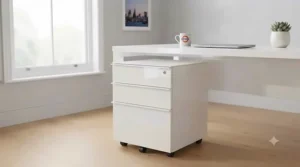
The Viking Realspace Pedestal comes in two- and three-drawer metal configurations, both fully lockable, and is aimed squarely at businesses rather than home users — think open-plan offices where multiple people might use the same desk across a week.
What stands out on paper is the combination of a metal carcase with a central lock and castors rated for repeated daily movement — a detail that matters far more in hot-desking environments, where a pedestal might get wheeled between desks several times a day rather than sitting still for years. Cheaper castors simply don’t survive that kind of repeated rolling and locking.
This one’s for office managers and IT/facilities buyers kitting out shared workspaces, or home users who specifically want office-grade hot-desk durability. On paper, this means you’re paying a bit more than the purely home-market units, but you’re buying into a supply chain (Viking Direct, a long-established UK office supplies retailer) that’s built around next-working-day replacement parts and consistent stock — a genuinely useful thing if a business needs five identical units, not just one.
Pros:
- ✅ Castors built for repeated daily repositioning
- ✅ Central lock across all drawers
- ✅ Backed by an established UK office supplier’s stock and support
Cons:
- ❌ Priced above comparable home-market pedestals
- ❌ Overkill for occasional single-desk home use
Pricing sits around £100-160 depending on the two- or three-drawer configuration, reflecting its commercial positioning.
7. Bisley Note Mobile Pedestal — best premium, built-to-last option
If you want the pedestal equivalent of buying one good coat instead of five cheap ones, the Bisley Note Mobile Pedestal is it. Bisley is a genuinely UK-manufactured brand, and the Note range uses a welded “vertical wrap” steel carcase — essentially one continuous piece of folded steel rather than several panels screwed together — with two lockable drawers, height-adjustable feet, and a five-year manufacturer’s guarantee.
That welded, single-piece construction is the real differentiator here. Screwed-panel cabinets can work loose at the joints over years of drawer-slamming; a welded carcase structurally can’t, in the same way. The drawer interlock — which only allows one drawer to open at a time — is also a genuine safety feature rather than marketing fluff, since a fully loaded steel pedestal with two open drawers can become genuinely top-heavy.
Who is this for: anyone who wants to buy a pedestal once and never think about it again, small businesses that value UK manufacturing and next-day-with-installation delivery, and anyone kitting out a permanent, long-term home office setup. What most buyers overlook about this model is that the five-year guarantee reflects genuine manufacturer confidence — Bisley has been making steel storage in the UK for decades — not just a marketing figure. Reviewers and long-term commercial buyers consistently note that Bisley pedestals from a decade ago are still in daily use, which says more about durability than any single spec sheet could.
Pros:
- ✅ Welded single-piece steel carcase, no loosening joints
- ✅ Drawer interlock prevents tip-over risk
- ✅ Five-year manufacturer guarantee, UK-made
Cons:
- ❌ Noticeably pricier than home-market alternatives
- ❌ Made-to-order lead times can run several weeks
Pricing typically runs in the £140-240 range depending on finish and drawer configuration — a genuine investment, but one aimed at buyers who value longevity over upfront saving.
What Are Office Pedestal Drawers?
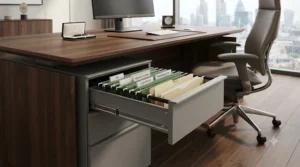
Office pedestal drawers are compact, freestanding storage units — usually two or three drawers on castors or fixed feet — designed to sit under or beside a desk. They hold files, stationery and personal items, freeing up desktop space while keeping essentials within arm’s reach. Most modern pedestals include at least one lockable drawer for security.
The core idea hasn’t changed much since filing cabinets first became standard office equipment in the early twentieth century — the filing cabinet itself emerged as a response to the sheer volume of paperwork generated by growing businesses, and the under-desk pedestal is essentially a scaled-down, mobile descendant of that same idea, built for individual workstations rather than whole departments.
Under Desk Drawers vs Freestanding Filing Cabinets
| Feature | Under Desk Drawers (Pedestals) | Freestanding Filing Cabinets |
|---|---|---|
| Footprint | Fits beneath/beside desk | Requires separate floor space |
| Mobility | Usually on castors | Often static, heavier |
| Capacity | 2-3 drawers, moderate | 3-5+ drawers, high capacity |
| Best For | Individual desk storage | Shared/departmental archiving |
The comparison here isn’t really about which is “better” — it’s about scale. Under desk drawers, including options like the SONGMICS Mobile File Cabinet or VASAGLE CUSTOS 2-Drawer File Cabinet, are built for one person’s daily-use items: current projects, stationery, a few active files. A freestanding filing cabinet is a different job entirely — long-term archiving, shared departmental records, or bulk storage that doesn’t need to move.
If you’re setting up a single desk, under-desk pedestals almost always win on space efficiency, since you’re not sacrificing any additional floor area. It’s only once your filing needs outgrow “a few active projects” that a proper freestanding cabinet, or a larger unit like the Viking Realspace Pedestal, starts to make more sense.
How to Choose Office Pedestal Drawers
What is the best desk pedestal for you? It depends on five practical factors, in roughly this order of importance:
- Measure your desk clearance first. Under-desk pedestals need to physically fit beneath your desktop with room to roll — a unit that’s a centimetre too tall will jam against the underside of your desk every single day.
- Decide if you need locking drawers. Anyone storing client paperwork, contracts, or personal documents should treat this as non-negotiable rather than a nice-to-have.
- Match drawer type to what you’re actually storing. A hanging-file drawer is wasted space if you mostly store loose stationery; a stationery tray is useless for A4 folders.
- Weigh mobility against stability. Castors are brilliant for hot-desking but can feel less planted than fixed feet if you’re constantly leaning your weight on an open drawer.
- Match material to lifespan expectations. Wood-effect units like the HOOBRO 2-Drawer Vertical Office Cabinet suit lighter, shorter-term use; steel units like the Bisley Note Mobile Pedestal are built for years of daily abuse.
Working through these five points in order tends to narrow seven options down to two or three fast, because most buyers already know their answer to at least three of them without realising it.
Practical Under Desk Organisation Guide
Buying the pedestal is honestly the easy part — under desk organisation actually sticking is the harder win. Here’s how to set one up properly in the first month rather than letting it become another junk drawer.
Day one: resist the urge to just tip everything you own into the drawers. Assign each drawer a single job — top drawer for daily-use stationery, bottom drawer for active files, and if you’ve got a third, use it for anything you touch less than weekly. A pedestal with undefined drawers becomes a junk drawer within about a fortnight; that’s not a guess, it’s just how clutter works.
First 30 days — common mistakes to avoid: overloading the top drawer with heavy items (it stresses the runners more than a full bottom drawer, since it’s used more often), forgetting to lock valuable items even when you’re just stepping away briefly, and letting “I’ll file it later” paperwork accumulate loose on top of the pedestal instead of inside it.
Maintenance schedule that actually works: wipe drawer runners with a dry cloth every few months to stop dust building into grit — grit is what actually wears runners out, not the weight of the files themselves. Check castor wheels aren’t picking up hair or carpet fibres, which is the single most common cause of a pedestal that suddenly won’t roll smoothly. Once a quarter, do a genuine clear-out rather than just topping the drawers up further.
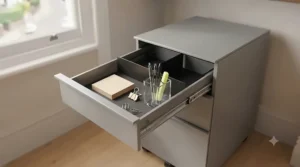
Optimisation trick most listings won’t tell you: use the top drawer’s dividers (or add cheap plastic ones) to stop pens and small stationery sliding to the back every time you open it — a small fix that saves an irritating amount of fumbling over a year.
Real-World Scenarios: Who Needs Which Pedestal
The postgrad student in a shared house, working from a bedroom desk. Budget is tight, space is tighter, and the pedestal needs to look presentable when it’s basically in a bedroom. The VASAGLE CUSTOS 2-Drawer File Cabinet or SONGMICS Mobile File Cabinet both fit this brief nicely — genuinely useful storage without a serious spend, and the VASAGLE’s furniture-like finish means it doesn’t scream “office equipment” in a room that’s also meant to be a bedroom.
The freelance consultant working three days a week from a home office and two from a client’s site. Frequency of use is high, and client paperwork means locking drawers are essential. The DEVAISE 2 Drawer Metal File Cabinet suits this well — quick to set up, genuinely lockable, and durable enough to handle daily use without constant maintenance thinking.
The small business owner setting up a two-person office in a converted garage. Budget allows for commercial-grade furniture, environment is a genuine working office rather than a lifestyle space, and durability matters more than looks. The Viking Realspace Pedestal or The Workplace Depot Desk High Pedestal both make sense here — built to standards that will outlast a five-year business plan, with the option to buy identical units as the team grows.
Common Mistakes When Buying Office Pedestal Drawers
The single biggest mistake is buying on looks alone and only measuring the desk clearance after the box arrives — a beautiful pedestal that doesn’t fit under your particular desk is just an expensive footstool. A close second is assuming all “lockable” drawers offer meaningful security; a basic cam lock on a budget unit deters casual snooping, not a determined attempt, so match the lock quality to what you’re actually protecting.
Buyers also frequently underestimate load capacity, particularly with wood-effect units — stacking a genuinely heavy printer on a pedestal rated for lighter static loads is a common cause of premature sagging. And a subtler mistake: choosing a fully-lockable, heavy commercial unit like the Viking Realspace Pedestal for a light home-office need that never required that much steel in the first place, paying a mobility and cost premium for durability that will simply never get tested.
Your Desk Companion: Problem → Solution Guide
Think of your pedestal as more than a box — it’s genuinely your desk companion for storage, and most of the everyday friction it causes has a straightforward fix.
Problem: the drawer won’t fully close. Almost always caused by an overstuffed file at the back catching the runner. Solution: remove everything, reload with slightly less per drawer, and check nothing’s wedged behind the runner track itself.
Problem: castors have stopped rolling smoothly. Usually hair, carpet fibre, or dust wound around the wheel axle. Solution: tip the unit on its side and pick the debris out with tweezers or a flat screwdriver — a five-minute fix that solves 90% of “sticky wheel” complaints.
Problem: the lock key has gone missing. Solution: most manufacturers, including SONGMICS and Bisley, can supply replacement keys against the model number stamped inside the drawer — check the manufacturer’s site before assuming you need a locksmith.
Problem: the pedestal feels wobbly when you lean on an open drawer. Solution: check if it’s on an uneven floor first (adjustable feet, like those on the Bisley Note Mobile Pedestal, solve this instantly); if it’s on castors, this is often just physics — a fully loaded top-heavy drawer will always feel less stable than a closed unit, which is exactly why interlock mechanisms exist on premium models.
Problem: drawers won’t glide as smoothly as they did when new. Solution: a light coat of silicone-based lubricant (not oil, which attracts dust) on the runner tracks restores most of the original glide.
Home Office Essentials: Building Your Storage System
Office pedestal drawers rarely work in isolation — they’re one piece of a broader set of home office essentials, and treating them as such tends to produce a genuinely tidier result than buying one big storage unit and hoping it solves everything.
A sensible system usually layers three tiers: the pedestal for daily-use files and stationery, a small desktop organiser for the handful of items you touch hourly (pens, notepad, headset), and either shelving or a second cabinet for anything accessed less than weekly. Trying to cram all three tiers into a single two-drawer pedestal is a common reason people feel their storage “isn’t working” even after buying decent furniture — it’s not the pedestal’s fault, it’s being asked to do a job meant for three different pieces of furniture.
Total cost of ownership matters here too. A £70 pedestal that needs replacing in eighteen months because the runners have failed under daily heavy use isn’t actually cheaper than an £150 steel unit that lasts a decade — do the maths on cost-per-year rather than upfront price alone when this is genuinely a long-term daily-use purchase.
Long-Term Cost & Maintenance
Thinking in cost-per-year rather than sticker price changes the calculus considerably. A budget wood-effect pedestal around £80 that lasts three years of moderate use works out to roughly £27 a year. A premium steel unit like the Bisley Note Mobile Pedestal at around £200, backed by a five-year guarantee and a genuine multi-decade lifespan in practice, can work out considerably cheaper per year of ownership — even before accounting for the hassle and landfill impact of replacing cheaper units repeatedly.
Maintenance costs are low across the board — the main ongoing “cost” is time: a few minutes of runner cleaning every few months, and occasionally replacing a lost key. Where costs actually creep in is with damaged particleboard units, since wood-effect drawer fronts generally aren’t repairable the way a dented steel panel can sometimes be straightened. That’s worth weighing if you’re comparing a HOOBRO 2-Drawer Vertical Office Cabinet against a metal equivalent for a genuinely heavy-use desk.
Features That Actually Matter (And Those That Don’t)
Actually matters: drawer runner quality (smooth, full-extension runners genuinely change daily experience), lock quality relative to what you’re storing, and load rating if you’re stacking anything on top. Doesn’t matter much: the number of colour options, marginal differences in castor diameter, or whether a pedestal has a “designer” name attached — most of the units in this guide, regardless of brand, are manufactured to broadly similar underlying standards.
Where it gets interesting is the middle ground: features that sound impressive but only matter in specific situations. A central locking system that secures all drawers with one turn (as on the Viking Realspace Pedestal and The Workplace Depot Desk High Pedestal) is genuinely useful in a shared office where you’re locking up multiple times a day, but largely irrelevant if your pedestal lives in a locked home office nobody else enters. Match the feature list to your actual routine, not the routine the marketing copy assumes you have.
Safety, Regulations and Compliance Guide
UK office storage furniture is generally tested against British and European standards — BS EN 14073 covers the safety, strength and stability requirements for office storage units including pedestals and filing cabinets, setting out load capacity and tip-resistance testing that reputable manufacturers design to, even for home-market products. It’s worth noting these standards aren’t a legal requirement for every product sold, so it pays to favour established brands — Bisley, SONGMICS, VASAGLE and the commercial suppliers featured here all design with these benchmarks in mind, even where a specific unit isn’t independently certified.
Beyond the furniture itself, the HSE’s guidance on display screen equipment is a useful reference for anyone setting up a proper home workstation — a well-organised pedestal is part of a wider picture that includes chair height, screen position and regular breaks. And when the time eventually comes to retire an old pedestal, most UK councils offer bulky item collection rather than requiring you to bin it piece by piece — you can arrange a collection for large waste items through your local authority, which is generally the simplest and most responsible route for old steel or wood-effect furniture.
Frequently Asked Questions
❓ Are office pedestal drawers worth it for a home office?
❓ What size are standard under desk drawers?
❓ Do office pedestal drawers need to be assembled?
❓ Can under desk drawers be locked?
❓ How long do office pedestal drawers typically last?
Conclusion
Office pedestal drawers aren’t the most exciting purchase you’ll make for a home office, but they’re one of the few that genuinely changes how a desk feels to work at day to day. The right pick really does come down to matching the unit to your actual habits: the SONGMICS Mobile File Cabinet or VASAGLE CUSTOS 2-Drawer File Cabinet for a first, budget-conscious setup; the DEVAISE 2 Drawer Metal File Cabinet or HOOBRO 2-Drawer Vertical Office Cabinet for a mid-range balance of convenience and style; and The Workplace Depot Desk High Pedestal, Viking Realspace Pedestal, or the Bisley Note Mobile Pedestal for anyone who wants commercial-grade durability that simply won’t need replacing.
Whichever you land on, the real win isn’t the pedestal itself — it’s what happens above it once the clutter has somewhere proper to go.
✨ Don’t Miss These Exclusive Deals!
🔍 Take your under desk organisation to the next level with these carefully selected picks. Click on any highlighted item to check current pricing and availability. A little order under your desk goes a long way toward a calmer working day!
Recommended for You
- Foolscap Filing Cabinet: 7 Best Picks for UK Offices (2026)
- A4 Filing Cabinet UK: 7 Best Picks Compared for 2026
- Metal Filing Cabinet: 7 Best Steel Picks for 2026 Offices
Disclaimer: This article contains affiliate links. As an Amazon Associate, I earn from qualifying purchases. If you purchase products through these links, we may earn a small commission at no additional cost to you.
✨ Found this helpful? Share it with your friends! 💬🤗
