
In This Article
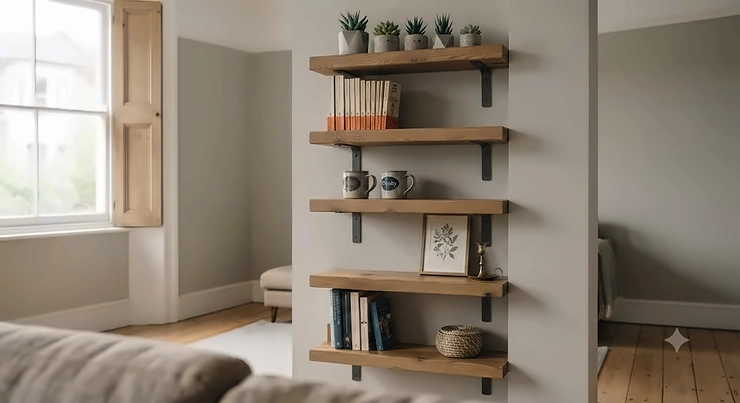
Stand in any UK homeware aisle for five minutes and you’ll hear the same debate on loop: wall mounted shelves vs floating shelves, and which one actually deserves a spot on your wall. Here’s the 40-second version. Wall mounted shelves vs floating shelves is really a contest between visible hardware and hidden hardware — bracket shelving shows its supports proudly (think scaffold-board industrial chic), while floating shelving conceals the metalwork inside the board itself, so the shelf appears to hover. Both can be sturdy, both can be flimsy, and the difference usually comes down to the fixing, not the marketing photo.

We’ve spent the past few weeks digging through spec sheets, aggregated review data, and enough anchor-bolt terminology to make a structural engineer proud, all to answer the question properly rather than parrot the usual “floating shelves look nicer” line you’ll find everywhere else. Because the truth is messier and more interesting: a badly-fitted floating shelf with a stack of hardback books on it is an accident waiting to happen, while a well-chosen bracket shelf can look every bit as sleek as its invisible cousin. Even the humble anchor bolt — the fixing that transfers load from the shelf into the actual structure of your wall — deserves more credit than it gets in this conversation.
Below, we’ve picked seven real, currently-available products spanning budget, mid-range and premium, covering both bracket shelving and floating shelving so you can see the trade-offs side by side. We’ll also dig into load capacity, installation difficulty, and the oddly underrated topic of the visual weight of brackets — because sometimes the thing holding your books up is also the thing ruining your minimalist living room.
Quick Comparison Table: Wall Mounted Shelves vs Floating Shelves
| Shelf Type | Visible Hardware | Typical Load Capacity | Installation Difficulty | Best For |
|---|---|---|---|---|
| Bracket (wall mounted) shelving | Yes — L-brackets or scaffold-style supports | Often 20-75kg per pair | Easy-moderate (studs help but aren’t always essential) | Heavy items, industrial/rustic looks, renters wanting visible reassurance |
| Floating shelving (hidden bracket) | No — bracket sits inside the board | Typically 5-25kg per shelf | Moderate-hard (precision drilling into the board itself) | Minimalist interiors, lighter décor, statement single shelves |
Looking at the table, the headline takeaway is that bracket shelving generally wins on raw load capacity because the metal is doing the visible, structural heavy lifting, while floating shelving wins on aesthetics because there’s simply nothing to look at except the wood. Installation difficulty flips the usual assumption: a lot of people expect floating shelves to be the “easy, no-drill” option, but in practice, drilling the internal cavity dead straight is fiddlier than screwing a bracket flush to the wall. If your priority is maximum weight for minimum fuss, bracket shelving usually has the edge; if you’re chasing a gallery-wall aesthetic, floating shelving is worth the extra ten minutes of patience.
💬 Just one click — help others make better buying decisions too!😊
Top 7 Wall Mounted and Floating Shelves: Expert Analysis
1. VASAGLE Floating Shelves (Set of 3) — best budget entry point into floating shelving
The VASAGLE Floating Shelves are the shelf equivalent of a gateway drug: cheap enough that you won’t cry if you drill a hole in the wrong spot, but sturdy enough to actually do the job. Built from particleboard with an internal steel bracket, each shelf in the set measures roughly 40cm x 20cm x 3.8cm and is rated to around 5kg once properly fixed into a stud or solid wall. That 5kg figure sounds modest until you remember most people are stacking paperbacks and a succulent, not encyclopaedias. Based on the spec comparison against similarly priced sets, the steel-reinforced internal frame is the standout feature — a lot of budget floating shelves skip this and rely on the particleboard alone, which sags within months. Reviewers consistently report that the shelves feel more solid than the price suggests, though several flag that the pre-drilled screw holes don’t always line up perfectly with stud positions, so a bit of measuring beforehand pays off. This is the shelf for a student room, a rental where you’re not planning to overload anything, or simply testing whether floating shelves suit your space before committing to something pricier.
Pros:
- ✅ Genuinely low price point for three full shelves
- ✅ Internal steel bracket outperforms pure-MDF rivals
- ✅ Simple white finish suits almost any room
Cons:
- ❌ 5kg limit rules out heavier books or ornaments
- ❌ Screw-hole alignment can be fiddly on some walls
Priced in the under-£20 range, the VASAGLE Floating Shelves represent solid value if you’re furnishing on a budget and don’t need to hang anything hefty.
2. MKGT Handcrafted Rustic Wooden Floating Shelves (Set of 2, 70cm) — best UK-made bracket-visible design
If the whole point of wall mounted shelves vs floating shelves is choosing a side, the MKGT Handcrafted Rustic Wooden Floating Shelves refuse to pick one. Despite “floating” in the name, this set is fitted with visible black L brackets and hand-finished solid timber boards, made in the UK — so you get the honesty of bracket shelving with the craftsmanship of a proper wood shelf. Each 70cm board is rated between 15-20kg per shelf, comfortably enough for a small library or a collection of kitchen jars, and the solid timber construction means there’s no chipboard core to worry about swelling near a kitchen or bathroom. What most buyers overlook about this model is that the visible bracket is actually a strength, not a compromise: because the load path is obvious and inspectable, you can see at a glance whether a fixing has worked loose, which isn’t possible with hidden-bracket designs. Aggregated review sentiment is strongly positive on build quality and finish, with a recurring theme that the timber grain looks noticeably better in person than in photos, though a handful of buyers note the black brackets show dust more readily than a plain wall would.
Pros:
- ✅ Solid UK-made timber, not composite board
- ✅ 15-20kg capacity handles genuinely heavy use
- ✅ Visible brackets make fixing integrity easy to check
Cons:
- ❌ Pricier than most floating alternatives in this size
- ❌ Black brackets need occasional dusting to stay sharp
Expect a fairly wide price range, from around £30 up into the £90s depending on length and finish — a fair trade for handcrafted timber and real load-bearing hardware.
3. Harbour Housewares Modern Floating Wall Shelf (Pack of 3, 60cm) — best-seller value pick
There’s a reason the Harbour Housewares Modern Floating Wall Shelf sits at the top of Amazon UK’s floating shelf charts: it’s the safe, sensible choice that quietly does everything asked of it. The laminated MDF construction with a hidden bracket system gives each 60cm shelf a rated capacity of roughly 10-15kg, which comfortably covers a photo gallery wall, a row of cookery books, or a small plant collection. Here’s what to weigh: MDF isn’t as prestige as solid oak, but it’s dimensionally stable, resists warping better than cheap chipboard, and the white laminate finish is genuinely hard-wearing against scuffs. Reviewers consistently report that the shelves arrive well-packaged and go up quickly, with the internal bracket system praised for feeling more secure than expected at this price. A common complaint in user reviews is that the wall plugs supplied are basic and better suited to solid brick than modern plasterboard-and-stud construction, so budgeting for your own heavy-duty fixings on a stud wall is sensible. For anyone furnishing a bedroom, hallway, or home office on a modest budget, this is the pack that turns up on more UK Pinterest boards than almost any other.
Pros:
- ✅ Reliable 10-15kg capacity per shelf for the price
- ✅ Clean white laminate resists everyday scuffing
- ✅ Consistently high review volume and star rating
Cons:
- ❌ Supplied wall plugs underwhelm on plasterboard
- ❌ MDF core isn’t as premium as solid wood
In the £15-£20 range for a pack of three, the Harbour Housewares Modern Floating Wall Shelf is arguably the best all-round value pick on this list.
4. Pipishell Floating Shelves (Set of 4) — best mid-range paulownia wood option
The Pipishell Floating Shelves occupy the sweet spot between the budget particleboard sets and the premium solid-timber pieces further down this list. Made from paulownia wood — a lightweight but surprisingly durable hardwood favoured for its resistance to warping — each 40cm shelf carries a rated capacity of around 10kg thanks to a reinforced hidden steel bracket. On paper this means you can comfortably mix hardback books with heavier décor pieces without constantly recalculating what’s “too much.” What most buyers overlook about paulownia specifically is that its natural grain hides minor scuffs far better than painted MDF, so the shelves age more gracefully in a busy household. Aggregated customer sentiment highlights the included spirit-level guide and templated drilling holes as genuinely useful for first-time installers, cutting down the trial-and-error that plagues cheaper sets. The main recurring gripe is depth: at roughly 15cm, these shelves suit display items and slim paperbacks better than oversized coffee-table books. Set of four gives enough shelves to build a proper asymmetric gallery arrangement, which is where this product earns its keep.
Pros:
- ✅ Reinforced 10kg bracket beats most rivals at this size
- ✅ Paulownia wood resists warping and hides minor knocks
- ✅ Drilling template speeds up first-time installation
Cons:
- ❌ Shallow 15cm depth limits larger books or décor
- ❌ Set of four needs a fairly wide wall run
At around £20-£25 for the full set, the Pipishell Floating Shelves deliver genuinely good materials without tipping into premium pricing territory.
5. DIY Doctor Heavy-Duty Scaffold Board Shelf Brackets (Set of 4, 23.5cm) — best visible industrial bracket
For anyone who wants their wall mounted shelves to look like wall mounted shelves, the DIY Doctor Heavy-Duty Scaffold Board Shelf Brackets are the honest, industrial answer. These are raw hardware — pair them with a reclaimed scaffold board or any timber plank of your choosing — meaning you’re buying pure structural bracket shelving rather than a boxed, ready-made unit. The powder-coated black steel brackets measure 23.5cm and, based on the spec comparison with similar heavy-duty designs on the market, are built from noticeably thicker gauge steel than the decorative L-brackets sold for lighter shelving. The spec sheet won’t tell you this, but user reports suggest the extra steel thickness translates into far less flex under load, particularly on longer boards spanning 1.2m or more. Reviewers consistently praise the rustic aesthetic for kitchens and studies with an exposed-brick or industrial theme, though several note that — unlike hidden-bracket floating shelves — you do need to commit to the “seen hardware” look permanently, since there’s no disguising a scaffold bracket as anything else.
Pros:
- ✅ Thick-gauge steel resists flex on long boards
- ✅ Genuine industrial aesthetic, not a printed imitation
- ✅ Works with any timber or reclaimed board you supply
Cons:
- ❌ You’ll need to source and finish your own board
- ❌ Visible bracket look isn’t reversible once fitted
Priced around £20-£25 for a set of four brackets (board sold separately), this is best suited to buyers who actively want their shelving to look load-bearing.
6. WELDUN 6 Pack Floating Shelf Brackets (15cm, 75kg Load Capacity) — best heavy-duty hidden hardware for DIY builds
The WELDUN 6 Pack Floating Shelf Brackets exist for one reason: to prove that “floating” doesn’t have to mean “flimsy.” These rod-style brackets are designed to slide invisibly into a pre-drilled timber board, and the manufacturer’s rated load capacity — around 75kg across the set when properly fixed into solid studs or masonry — puts this firmly in bracket-shelving territory despite the hidden-hardware design. Here’s what to weigh: that headline figure assumes ideal fixing conditions (solid stud or brick, not hollow plasterboard alone), so treat it as a ceiling rather than a guarantee for every wall type. What most DIYers overlook is that buying brackets separately from the shelf gives you full control over board thickness and material, which matters enormously for load capacity — a thin MDF board will bow long before these brackets give way. Aggregated reviews are strongly positive on build quality and the black coated-metal finish, with several buyers specifically praising the brackets for floating bookshelves loaded well beyond what typical off-the-shelf floating shelves could handle.
Pros:
- ✅ 75kg rated capacity rivals most bracket shelving
- ✅ Full flexibility over board material and thickness
- ✅ Hidden design keeps the finished look minimalist
Cons:
- ❌ Requires buying and preparing your own board separately
- ❌ Rated capacity depends heavily on wall type
Typically priced in the £15-£25 range for six brackets, this is the pick for anyone building a custom heavy-duty floating bookshelf rather than buying an off-the-peg set.
7. Gieanoo Solid Oak Floating Shelf (120cm) — best premium statement shelf
Sitting at the top of this list, the Gieanoo Solid Oak Floating Shelf is what happens when floating shelving stops apologising for its price tag. Made from genuine solid oak rather than veneer or MDF, the 120cm board is rated to a generous 20-25kg thanks to a reinforced hidden bracket system designed specifically to handle the extra weight of solid hardwood itself, before you’ve even added anything to it. Based on the spec comparison against the paulownia and MDF options earlier in this list, oak’s density is both a blessing and a consideration: it’s dramatically more resistant to scratches and dents, but the shelf itself is heavier, so wall fixing quality matters even more than usual. Reviewers consistently note the grain and colour variation between individual units — a hallmark of genuine solid wood rather than a manufacturing flaw — and describe the finished look as closer to bespoke carpentry than a mass-produced shelf. The trade-off, unsurprisingly, is price; this sits well above the budget and mid-range sets earlier on this list, but for a single statement piece above a fireplace or in a study, the material quality genuinely shows.
Pros:
- ✅ Genuine solid oak, not veneer or engineered board
- ✅ 20-25kg capacity suits heavy books or décor
- ✅ Natural grain gives a bespoke, one-off appearance
Cons:
- ❌ Noticeably more expensive than composite alternatives
- ❌ Extra weight of the oak itself demands solid fixings
Expect to pay in the £35-£55 range, which puts the Gieanoo Solid Oak Floating Shelf firmly in premium territory — justified if longevity and appearance matter more than budget.
Practical Usage Guide: Getting Wall Mounted and Floating Shelves Right
Buying the right shelf is only half the job; getting it onto the wall without it becoming a cautionary tale is the other half. Start by identifying your wall type before anything else touches a drill bit — solid masonry, dot-and-dab plasterboard, and stud partition walls all behave completely differently under load, and a fixing that’s bombproof in brick can pull straight out of hollow plasterboard. A proper stud detector earns its keep here; wherever possible, position at least one fixing point over a stud or into masonry, because that’s where the real structural strength lives, not in the wall covering itself. For a genuinely thorough walkthrough of matching fixings to wall type, the DIY Doctor plasterboard fixing guide is one of the clearer UK resources on the subject, and it’s worth ten minutes before you touch a masonry bit.
Once you’ve confirmed the wall, the maintenance schedule for shelving is refreshingly light — a six-monthly wobble-test is genuinely all most shelves need. Grip the shelf firmly and apply gentle downward and outward pressure; any give at all means it’s time to re-tighten or re-fix before it becomes a problem rather than after. The most common mistake in the first 30 days isn’t drilling technique, it’s impatience: loading a shelf to its full rated capacity on day one, before the adhesive on any resin-anchor fixings has fully cured, or before you’ve double-checked the level with a spirit level rather than eyeballing it. Give fixings 24 hours before loading anything heavier than décor, and always load from the wall outward so weight sits closer to the fixing point rather than at the shelf’s outer edge, which reduces leverage and stress on the bracket.
Real-World Scenarios: Matching Shelves to How You Actually Live
The renter in a Victorian conversion: solid plaster-on-brick walls but a strict no-large-holes clause in the tenancy agreement. Bracket shelving with slimline fixings, like the DIY Doctor Heavy-Duty Scaffold Board Shelf Brackets, works well here because the holes are small, countable, and easily filled at the end of a tenancy — versus the larger cavity needed to conceal a rod-style floating bracket.
The home-office worker doing an office wall storage comparison: this is one of the most common searches we see, and for good reason — a desk-adjacent wall is prime real estate for files, monitor accessories, and the inevitable tangle of cables. For office wall storage comparison purposes, floating shelves like the Pipishell Floating Shelves suit lighter paperwork and decorative plants, while heavier reference binders and equipment are better served by bracket shelving rated well above their expected load, simply because office shelves tend to accumulate weight gradually and unpredictably over years, not months.
The family with a growing book collection: frequency of use is high, budget is moderate, and the environment (a busy living room) means knocks and bumps are inevitable. The Harbour Housewares Modern Floating Wall Shelf or MKGT Handcrafted Rustic Wooden Floating Shelves both strike a sensible balance of capacity and cost for this use case, particularly since MDF and solid timber both shrug off the odd accidental knock better than acrylic or thin veneer alternatives.
✨ Don’t Miss These Exclusive Deals!
🔍 Take your shelving project to the next level with these carefully selected products. Click on any highlighted item to check current pricing and availability. These picks will help you create the storage-savvy, clutter-free home your family will actually love!
How to Choose Wall Mounted or Floating Shelves
| Storage Type | Floor Space Used | Load Capacity | Visual Weight of Brackets | Best For |
|---|---|---|---|---|
| Wall mounted / floating shelving | None | Moderate-high (varies by hardware) | Low (floating) to moderate (bracket) | Display, books, everyday storage |
| Freestanding bookcase or cabinet | High | High and very consistent | N/A — no wall fixing needed | Very heavy loads, renters avoiding drilling |
| Built-in fitted shelving | None once built | Very high | N/A — integrated into the structure | Permanent homes, whole-wall storage runs |
Compared with freestanding furniture, both bracket shelving and floating shelving free up valuable floor space, which matters enormously in typical UK room sizes. The trade-off is that freestanding units don’t ask anything of your wall at all, making them the safer default for renters nervous about drilling, while built-in fitted shelving sits at the opposite extreme — maximum capacity and a seamless look, but only sensible as a long-term investment in a permanent home.
- Identify your wall type first. Solid masonry, dot-and-dab plasterboard, and stud walls all demand different fixings, and this single factor affects both installation difficulty and maximum safe load more than any spec on the shelf’s own packaging.
- Decide how much load capacity you actually need. Be honest about what’s going on the shelf — books, plants, and kitchenware all weigh more collectively than people expect, and it’s far better to overspec than to find out the hard way.
- Weigh up the visual weight of brackets against your interior style. A minimalist room generally wants hidden-bracket floating shelving; an industrial or rustic scheme often looks better embracing visible bracket shelving rather than fighting it.
- Check the reinforcement, not just the material. A steel-reinforced internal bracket on a floating shelf usually outperforms a pure MDF or particleboard shelf of the same thickness, regardless of how the listing photo looks.
- Factor in installation difficulty realistically. If you’re not confident locating studs or using a spirit level accurately, bracket shelving is generally the more forgiving option to fit correctly on the first attempt.
- Consider reversibility if you’re renting. Bracket shelving with small, discrete fixing points is typically easier to patch and disguise at the end of a tenancy than a large cavity cut for a hidden floating bracket.
- Match the finish to the room’s moisture and use levels. Solid wood and painted MDF both need consideration in kitchens and bathrooms, where humidity can warp cheaper composite boards over time.
Which? offers useful general guidance on wall-mounted versus freestanding storage, and while that particular guide focuses on bathrooms, the underlying logic — wall-mounted solutions save floor space but demand more careful fixing consideration — applies just as well to living rooms, offices, and hallways.
Bracket Shelving vs Floating Shelving: Which Wins Where?
This is the heart of the wall mounted shelves vs floating shelves debate, and the honest answer is: it depends entirely on what you’re optimising for. In a straight bracket shelving vs floating shelving contest on raw strength, bracket shelving usually wins, because the load-bearing metal is fully visible, easy to inspect, and typically rated higher per fixing than the compact hardware hidden inside a floating shelf’s cavity. Products like the WELDUN 6 Pack Floating Shelf Brackets narrow that gap by using genuinely substantial rod-style hardware, but even then, the manufacturer’s own guidance assumes ideal fixing conditions rather than the patchy plasterboard many UK homes actually have.
On aesthetics, the result flips entirely. Floating shelving, almost by definition, creates a cleaner sightline — there’s nothing to distract from the shelf and whatever’s displayed on it. Bracket shelving, even at its most stylish, always introduces a visual element beneath the board, whether that’s a discreet L-bracket or a statement scaffold-style support. Neither is objectively “better”; a farmhouse kitchen often looks incomplete without visible bracket shelving, while a Scandinavian-inspired bedroom tends to lean hard into the floating look. Cost splits the difference too: bracket shelving hardware is often cheaper per unit of load capacity, but you’re buying and finishing your own board, whereas floating shelving typically arrives ready to hang, which some buyers value enough to accept the higher price per kilogram of rated capacity.
Load Capacity: What the Numbers Actually Mean
Load capacity figures on shelf listings look reassuringly precise, but they’re rarely tested under real-world conditions. A “20kg load capacity” rating typically assumes correct fixing into solid material — masonry or timber studs — not the actual hollow plasterboard many buyers are working with. What most buyers overlook is that load capacity isn’t just about the bracket; it’s about the weakest link in the entire chain, which is very often the wall itself, not the hardware bolted to it. A 75kg-rated bracket fixed only into thin plasterboard with basic wall plugs will fail long before it reaches that figure, while a modest 10kg-rated shelf fixed properly into a stud can comfortably outperform its own rating over time.
There’s also a distinction worth understanding between static load and distributed load. Books spread evenly along a shelf place far less stress on individual fixing points than a single heavy item, like a stack of plates, concentrated in the middle. As a rule of thumb, spacing fixings no more than 40-45cm apart on longer shelves reduces flex and spreads the load more evenly, regardless of whether you’ve gone with bracket shelving or floating shelving. If in doubt, choosing a shelf rated comfortably above your expected load — rather than cutting it fine — is the cheapest insurance policy available.
The Visual Weight of Brackets: Why It Matters More Than You Think
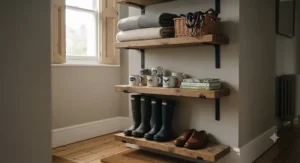
Here’s an angle most buying guides skip entirely: the visual weight of brackets can make or break a room’s proportions in a way that has nothing to do with actual load-bearing strength. A chunky black L-bracket beneath a pale oak shelf draws the eye downward, effectively “anchoring” the shelf visually to the wall — which suits industrial, farmhouse, and eclectic interiors beautifully. That same bracket beneath a minimalist white shelf in a small hallway, however, can make the whole arrangement feel cluttered and busy, even though nothing about the actual storage has changed.
Floating shelving sidesteps this entirely by hiding the visual weight of brackets inside the board, which is precisely why it’s become the default choice for gallery walls and open-plan living spaces where visual calm matters. That said, visible bracket shelving isn’t automatically “heavier” looking if chosen deliberately — slim, powder-coated brackets in a colour that complements rather than contrasts with the wall can read as intentional rather than accidental. The lesson: don’t just ask whether a bracket is strong enough, ask whether its visual weight suits the room it’s going into, because that’s a factor no load-capacity spec sheet will ever mention.
Common Mistakes When Buying Wall Mounted and Floating Shelves
The single most frequent error is buying purely on aesthetics without checking load capacity against intended use — a beautiful floating shelf rated to 5kg will sag or fail under a row of hardback cookbooks, no matter how good it looked in the product photos. A close second is ignoring wall type entirely; the same shelf that performs brilliantly in solid masonry can become a genuine hazard in unsupported plasterboard, which is why checking your wall before your shelf, not after, saves both money and plaster repair bills.
Buyers also commonly underestimate installation difficulty, particularly with floating shelves, where drilling perfectly straight and level holes into a hidden cavity is considerably less forgiving than fixing a visible external bracket. Finally, there’s a tendency to buy a single long shelf when two or three shorter, individually-fixed shelves would distribute weight — and risk — far more safely across multiple wall points, especially on partition walls where studs may be spaced further apart than expected.
Safety, Regulations and Load Ratings: What UK Buyers Should Know
Domestic shelving in the UK isn’t subject to the same formal inspection regime as commercial racking, but the underlying safety principle is identical: a falling object is a falling object, whether it’s in a warehouse or a living room. UK workplace regulations specifically address this risk under the Workplace (Health, Safety and Welfare) Regulations 1992, which cover falls and falling objects as a distinct hazard category that employers must actively manage — a useful reminder that “it’s just a shelf” is exactly the kind of assumption that leads to preventable accidents in both offices and homes.
For domestic use, the practical takeaway is simple: never exceed a manufacturer’s stated load capacity, always check fixings periodically rather than assuming they’ll hold forever, and take particular care with shelving positioned above seating, beds, or anywhere a falling item could cause real harm. If you’re setting up an office wall storage comparison for a home workspace shared with family members, this matters even more, since desks are frequently positioned directly beneath wall-mounted storage.
Frequently Asked Questions
❓ Are floating shelves as strong as bracket shelves?
❓ What's the maximum weight a floating shelf can hold?
❓ Do floating shelves damage walls more than bracket shelves?
❓ Can I install floating shelves on plasterboard without finding a stud?
❓ Which is cheaper: wall mounted bracket shelves or floating shelving?
Conclusion
If this deep dive into wall mounted shelves vs floating shelves has proved anything, it’s that neither option is universally “better” — they’re simply solving slightly different problems. Bracket shelving, whether that’s the industrial charm of the DIY Doctor Heavy-Duty Scaffold Board Shelf Brackets or the substantial capacity of the WELDUN 6 Pack Floating Shelf Brackets, tends to win when raw load capacity and visible reassurance matter most. Floating shelving, from the budget-friendly VASAGLE Floating Shelves through to the premium Gieanoo Solid Oak Floating Shelf, wins when a clean, minimal look takes priority and the load involved is realistically modest.
For most UK households, the honest recommendation is a mix: bracket shelving in high-use, heavy-load spots like a kitchen or office, and floating shelving where the visual calm matters more than raw capacity, like a hallway gallery wall or a bedroom display shelf. Whichever route you take, the wall fixing — not the shelf itself — is what determines whether this becomes a five-year success story or a Tuesday-night emergency Google search.
Recommended for You
- Modular Shelving System For Office: 7 Best Picks (2026)
- Industrial Shelving for Office: 7 Best UK Picks (2026)
- Floating Shelves for Home Office: 7 Best Concealed-Fixing Picks (2026)
Disclaimer: This article contains affiliate links. As an Amazon Associate, I earn from qualifying purchases. If you purchase products through these links, we may earn a small commission at no additional cost to you.
✨ Found this helpful? Share it with your friends! 💬🤗
