
In This Article
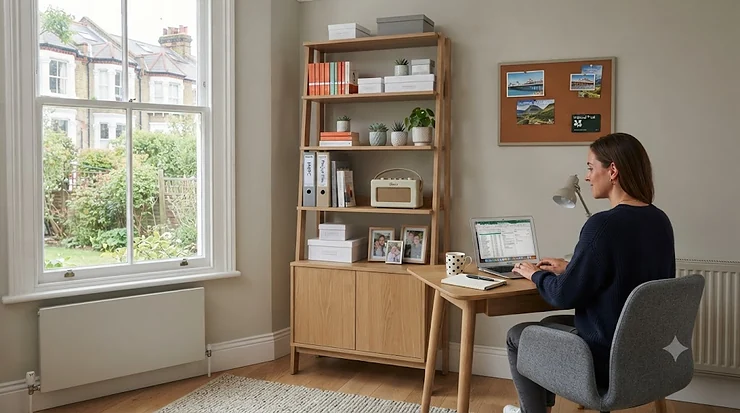
Here’s the thing nobody tells you about small offices: the desk is rarely the problem. It’s everything else — the printer nobody wants to look at, the box files breeding on the floor, the tangle of cables that somehow multiplies overnight. A good shelving unit for small office use isn’t just storage, it’s the difference between a room you can think in and one that makes your shoulders creep up around your ears the second you walk in.
We’ve spent time digging through real listings, real specs, and real aggregated feedback from UK shoppers to put together seven genuinely useful options — not a rehashed Amazon category page, but an honest breakdown of what actually earns its footprint in a tight home office. Whether you’re kitting out a box room, a stair cupboard conversion, or a corner of the spare bedroom, there’s a shelving unit for small office needs somewhere on this list, and we’ll tell you exactly who each one suits and why.
A shelf, in the simplest sense, is just a flat surface for storing or displaying things — usually raised off the floor and anchored to a wall or frame. What separates a good one from a bad one in a small office is everything around that flat surface: footprint, load rating, how it copes with an awkward corner, and whether it’ll still be standing straight in eighteen months.
Quick Comparison Table
| Product | Type | Footprint (approx.) | Price Range | Best For |
|---|---|---|---|---|
| Amazon Basics 5-Shelf Narrow Storage Unit | Steel wire, adjustable | Narrow, deep | £40-£60 range | Heaviest loads on a budget |
| SONGMICS 5-Tier Shelving Unit | Powder-coated steel | Slim, corner-friendly | £30-£45 range | Tightest floor space |
| VASAGLE 5-Tier Ladder Shelf | Steel frame + FSC wood | Narrow, tapering | £45-£65 range | Stylish corners |
| HOMCOM 6-Cube Metal Wire Storage Unit | Modular wire cubes | Reconfigurable | Under £30 | Flexible, changeable layouts |
| IKEA BILLY Bookcase (Narrow) | Adjustable, engineered wood | Slim, 40cm wide | £30-£60 range | Adaptable all-rounder |
| Vida Designs Oxford 5-Tier Cube Bookcase | Engineered wood | Compact ladder cube | £45-£60 range | Budget furniture-grade look |
| Bisley Lockable Steel Storage Cupboard | Enclosed, lockable steel | Boxy, freestanding | £150-£250 range | Confidential documents |
Looking at the spread, the clearest split is between open wire or ladder-style units — the Amazon Basics 5-Shelf Narrow Storage Unit, SONGMICS 5-Tier Shelving Unit, and VASAGLE 5-Tier Ladder Shelf — which prioritise a slim footprint over anything else, and enclosed or lockable options like the Bisley Lockable Steel Storage Cupboard, which trade some floor space for security and a tidier visual line. If your small office doubles as a spare bedroom or a corner of the lounge, the wood-finish pieces (VASAGLE, IKEA BILLY, Vida Designs Oxford) will blend in far better than anything in bare steel.
💬 Just one click — help others make better buying decisions too!😊
Top 7 Shelving Units for a Small Office: Expert Analysis
1. Amazon Basics 5-Shelf Narrow Storage Unit — best load capacity for the money
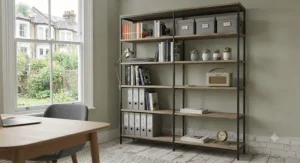
If you’ve ever bent a cheap shelf under the weight of a printer, this is the antidote. The Amazon Basics 5-Shelf Narrow Storage Unit is built from chrome-finished steel wire, and that wire construction is doing real work — it distributes weight across the whole grid rather than relying on a single central support, which is exactly why wire shelving tends to outlast boarded units under sustained heavy loads.
Shelves adjust in small increments without tools, which matters more than it sounds: a printer at 22cm tall and a stack of lever-arch files at 32cm rarely sit well on shelves fixed 30cm apart, so being able to nudge each level up or down by a couple of centimetres means you waste far less vertical space. The narrow depth variant is specifically built to slot against a wall in a box room without eating into your chair’s roll-back zone.
This is the pick for anyone treating their small office as genuinely functional storage rather than a display piece — a printer, a router, spare stationery boxes, the lot. The trade-off is aesthetic: wire shelving reads as “utility room” rather than “considered home office,” so if the unit will be visible on video calls, you may want to pair it with the VASAGLE 5-Tier Ladder Shelf for anything within camera shot. Reviewers of comparable wire shelving units consistently flag two things: assembly is genuinely tool-free and quick, and the feet benefit from rubber pads or a levelling shim on anything other than a dead-flat floor.
Pros:
- ✅ High weight capacity relative to price
- ✅ Tool-free height adjustment in small steps
- ✅ Narrow depth suits tight box-room walls
Cons:
- ❌ Utilitarian look, not ideal for camera-visible spots
- ❌ Open wire shelves show clutter, not just store it
Typically found in the £40-£60 range, this is strong value if raw storage capacity is your priority over polish — check the current listing for the exact narrow-depth variant before buying.
2. SONGMICS 5-Tier Shelving Unit — narrowest true footprint on this list
At roughly 40cm wide and 30cm deep, the SONGMICS 5-Tier Shelving Unit is built for the kind of gap most furniture simply can’t fill — the sliver of wall beside a desk, or the dead space behind a door. Five tiers of powder-coated steel stack up to around 144cm tall, giving you real vertical storage without the unit ever feeling like it’s crowding the room.
The steel construction carries a combined static load rating in the region of 100kg, which sounds modest next to garage-grade shelving, but for an office context — ring binders, a small printer, reference books, a stationery caddy — it’s comfortably more than most people will ever load onto it. What the spec sheet won’t tell you is how much that narrow depth changes the feel of a small room: a 30cm-deep unit reads as a slim vertical line rather than a bulky block, which matters enormously when your whole office is 2.5 metres square.
This is the pick for genuinely tight spaces where every centimetre of floor is accounted for — box rooms, stair-cupboard conversions, alcoves either side of a chimney breast. Aggregated feedback on this style of compact steel shelving tends to note that assembly is straightforward but benefits from a second pair of hands to keep the frame square while the first few bolts go in.
Pros:
- ✅ Smallest genuine footprint on this list
- ✅ Solid ~100kg combined load rating
- ✅ Matte finish suits modern, minimal offices
Cons:
- ❌ Narrow shelves limit what fits per tier
- ❌ Not designed for very heavy single items
Sitting in the £30-£45 range, it’s one of the most affordable ways to add serious vertical storage to a room too small for anything wider.
3. VASAGLE 5-Tier Ladder Shelf — best-looking corner solution
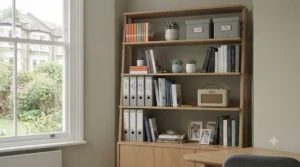
The VASAGLE 5-Tier Ladder Shelf takes a completely different shape to the two units above it: a tapering, trapezium-style frame that leans back slightly as it rises, in the industrial style VASAGLE has built a reputation on. At around 30cm deep, 34cm wide, and 170cm tall, it’s genuinely narrow, but the angled silhouette makes it feel considerably less boxy in a small room than a straight-sided unit of the same dimensions.
Construction pairs a steel frame with FSC-certified chipboard shelves, which is worth knowing if sourcing matters to you — the timber in the shelves comes from responsibly managed forests rather than an unverified supply chain. Total static load capacity sits around 50kg, spread across five tiers, which comfortably handles books, box files, a small desk lamp, and decorative pieces, but this isn’t the unit for a heavy laser printer.
Where this genuinely earns its place is video-call visibility. If your small office is also the backdrop for client meetings, a VASAGLE 5-Tier Ladder Shelf styled with books spine-out and a couple of plants photographs far better than open wire shelving. Reviewers of VASAGLE’s ladder-shelf range commonly mention that the numbered assembly instructions make the build unusually painless for flat-pack furniture, alongside occasional notes that the lightest chipboard shelves flex slightly under a full row of hardbacks.
Pros:
- ✅ Distinctive silhouette, genuinely camera-friendly
- ✅ FSC-certified timber shelving
- ✅ Straightforward, well-numbered assembly
Cons:
- ❌ Lower load rating than steel-wire alternatives
- ❌ Top shelf sits high — awkward for shorter users
Priced in the £45-£65 range depending on width option, it’s the strongest pick here for style-conscious small offices that double as a video-call backdrop.
4. HOMCOM 6-Cube Metal Wire Storage Unit — most flexible layout
Everything else on this list is a fixed shape. The HOMCOM 6-Cube Metal Wire Storage Unit isn’t — it’s built from interlocking wire panels and plastic connectors, so instead of committing to one footprint, you build it into whatever shape your small office actually has. Six individual 35cm cubes can be stacked two-by-three, three-by-two, or split into two smaller towers either side of a doorway.
Each cube is rated to roughly 30kg, and because the whole system relies on ABS connectors rather than screws, reconfiguring it later — say, when you move desks or the room changes use — takes minutes rather than a full rebuild. That modularity is the entire pitch: what most buyers overlook about cube systems is that they’re really a small-office solution for people whose storage needs change, not people who want to set something up once and forget it.
This suits anyone renting, anyone who redecorates often, or anyone genuinely unsure yet how their small office will end up being used. The honest trade-off is rigidity — interlocking wire-and-connector builds are noticeably less sturdy than a welded or bolted steel frame, and putting real weight on a top cube without anchoring the whole stack to the wall is asking for trouble. Feedback on this style of connector-based cube system frequently flags that the plastic connectors, while adequate, are the first thing to loosen if the unit gets knocked or dragged across a floor repeatedly.
Pros:
- ✅ Fully reconfigurable into almost any shape
- ✅ Cheapest entry price on this list
- ✅ Tool-free assembly with a mallet and connectors
Cons:
- ❌ Less rigid than welded steel alternatives
- ❌ Connectors can loosen with repeated moving
At under £30, it’s the cheapest way onto this list, and arguably the best value if your small office’s layout isn’t fixed yet.
5. IKEA BILLY Bookcase (Narrow) — the adaptable all-rounder
There’s a reason the IKEA BILLY Bookcase has been a fixture of British home offices for decades: it does the boring things extremely well. The narrow 40cm-wide version is specifically sized for tight rooms, and — unusually for budget flat-pack furniture — its shelves are height-adjustable across the full internal depth, not just in two or three fixed positions.
Available in a genuinely wide range of finishes, from plain white to oak-effect and black-brown, it’s one of the few units on this list that will still match your office in five years if the rest of the room’s decor changes around it. IKEA also sells matching glass doors and extension units for the BILLY range, so a narrow bookcase bought today can become a fully enclosed, dust-free storage wall later without starting from scratch.
Based on the spec comparison, the standout advantage here isn’t raw storage capacity — it’s longevity of the system. Few flat-pack ranges let you extend, glaze, or reconfigure years after the original purchase, and that matters for anyone who expects their small office to evolve rather than stay static. Reviewers of the BILLY range consistently highlight the sheer number of finish and width combinations as the main draw, alongside the usual flat-pack caveat that the rear panel is thin hardboard rather than solid backing.
Pros:
- ✅ Enormous range of widths, heights and finishes
- ✅ Extendable with matching doors and units later
- ✅ Fully adjustable shelf spacing
Cons:
- ❌ Thin hardboard rear panel, not solid wood
- ❌ Popular sizes can go out of stock locally
Generally sitting in the £30-£60 range depending on size and finish, it remains one of the safest, most future-proof choices for a small office that might grow.
6. Vida Designs Oxford 5-Tier Cube Bookcase — furniture-grade look on a tight budget
The Vida Designs Oxford 5-Tier Cube Bookcase takes the ladder-cube shape popularised by pricier industrial ranges and builds it in engineered wood at a genuinely budget price point. Compact enough for a bedroom-office or box room, it steps down in width as it rises, giving five graduated shelves rather than one uniform column.
Engineered wood keeps the price low without the flat, slightly flimsy feel some budget bookcases have — the graduated cube shape also happens to add structural rigidity, since a narrower top section puts less leverage on the base than a tall, uniform-width tower would. What most buyers overlook about this shape is that it’s genuinely more stable loaded top-heavy than a straight-sided equivalent, purely down to the physics of a lower centre of gravity.
This is the pick for anyone who wants a bookcase that photographs like furniture rather than storage, without paying industrial-range prices for it. Honest caveat: as with most engineered-wood cube bookcases at this price, expect the lightest possible construction that still holds books safely — heavy box files stacked several deep on the lower shelves are fine, but this isn’t a unit for genuinely heavy equipment.
Pros:
- ✅ Furniture-grade look at budget pricing
- ✅ Graduated shape adds real stability
- ✅ Compact enough for the smallest box room
Cons:
- ❌ Not rated for heavy equipment storage
- ❌ Limited colour options compared with rivals
Typically priced in the £45-£60 range, it edges close to the ceiling of “budget” while still delivering a noticeably more finished appearance than wire alternatives.
7. Bisley Lockable Steel Storage Cupboard — the premium, secure choice
Every unit above this one is open shelving. The Bisley Lockable Steel Storage Cupboard isn’t, and that’s entirely the point. Bisley has manufactured steel office furniture in the UK for close to a century, and their lockable cupboards are built to a genuinely different standard — welded steel construction, a proper lock and key rather than a token catch, and load ratings designed around commercial office use rather than domestic bookshelves.
For a small office handling anything sensitive — client contracts, HR paperwork, financial records, device chargers and spare hardware you don’t want visible — this is the only unit on this list that actually solves that problem. Open shelving, however tidy, leaves everything visible to anyone who walks into the room; a locked steel cupboard doesn’t. Here’s what most buyers overlook about steel cupboards specifically: because the doors close over the full front face, you also get a far tidier visual line on a video call, with none of the “look at my stationery” clutter open shelving inevitably shows.
The trade-off, unsurprisingly, is price and footprint — this is the most expensive item here by a wide margin, and its boxy shape doesn’t compress into an awkward corner the way a ladder shelf can. Reviewers of Bisley’s steel storage range consistently point to the brand’s reputation for durability, built on decades of supplying UK commercial offices, alongside occasional notes that the lock mechanism benefits from an annual squirt of light oil to stay smooth.
Pros:
- ✅ Genuine lockable security for sensitive documents
- ✅ Commercial-grade welded steel construction
- ✅ Fully enclosed — no visible clutter on calls
Cons:
- ❌ Highest price point on this list
- ❌ Boxier footprint than open shelving units
Expect somewhere in the £150-£250 range depending on size and colour — a genuine investment, but one that pays off if confidentiality is non-negotiable for your work.
Setting Up Your Shelving Unit: A Practical Guide
Getting a shelving unit for small office use right doesn’t stop at the checkout. The first thirty minutes after the box arrives decide whether you’re using the thing for the next five years or fighting it every single day.
Start by clearing and measuring the actual wall space before you open the box — not the room, the specific wall — including the door swing and any radiator pipework that might eat into your planned depth. Most flat-pack failures happen because someone assembled the frame first and discovered the fit problem second. Assemble on a soft surface like a folded blanket to avoid scratching either the floor or the panels, and keep every bag of fixings sorted by step rather than tipped into one pile; missing a single connector three steps in is the single most common cause of wobbly, half-finished units left leaning against a wall.
Once it’s up, anchor it. Even a modest unit becomes a genuine tip-over risk once loaded with box files and a printer, particularly with pets or children in the house — the included anti-tip strap or bracket takes two minutes to fit into a wall stud and is worth every second. Load heavier items low and lighter items high, both for stability and because lifting a heavy printer box up to shoulder height is exactly the kind of movement that causes back strain; the NHS’s guidance on safe lifting is worth a genuine read before you start hauling boxes of paper about. In the first month, resist the urge to fill every shelf immediately — leave one tier empty for a fortnight and see what actually migrates there day to day, rather than guessing upfront.
Real-World Scenarios: Which Small Office Shelving Unit Suits You?
The freelance graphic designer in a converted box room. Space is measured in centimetres, not metres, and every visitor sees the room on a video call. The VASAGLE 5-Tier Ladder Shelf or Vida Designs Oxford 5-Tier Cube Bookcase solve this cleanly — narrow enough to fit, styled enough to photograph well, and light enough that neither dominates a room that’s doing double duty as a spare bedroom.
The self-employed bookkeeper working with client financial data. Confidentiality genuinely matters here, and open shelving simply won’t cut it once you’re storing paperwork with other people’s bank details on it. The Bisley Lockable Steel Storage Cupboard is the obvious answer — yes, it costs more, but weigh that against the professional and legal risk of leaving sensitive documents in plain view of anyone who steps into the room.
The remote employee whose home office is also a spare room, a gym corner, and a gaming setup. Needs change monthly, and committing to a fixed shelving footprint before you know how the room will actually be used is a waste of money. The HOMCOM 6-Cube Metal Wire Storage Unit is built for exactly this uncertainty — cheap enough that getting it slightly wrong isn’t a disaster, and reconfigurable enough that it can be rebuilt into a completely different shape the day your priorities shift.

Common Small-Office Storage Problems, Solved
Problem: the printer takes up an entire shelf and blocks everything behind it. Move it to the bottom tier of a wire unit like the Amazon Basics 5-Shelf Narrow Storage Unit, where the open-sided design means you can still reach a box behind it without lifting the printer itself.
Problem: cables trail across every visible shelf. Route them down the rear leg of the unit using simple adhesive clips, and keep a small designated box or tray on one shelf specifically for chargers and leads rather than letting them drape across open tiers.
Problem: the unit looks cluttered within a fortnight of setup. This is almost always a sorting problem, not a storage-capacity problem — group items by frequency of use, keep daily essentials at eye level, and move anything used less than monthly to the least accessible shelf or into a closed box.
Problem: paperwork keeps ending up in a pile on the desk instead of on the shelf. A shelving unit with no dedicated “inbox” tier will always lose this battle; assign one specific shelf as a paper-only zone and physically move everything else off it weekly.
Problem: the unit wobbles slightly whenever you reach for the top shelf. Check the anti-tip strap is actually fitted to a stud rather than plasterboard alone, and confirm all fixings are torqued fully — a loose bottom-frame bolt is the most common, and most overlooked, cause of a wobble that seems to come from the top.
How to Choose a Shelving Unit for a Small Office
Choosing the right shelving unit for small office use comes down to matching the product to your actual constraints, not the flashiest listing photos. Work through these in order:
- Measure the exact footprint first, not the room. A unit that’s “small” in general terms can still be wrong for your specific wall — measure width, depth, and height including any obstructions like skirting boards or radiators.
- Decide open versus enclosed before you shop by style. If anything confidential will live on it, that rules out open shelving entirely, regardless of how good it looks.
- Match load rating to what you’re actually storing. A printer and box files need a steel-frame unit; books and decorative pieces are fine on lighter engineered-wood shelving.
- Prioritise depth over width in genuinely tight rooms. A narrow, deep unit eats into your working floor space far more than a slim, shallow one against the same wall.
- Check whether the range is extendable. Ranges like the IKEA BILLY Bookcase let you add matching units later, which matters if your storage needs will grow.
- Factor in assembly and future moves. Modular, tool-light systems like the HOMCOM 6-Cube Metal Wire Storage Unit are far easier to disassemble and relocate than welded steel.
- Anchor for safety before you load it. Whatever you choose, budget five minutes and a wall bracket for anti-tip fixing — it’s not optional once the unit carries real weight.
If your small office also functions as your main workstation, it’s worth reading the Health and Safety Executive’s guidance on display screen equipment too — storage is only half the picture; the layout of everything around your screen matters just as much for long-term comfort.
Common Mistakes When Buying Small Office Shelving
The single biggest mistake is buying by width alone and ignoring depth — a 60cm-wide unit that’s 40cm deep eats far more usable floor space in a small room than an 80cm-wide unit that’s only 25cm deep, even though the wider figure feels scarier on paper. Depth is what determines how much the unit intrudes into your actual working area, not width.
The second mistake is under-specifying load capacity to save a few pounds, then discovering the shelf sags within a month once real books and files go on it. Always check the per-shelf rating against your heaviest planned item, not the average. A close third: skipping the anti-tip anchor because “it’s not that heavy” — tip-over risk isn’t really about the empty unit’s weight, it’s about what happens once five shelves of files and a printer are loaded onto a base that was never secured. Finally, plenty of buyers choose purely on price and end up needing a second unit within a year because the first one was never going to hold what they actually needed — buying once for genuine capacity is almost always cheaper than buying twice.
Compact Shelving vs Fitted Office Storage: Which Wins for a Small Office?
Fitted office storage — built-in shelving, bespoke alcove units, a carpenter-made wall of cupboards — will always beat freestanding compact shelving office solutions on one metric: it uses every millimetre of available space with zero wasted gaps. If you own your home, aren’t moving soon, and have the budget for joinery, fitted storage genuinely is the better long-term answer.
For almost everyone else, that calculation flips. Compact shelving office units like the seven above cost a fraction of a bespoke build, arrive and assemble within a day rather than weeks, and — critically for renters — travel with you when you move. A fitted unit is also a fixed decision: once it’s built into an alcove, changing your mind about the layout means demolition, not a Saturday afternoon with an Allen key. Freestanding units let you reconfigure, downsize, or completely rethink your storage the moment your circumstances change, which matters enormously for anyone renting, anyone whose work setup is still evolving, or anyone who simply isn’t ready to commit thousands of pounds to a permanent fixture.
The honest middle ground, and the one most small-office owners actually land on, is freestanding shelving chosen to fit the space as precisely as fitted joinery would — which is exactly why footprint and depth matter so much more in this buying decision than they would in a larger room.
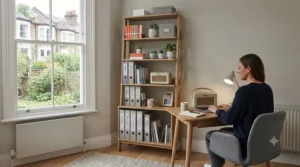
Small-Space Shelving Solutions for Awkward Office Layouts
Not every small office is a neat rectangle. Sloped ceilings, chimney breasts, under-stair triangles, and box rooms with a single usable wall all demand different small space shelving solutions than a standard square room does.
For a sloped ceiling, prioritise units under 150cm tall so the top shelf never sits in the reduced-headroom zone — the Vida Designs Oxford 5-Tier Cube Bookcase, at a more modest height than most of the ladder-style pieces, tends to fit these spaces better. For the awkward triangle under a staircase, a modular option like the HOMCOM 6-Cube Metal Wire Storage Unit can be built asymmetrically, with fewer cubes on the shallow end and more on the deep end, in a way no fixed-shape bookcase can match. Chimney-breast alcoves — a near-universal feature in older British homes — are usually narrower than standard shelving widths, making slimline units like the SONGMICS 5-Tier Shelving Unit a far better fit than anything designed for a straight, uninterrupted wall.
If you’re weighing up a full room reconfiguration rather than just a shelving purchase, Homebuilding & Renovating’s guide to small home office layouts is a genuinely useful next step — it covers the desk-and-storage relationship in more depth than any single shelving guide can.
Weight Limits, Safety & Wall-Anchoring Guide
Every shelving unit on this list carries a stated maximum load, and that figure matters more than most buyers assume — it’s not a suggestion, it’s the point at which the manufacturer stops guaranteeing the frame won’t deform or fail. Distribute weight evenly across tiers rather than loading one shelf to its absolute limit while others sit empty; an unevenly loaded frame puts far more stress on individual joints than the same total weight spread across all five shelves.
Anti-tip anchoring isn’t just for households with children, though it’s especially important there — a tall, narrow unit has a naturally high centre of gravity once loaded, and a moderate knock or an open drawer used as a step can be enough to bring it forward. Fix the supplied strap or bracket into a genuine wall stud wherever possible; a fixing into plasterboard alone will hold far less force than one anchored into solid timber or masonry behind it. For steel units specifically, check that all bolted joints are fully torqued after the first week of use — flat-pack steel frames often settle slightly as the powder coating beds in, and a joint that was snug on day one can loosen marginally by day seven.
Finally, think about what’s above and around the unit, not just on it. Keep heavier items low, avoid stacking anything on top of the frame that wasn’t designed to sit there, and leave a genuine gap between the top shelf and the ceiling if the unit will be climbed on for access — a stepladder next to open shelving is a far safer combination than treating the shelves themselves as a ladder.
Space-Saving Design Principles That Actually Work
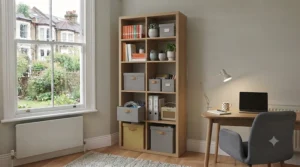
Genuine space-saving design in a small office is less about buying the smallest possible unit and more about matching shape to the room’s actual geometry. Vertical storage nearly always beats horizontal in a tight footprint — a tall, narrow unit stores as much as a short, wide one while claiming a fraction of the floor area, which is exactly why every genuinely compact option on this list favours height over width.
Depth is the dimension that matters most and gets thought about least. Two units with identical widths can feel completely different in a small room if one is 25cm deep and the other is 40cm — that extra 15cm is floor space you’ll bump into with your chair every single day. Colour and material also play a real role: pale finishes and open wire designs read as visually “lighter” than solid dark wood, which matters in a room where every surface competes for attention. Finally, resist the instinct to buy the biggest unit that technically fits — a shelving unit for small office use should leave breathing room around it, not touch every wall it’s near; a slightly undersized unit in a room that still feels open almost always beats an oversized one that technically holds more but makes the whole space feel smaller.
Frequently Asked Questions
❓ What is the best shelving unit for a small office?
❓ How much weight can a small office shelving unit hold?
❓ Do I need to anchor a shelving unit to the wall?
❓ What's the best narrow shelving unit for a home office corner?
❓ How much does a good small office shelving unit cost in the UK?
Conclusion
There’s no universal answer to “which shelving unit for small office use is best” — and honestly, any article claiming otherwise is skipping the part where your room, your budget, and what you’re actually storing all pull in different directions. What we can say with confidence: measure depth before width, match load rating to your heaviest item rather than your average one, anchor whatever you buy to the wall, and don’t be tempted by the biggest unit that technically fits.
If capacity is the priority, the Amazon Basics 5-Shelf Narrow Storage Unit and SONGMICS 5-Tier Shelving Unit both punch well above their price. If your office is on camera regularly, the VASAGLE 5-Tier Ladder Shelf and Vida Designs Oxford 5-Tier Cube Bookcase do the visual heavy lifting. If your needs are still shifting, the HOMCOM 6-Cube Metal Wire Storage Unit and the ever-reliable IKEA BILLY Bookcase give you room to change your mind. And if confidentiality genuinely matters, the Bisley Lockable Steel Storage Cupboard is the only serious option on this list. Pick the one that solves your actual problem, not the one with the nicest listing photo — your small office, and your back, will thank you.
Recommended for You
- Industrial Shelving vs Modular Shelving: 7 Best UK Picks (2026)
- Wall Mounted Shelves vs Floating Shelves: 7 Best Picks (2026)
- Modular Shelving System For Office: 7 Best Picks (2026)
Disclaimer: This article contains affiliate links. As an Amazon Associate, I earn from qualifying purchases. If you purchase products through these links, we may earn a small commission at no additional cost to you.
✨ Found this helpful? Share it with your friends! 💬🤗
