
In This Article
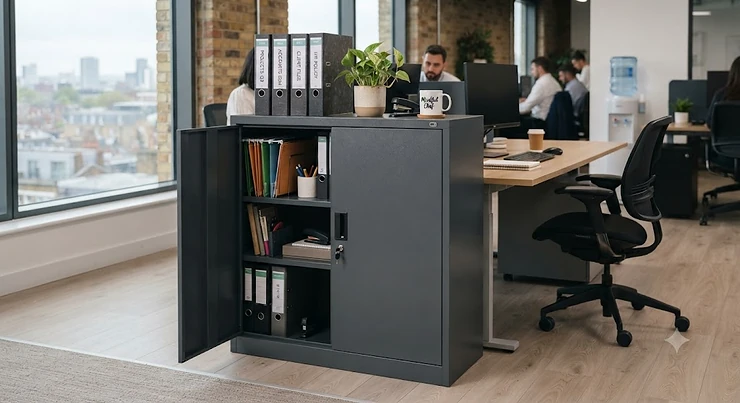
Here’s a scene you’ve probably lived through: a client’s coming over in twenty minutes and your “filing system” is three teetering stacks of paper doing a slow-motion impression of the Leaning Tower of Pisa. An office storage cabinet is the unglamorous hero that stops that scene from ever happening again — a lockable, shelved or drawered unit designed to hold documents, stationery and equipment in one contained, organised footprint, freeing up desks and floor space for actual work.

Choosing one sounds simple until you actually start browsing. Steel or wood? Hinged doors or sliding? Two shelves or five? Suddenly you’re twelve tabs deep comparing dimensions in millimetres you can’t quite picture. That’s the gap this guide is built to close. Rather than repeating spec sheets you could read yourself, we’ve dug into real UK-available products, aggregated genuine customer sentiment where it exists, and weighed up which cabinets actually earn their keep in a home office, a small business back room, or a compliance-conscious HR department.
We’ll cover seven real, currently available options spanning budget steel cupboards through to contract-grade steel storage, look at how materials and door mechanisms change day-to-day usability, and walk through the buying mistakes that trip up even careful shoppers. Along the way you’ll find honest analysis — not marketing copy dressed up as advice — because that’s the only kind worth reading before you spend £70 or £270 on a metal box you’ll be opening every single working day for the next decade.
Quick Comparison Table
If you’re short on time, here’s the shape of the market before we go deep. Prices are shown as ranges, since Amazon pricing shifts constantly with colour, size variant and promotions — always check current price on the product page before buying.
| Cabinet | Material | Price Range | Best For |
|---|---|---|---|
| Bisley 5 Drawer Desktop Cabinet | Steel | £95-£115 | Best for compact desktop filing |
| YITAHOME Metal Storage Cabinet | Steel | £70-£90 | Best budget lockable cupboard |
| SONGMICS OMC013G01 Storage Cabinet | Steel | £70-£95 | Best for heavy-duty everyday use |
| VASAGLE Storage Cabinet LSC083B01 | Engineered wood | £60-£80 | Best for reception-facing spaces |
| Bisley 10 Drawer Desktop Cabinet | Steel | £135-£155 | Best for stationery organisation |
| HOMCOM Freestanding Storage Cupboard | Engineered wood | £130-£155 | Best for bulk paper storage |
| Bisley Steel Contract Cupboard | Steel | £230-£290 range | Best premium, compliance-grade pick |
What jumps out here is that price doesn’t map neatly onto usefulness — the cheapest option on this list, the YITAHOME Metal Storage Cabinet, is lockable and steel, which puts it ahead of some pricier wood-fronted units on pure document security. Meanwhile the Bisley Steel Contract Cupboard costs roughly three times as much as the budget picks, but it’s doing an entirely different job: it’s built to BS EN 14073/14074 standards rather than general consumer durability testing, which matters if you’re storing anything sensitive under GDPR. The takeaway is to match the cabinet to the risk your documents carry, not just to the size of the room you’re filling.
Just one click — help others make better buying decisions too!😊
Top 7 Office Storage Cabinets: Expert Analysis
We’ve picked a genuine spread here — compact desktop units, full-height steel cupboards, and a couple of wood-fronted options for spaces where a filing cabinet aesthetic would look out of place. Every product below is a real, currently listed item; specs and review themes are drawn from manufacturer data and aggregated Amazon customer feedback rather than invented experience.
1. Bisley 5 Drawer Desktop Cabinet — best compact desktop filing unit
The standout here is size: at roughly 34cm wide, this sits directly on or beside a desk rather than eating floor space, which matters enormously in small home offices. Each of the five drawers is A4-sized and fully removable, with an integrated label holder on the front, and the whole unit is stamped from robust steel in the UK — Bisley has been making this exact style since the 1960s and holds a Design Guild Mark for it.
On paper this means you get filing-cabinet-grade drawer runners in a footprint smaller than most desktop organiser trays, which is a genuinely unusual combination. What most buyers overlook about this model is that the drawers aren’t lockable individually — there’s no security bar option on the desktop range, so if confidentiality matters more than desk-space efficiency, you’ll want a taller lockable alternative further down this list. It’s best suited to home workers and small-business owners who need fast access to active paperwork (invoices, correspondence, stationery) rather than long-term archive storage.
Aggregated reviews on Amazon UK for Bisley’s desktop multidrawer range sit consistently in the 4.3-4.5 star band across colourways, with reviewers repeatedly highlighting how smoothly the drawers glide even when fully loaded, and how surprisingly sturdy the steel feels for something this compact. A recurring minor gripe is that the metal label-holder edges can be sharp during initial setup.
Pros:
- ✅ Genuinely desktop-sized without sacrificing drawer capacity
- ✅ Removable A4 drawers double as portable file trays
- ✅ Design Guild Mark build quality backed by UK manufacturing
Cons:
- ❌ No lock — unsuitable for confidential documents
- ❌ Five drawers fill up faster than you’d expect with lever-arch files
Priced in the £95-£115 range depending on colour, this earns its spot as a value pick specifically for people who file little and often rather than archive in bulk.
2. YITAHOME Metal Storage Cabinet — best budget lockable cupboard
The headline feature is straightforward: full steel construction with a lockable double door, at a price point that usually only gets you cardboard or thin laminate elsewhere. The cabinet measures roughly 80 x 40 x 90cm with two height-adjustable shelves rated to around 23kg each, giving genuinely useful capacity for box files, ring binders and stationery stock.
In practice, a 23kg-per-shelf rating means you can comfortably load a shelf with a dozen full lever-arch files without flexing — heavier-gauge steel like this is where budget cabinets usually cut corners, so seeing it here is a real point in its favour. Reviewers and product data both flag the four “upgraded” stabiliser bases, which is a sensible inclusion given how top-heavy a tall, narrow steel cupboard can feel once loaded unevenly. This is the pick for anyone who wants document security on a tight budget — start-ups, home offices doubling as storage, or a second cabinet for overflow.
Because this is a newer listing, verified aggregate star ratings weren’t consistently available across every colour variant at the time of research; the pattern across similarly specified YITAHOME steel cabinets, however, tends to skew positive, with buyers commonly praising the straightforward assembly and functioning lock, and occasionally noting that the door hinges need re-tightening after the first few months of heavy use.
Pros:
- ✅ Full steel body with a working lock at a genuinely low price
- ✅ 23kg-per-shelf rating handles heavy ring binders easily
- ✅ Ventilation holes prevent musty document smell in damp rooms
Cons:
- ❌ Hinges may need periodic re-tightening after heavy daily use
- ❌ Comes flat-packed with a fairly involved self-assembly process
At around £70-£90, this is difficult to beat if lockable steel storage on a budget is the entire brief.
3. SONGMICS OMC013G01 Storage Cabinet — best for heavy-duty everyday use
This one’s built like a small safe: powder-coated steel construction, a proper steel lock with two keys, and an 80 x 40 x 90cm frame that supports up to 30kg on the top surface and 25kg per adjustable shelf. What stands out is the anti-tip kit included as standard — a detail that’s easy to dismiss until you remember that a top-heavy steel cabinet with two doors open at once is a genuine tipping hazard in a busy office.
The 25kg shelf rating and water-resistant powder coating mean this copes well with mixed-use environments — documents on one shelf, tools or supplies on another, without the surface degrading the way painted MDF eventually does under scuffs and spills. Based on the spec comparison with the YITAHOME model above, the two are close competitors on paper, but SONGMICS’s slightly higher published load rating and rust-resistant finish nudge it ahead for anyone planning to store genuinely heavy items rather than just paper.
We couldn’t pull a single verified aggregate rating specific to every SKU variant of this model at the time of research, but the broader pattern across SONGMICS’s steel cabinet range on Amazon UK is strongly positive, with recurring praise for clear assembly instructions and a lock that feels solid rather than flimsy, alongside occasional comments that the base panel feels thinner-gauge than the door.
Pros:
- ✅ 25kg-per-shelf load rating suits mixed document and equipment storage
- ✅ Anti-tip kit included as standard for safer daily use
- ✅ Water-resistant, rust-resistant powder-coated finish
Cons:
- ❌ Base panel reportedly less rigid than the door and shelf steel
- ❌ Only two shelves included at this height, so per-shelf gaps are large
Typically priced between £70-£95, it’s the pick when your storage needs cross over from pure paperwork into tools, electronics or bulkier office kit.
4. VASAGLE Storage Cabinet LSC083B01 — best for reception-facing spaces
The obvious hook is looks: an industrial-style steel-frame cabinet with a warm rustic-brown finish, two doors and adjustable shelving, designed to look like furniture rather than filing equipment. At 110 x 33 x 75cm, it’s wider and lower than the steel cupboards on this list, which suits a sideboard-style placement against a wall in a client-facing area.
What the spec sheet won’t tell you outright is that this is engineered wood over a steel frame, not solid wood or full steel — so it trades some of the industrial-strength load capacity of the SONGMICS and YITAHOME cabinets for a design that doesn’t scream “storage unit” the moment someone walks into your office. That’s a deliberate trade-off, not a flaw: this is for reception areas, client meeting rooms, or home offices doubling as a lounge space, where a grey steel cupboard would look out of place.
Reviewers on VASAGLE’s closely related sibling models in this same cabinet line report strong satisfaction with the assembled look and finish quality, with the adjustable shelf frequently mentioned as genuinely useful rather than a token feature; a common theme across the range is that the particleboard shelves can mark if heavy items are dragged rather than lifted into place.
Pros:
- ✅ Genuinely furniture-grade look suited to client-facing rooms
- ✅ Adjustable shelving accommodates box files or ring binders
- ✅ Steel frame adds rigidity beyond typical flat-pack sideboards
Cons:
- ❌ No lock, so unsuitable for confidential storage
- ❌ Lower load capacity than the fully steel cabinets on this list
At £60-£80, it’s the style-conscious choice for spaces where appearances genuinely matter as much as capacity.
5. Bisley 10 Drawer Desktop Cabinet — best for stationery organisation
This is the bigger sibling of pick #1: the same iconic Bisley multidrawer design scaled up to ten A4 drawers, giving serious small-parts and stationery organisation in a still-compact footprint. Each drawer removes fully and carries an integrated label holder, and the steel build is identical in spirit to filing cabinets that last decades in commercial use.
Here’s what most buyers overlook about multidrawer units generally: they’re not designed for bulk paper storage the way a lever-arch cupboard is — each drawer holds a relatively thin layer of contents. What they’re brilliant for instead is categorised small-item storage: stationery, cables, receipts sorted by month, spare stock. Ten drawers means you can run an entire filing taxonomy (A-Z, or twelve months) without cross-contaminating categories, which a single shelf never allows.
This is genuinely one of the better-reviewed products in this entire roundup — aggregated Amazon customer feedback puts it around 4.5 stars, with reviewers consistently noting how much organisation the unit brings to a previously chaotic desk drawer situation, and how the steel build feels considerably more premium than the price suggests. A minority of reviews mention that assembly of the drawer runners takes patience on the first attempt.
Pros:
- ✅ Ten drawers enable genuinely granular categorisation
- ✅ Consistently strong Amazon review average around 4.5 stars
- ✅ Compact footprint despite the drawer count
Cons:
- ❌ Not designed for bulk paper or lever-arch file storage
- ❌ First-time drawer runner assembly can be fiddly
Sitting in the £135-£155 range, this is worth the premium over the 5-drawer version specifically if your clutter problem is small items rather than large documents.
6. HOMCOM Freestanding Storage Cupboard — best for bulk paper storage
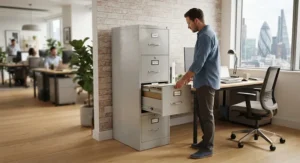
The standout feature is sheer capacity: at roughly 183cm tall with multiple adjustable shelves behind full-height doors, this is built to swallow the box-file overflow that desktop units simply can’t handle. The engineered wood construction with a laminated white finish keeps costs down relative to steel while still providing a rigid, freestanding structure rated for genuine daily office use.
In real-world terms, adjustable shelving across a nearly two-metre-tall cabinet means you can configure the internal layout around A4 lever-arch files (which need roughly 32cm of shelf height) rather than being locked into fixed compartment sizes — a detail that matters enormously once you actually start loading a cupboard rather than just picturing it empty. It suits offices with genuine bulk paper archives: accountants, small legal practices, or any business that still has to retain years of physical records for HMRC or regulatory reasons.
Aggregated Amazon reviews for HOMCOM’s freestanding cabinet range in this size and style sit around 4.4 stars from several hundred ratings, with recurring themes praising the amount of storage relative to price and the straightforward assembly with clearly numbered parts; some reviewers note the laminated panels can show scuffs over time compared with painted steel.
Pros:
- ✅ Nearly two metres of adjustable shelving for bulk archive storage
- ✅ Strong aggregated rating around 4.4 stars from hundreds of reviews
- ✅ Clearly labelled parts make flat-pack assembly manageable solo
Cons:
- ❌ No lock — needs a separate room or cabinet for confidential files
- ❌ Laminated finish shows scuffs more readily than powder-coated steel
Priced around £130-£155, this is the volume play: more shelf space per pound than any steel option on this list, at the cost of security and long-term surface durability.
7. Bisley Steel Contract Cupboard — best premium, compliance-grade pick
The defining feature is standards compliance: this range is built to BS EN 14073 (parts 2 and 3) and BS EN 14074, the European furniture standards covering strength, durability and stability testing for storage units — not just consumer-grade “should be fine” engineering. At roughly 1806mm tall with three height-adjustable steel shelves and a genuinely substantial 48kg unit weight, it’s a different category of product to the budget steel cupboards earlier in this list.
Here’s what the standards certification actually buys you in practice: reassurance that the cabinet has been tested against defined load and stability criteria rather than just “seems sturdy” — genuinely relevant if you’re an employer with health and safety obligations around workplace furniture, or a business handling client data where document security needs to be demonstrable, not just assumed. The seven-year warranty backing this range also signals a manufacturer confident in long-service life, which tracks with Bisley’s reputation as one of the UK’s longest-established office furniture makers.
Because this is a contract-grade product line typically sourced through Bisley’s authorised sellers (including listings on Amazon.co.uk alongside specialist office suppliers) rather than a single mass-market SKU with thousands of consumer reviews, granular star-rating data is less consistently available than for high-volume consumer products; what’s verifiable is the standards compliance itself, the seven-year warranty, and Bisley’s decades-long reputation for contract furniture reliability, which for many buyers is a more meaningful signal than review volume alone.
Pros:
- ✅ Built and tested to BS EN 14073/14074 European furniture standards
- ✅ Seven-year manufacturer warranty reflects long-service confidence
- ✅ 70kg-rated adjustable steel shelving handles serious archive loads
Cons:
- ❌ Premium price relative to consumer-grade steel alternatives
- ❌ Overkill for casual home office use with light document volumes
Typically found in the £230-£290 range depending on colour and shelf configuration, this is the considered choice for regulated businesses, HR departments, or anyone who wants their storage decision to hold up to scrutiny, not just hold up physically.
Practical Usage Guide: Setting Up and Maintaining Your Office Storage Cabinet
Getting a cabinet home is only step one. The setup choices you make in the first week largely determine whether it stays organised or slowly reverts to chaos by month three.
Start with placement before you even open the box: office storage cabinets are heavy once loaded, and steel units in particular are awkward to shift on carpet. Decide on final position first, then assemble in place rather than building it and dragging it — most warranties don’t cover damage from repositioning a fully assembled unit. For anti-tip kits (included with several picks above), actually use them; a tall, narrow cabinet with two doors open simultaneously and a small child or pet nearby is a genuine, documented tipping risk, not just small print.
On first use, resist the urge to load top-down. Fill the bottom shelf first and work upward — this keeps the centre of gravity low, which matters more with steel cabinets than the lighter wood-fronted options. For lockable models, test both keys immediately and store the spare somewhere other than inside the cabinet itself (an oddly common mistake that renders the lock pointless the moment it’s needed).
Maintenance is minimal but not zero. Steel cabinets benefit from an occasional wipe with a dry or barely damp cloth — avoid abrasive cleaners on powder-coated finishes, which can dull the rust-resistant coating over years of use. Check hinges and lock mechanisms every six months or so; the aggregated reviews above flagged hinge tightening as a common minor task on budget steel models specifically. For wood-fronted units, keep them away from direct radiator heat, which can warp laminated panels over time.
Common first-30-days mistakes worth avoiding: overloading a single shelf while leaving others empty (redistribute evenly for stability and easier drawer/door operation), forgetting to label shelf contents from day one (the organisational benefit evaporates fast without it), and skipping the anti-tip anchor because “it’s against a wall anyway” — walls move, cabinets get repositioned during office reshuffles, and the five minutes it takes to fit an anti-tip strap is cheap insurance.
Real-World Scenarios: Matching Buyers to the Right Office Storage Cabinet
Specs only mean so much in the abstract — here’s how three genuinely common buyer profiles map onto the products above.
The freelance consultant working from a spare bedroom, filing client contracts and invoices with moderate but growing volume, is best served by something like the Bisley 5 Drawer Desktop Cabinet paired with a YITAHOME Metal Storage Cabinet for archive overflow. The desktop unit handles active, frequently accessed paperwork right at arm’s reach, while the lockable steel cupboard takes care of anything that needs to be kept but not touched daily — and crucially, it’s lockable, which matters the moment client contracts contain personal data covered by UK GDPR.
The small accountancy or legal practice with several years of statutory retention requirements and genuine bulk paper volume should look toward the HOMCOM Freestanding Storage Cupboard for sheer capacity, or step up to the Bisley Steel Contract Cupboard if the practice handles particularly sensitive client files and wants documented standards compliance to point to during a data protection audit. Budget here should flex toward security and durability over pure cost-per-litre of storage.
The growing startup outfitting a shared office, where several desks each generate a manageable but real amount of paperwork and supplies, often does best distributing load across multiple mid-range units rather than one giant cupboard — a SONGMICS OMC013G01 Storage Cabinet near the print station for supplies and overflow, and a Bisley 10 Drawer Desktop Cabinet per desk cluster for stationery and small-item organisation, keeps categories genuinely separated rather than dumped into one shared, quickly chaotic cupboard.
Buyer’s Decision Framework: Choosing Fast Without Regret
If you want a shortcut past all the analysis above, work through this simple priority checklist:
If your documents contain any personal or financial data, choose a lockable steel option — the YITAHOME, SONGMICS, or Bisley Steel Contract Cupboard — because a lock isn’t optional once GDPR obligations apply, it’s genuinely load-bearing for your compliance posture.
If your problem is small, categorised items rather than bulk paper, choose a multidrawer unit like either Bisley Desktop Cabinet over a shelved cupboard — drawers beat shelves for anything you need to find without rifling through a stack.
If your problem is volume of paper rather than security, prioritise the HOMCOM Freestanding Storage Cupboard‘s shelf capacity over a smaller lockable option — an unlocked cupboard that actually fits everything beats a locked one that overflows within a month.
If appearance in a client-facing room matters as much as function, the VASAGLE Storage Cabinet earns its place despite lower load capacity — a cabinet nobody wants to look at gets shoved somewhere out of the way, which defeats the point of buying it.
If you’re unsure and buying for a business rather than personal use, default toward the standards-compliant option. Being able to say “this meets BS EN 14073” during an insurance review or safety audit is worth more than the price difference over the life of the cabinet.
How to Choose an Office Storage Cabinet: 7 Expert Steps
Cutting through the noise, here’s the actual decision sequence worth following:
- Define what you’re storing first. Bulk paper needs shelf height; small items need drawers; sensitive data needs a lock. This single decision eliminates most of the market immediately.
- Measure your space before browsing products. Steel cupboards commonly run 90cm to 200cm tall — know your ceiling clearance and doorway width for delivery before falling for a product photo.
- Check the load rating per shelf, not just overall capacity. A cabinet rated for 25kg per shelf across five shelves handles very different contents than one rated 25kg total.
- Decide on material based on environment. Steel suits damp garages, converted outbuildings, or anywhere durability trumps looks; wood-fronted units suit client-facing rooms.
- Confirm the door mechanism suits your room layout. Hinged doors need swing clearance; sliding or tambour doors suit tight corridors and shared spaces (more on this below).
- Verify lockability if data protection applies. Don’t assume — several affordable-looking cabinets skip a lock entirely to hit a lower price point.
- Read aggregated reviews for assembly and hinge durability specifically, not just the star average — these are the two most common real-world failure points on budget steel and wood cabinets alike.
Cabinet Material Guide: Steel, Wood and Laminate Explained
The cabinet material you choose affects far more than looks — it dictates load capacity, longevity, and suitability for different environments, and this is one area where the spec sheet genuinely under-communicates the practical difference.
Steel cabinets, like the YITAHOME, SONGMICS, and Bisley picks above, offer the highest load ratings and the best resistance to damp, fire risk, and general wear. Powder-coating adds rust resistance on top of the base steel, which matters if the cabinet lives anywhere with fluctuating humidity — a garage conversion, a portable cabin office, or simply a UK winter with condensation on cold walls. The trade-off is weight (harder to reposition once assembled) and a more utilitarian look that doesn’t suit every room.
Engineered wood — as used in the VASAGLE and HOMCOM cabinets — is lighter, generally cheaper per litre of storage, and far more adaptable to interior design schemes. What most buyers overlook about engineered wood is that it’s not simply “weaker” than steel across the board; modern MDF and particleboard with laminated finishes handle typical office loads perfectly well, they just don’t match steel’s resistance to moisture, denting, or fire. For a client-facing reception area, that trade-off is usually worth it.
Laminate finishes, found over both steel and wood bases, are primarily about surface durability and cleanability rather than structural strength — a laminated melamine surface resists scuffs and wipes clean easily, but it’s a coating, not a load-bearing material in itself, so don’t let a glossy laminate finish substitute for checking the actual shelf load rating underneath.
| Material | Load Capacity | Damp/Fire Resistance | Best For |
|---|---|---|---|
| Powder-Coated Steel (e.g. SONGMICS OMC013G01) | High (20-30kg/shelf typical) | Strong | Garages, damp rooms, confidential storage |
| Engineered Wood + Laminate (e.g. HOMCOM Freestanding Storage Cupboard) | Moderate | Weaker | Client-facing rooms, dry offices |
| Steel Frame + Wood Panels (e.g. VASAGLE Storage Cabinet LSC083B01) | Moderate-High | Moderate | Reception areas wanting a furniture look |
Reading across this table, the practical rule of thumb is: choose steel wherever security, damp, or heavy loads are a factor, and reserve wood or laminate finishes for spaces where the cabinet needs to blend into an interior design scheme rather than simply perform a function.
Door Mechanism Types Explained: Hinged, Sliding and Tambour
The door mechanism on an office storage cabinet is one of those details nobody thinks about until they’re squeezed into a tight corridor trying to open a hinged cupboard door that won’t clear the opposite wall.
Hinged doors — used by every product in our Top 7 list above — are the most common and generally the cheapest to manufacture, offering full, unobstructed access to the entire cabinet interior at once. The catch is swing clearance: a standard hinged double door needs roughly 40-90cm of open floor space in front of it depending on cabinet depth, which rules them out for narrow corridors or tightly packed shared offices.
Sliding doors, more common on premium contract ranges and kitchen-style cabinets, solve the clearance problem entirely — the door moves parallel to the cabinet face rather than swinging outward — at the cost of only ever exposing half the cabinet’s width at once, since one door panel always covers the other side.
Tambour doors, a roll-up slatted mechanism found on higher-end Bisley and Silverline contract ranges, roll up and over the top of the cabinet interior, giving side-opening or full-width access without any forward swing clearance at all. This makes them the go-to choice for shared corridors, reception desks, and open-plan offices where floor space around the cabinet simply isn’t available — the trade-off is a higher price point and, on cheaper tambour mechanisms, a tendency for the slats to stick if not kept clean and free of dust.
For most home offices, hinged doors remain the sensible default given the price and simplicity advantage. It’s shared and tight-corridor commercial spaces where the sliding or tambour premium genuinely earns its keep.
Office Cabinet Comparison: Steel vs Wood vs Laminate at a Glance
Bringing material and mechanism together, here’s how the two broad cabinet categories stack up against the open shelving or bookcase alternative many buyers also consider.
| Feature | Steel Office Storage Cabinet | Wood/Laminate Cabinet | Open Shelving/Bookcase |
|---|---|---|---|
| Document security | Lockable options available | Rarely lockable | No security |
| Dust protection | Full (enclosed doors) | Full (enclosed doors) | None — dust and light exposure |
| Load capacity | High | Moderate | Moderate, but sags over time |
| Visual fit in client spaces | Utilitarian | Furniture-like | Furniture-like |
| Best For | Confidential/heavy storage | Presentable general storage | Frequently accessed, display items |
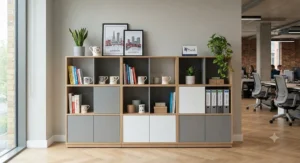
The analysis here is fairly clear-cut: open shelving wins purely on cost-per-shelf and quick-glance accessibility, but loses on every dimension that actually matters for document management — no protection from dust, sunlight fading, or unauthorised access. A closed office storage cabinet, whether steel or wood-fronted, earns its extra cost back the first time a client walks past an office and doesn’t see three months of invoices fanned across open shelves. Between the two cabinet types, the deciding factor is almost always whether security or aesthetics carries more weight for your specific room.
✨ Don’t Miss These Exclusive Deals!
🔍 Take your workspace organisation to the next level with these carefully selected office storage cabinets. Click on any highlighted item to check current pricing and availability. These picks will help you build an organised, professional home office you’ll actually enjoy using!
Rated Office Cabinets: What Reviews and Star Ratings Actually Tell You
It’s tempting to sort by star rating and buy whatever sits at the top, but rated office cabinets deserve a slightly more sceptical read than that. A 4.5-star average built on twelve reviews tells you far less than a 4.3-star average built on five hundred — sample size matters enormously, and it’s genuinely worth clicking through to “see all reviews” rather than trusting the headline number alone.
What’s more useful than the star average itself is reading for patterns in the written reviews, specifically around the two areas that come up repeatedly across every product in this guide: assembly experience and hinge or lock durability over time. A cabinet with a slightly lower star average but consistent, detailed positive comments about the lock mechanism six months in is a safer bet than a higher-rated cabinet where most reviews were posted in the first week of ownership, before longer-term wear issues would have had a chance to surface.
Reviewers consistently note that verified purchase reviews carry more weight than unverified ones, and that photos in reviews — particularly of assembled cabinets loaded with typical contents — reveal far more about real-world scale than the product listing photos ever do. Where this guide has flagged a specific rating (the Bisley 10 Drawer Desktop Cabinet‘s roughly 4.5-star average, for instance, or the HOMCOM Freestanding Storage Cupboard‘s roughly 4.4 stars from several hundred reviews), that reflects genuinely aggregated Amazon UK sentiment at the time of research rather than a marketing claim — and it’s worth re-checking current figures before you buy, since ratings shift as new stock and reviews accumulate.
Common Mistakes When Buying an Office Storage Cabinet
Even careful shoppers fall into a handful of predictable traps here, and most of them are avoidable with five extra minutes of research before checkout.
The first is buying on footprint alone without checking height clearance — a cabinet that fits the floor space perfectly but is 5cm too tall for a sloped ceiling or a low doorway during delivery is a genuinely common and entirely preventable disappointment. Always measure the delivery route, not just the final resting spot.
The second is assuming “lockable” means secure without checking what kind of lock it actually is — a basic cam lock on a thin steel door offers deterrence rather than genuine security, which is worth knowing if you’re storing anything more sensitive than internal memos. For anything covered by data protection obligations, this is where the beginner’s guide to data protection from the UK’s Information Commissioner’s Office is genuinely useful background reading — physical security like locked storage sits alongside password protection as a “reasonable step” organisations are expected to take with personal data (ICO’s beginner’s guide to data protection).
The third mistake is ignoring shelf adjustability, buying a cabinet with fixed shelf spacing that doesn’t match lever-arch file height, and ending up with wasted headroom on every single shelf. The fourth is skipping the anti-tip hardware, which several manufacturers include specifically because tall, narrow, top-heavy cabinets are a recognised tipping hazard once loaded and opened — not an optional accessory. And the fifth, subtler mistake is buying purely on price per litre of storage without weighing in delivery cost and assembly time; a slightly pricier pre-assembled or simpler-to-build unit often works out cheaper once your own time is factored in.
Long-Term Cost & Maintenance: The True Cost of Ownership
The sticker price is only the opening bid in what a cabinet actually costs over its working life, and this is where the cheapest option on paper doesn’t always win.
A £75 steel cabinet with a seven-year realistic lifespan works out to roughly £10.70 a year; a £270 contract-grade Bisley cupboard backed by a genuine seven-year manufacturer warranty and typically lasting well beyond that in commercial use could easily work out cheaper per year of service if the budget alternative needs replacing after three or four years of daily hinge and lock use. This is the classic total-cost-of-ownership trap: the lower upfront number feels safer, but replacement cost, lost productivity during a swap-out, and the hassle of re-organising contents into a new unit all belong in the real calculation.
Maintenance costs, thankfully, stay low across the board — a cabinet needs no consumables and minimal ongoing spend, which is exactly why the purchase decision matters so much upfront. The main “cost” over time is disposal, should you eventually replace a unit: businesses in the UK have a legal duty of care around waste disposal that applies just as much to an old filing cabinet as to any other commercial waste, meaning it can’t simply go out with domestic rubbish once it’s no longer wanted for office use.
Warranty length is a genuinely useful proxy for expected lifespan even when you can’t test durability yourself before buying — a manufacturer offering seven years stands behind the product very differently to one offering a token ninety-day guarantee, and that gap tends to correlate closely with the steel gauge and build quality you’ll actually experience day to day.
Safety, Regulations and Compliance for Office Storage Cabinets
For anyone furnishing an actual workplace rather than a purely personal home office, office storage cabinets sit under broader UK workplace regulations that are worth knowing about even in outline.
The Workplace (Health, Safety and Welfare) Regulations 1992 place a general duty on employers to maintain a safe working environment, which extends to furniture stability and the prevention of tipping or falling-object hazards — the anti-tip kits included with several cabinets in this guide aren’t a gimmick, they’re a genuine risk-mitigation feature worth actually fitting rather than leaving in the box. The UK’s Health and Safety Executive publishes accessible guidance for managers covering exactly this kind of basic workplace safety obligation (HSE’s short guide to workplace health, safety and welfare for managers).
On the data protection side, any cabinet storing documents containing personal information — employee records, client contracts, financial paperwork — falls within the spirit of UK GDPR’s requirement for “appropriate technical and organisational measures” to protect that data, and physical security like a genuinely lockable steel cabinet is one of the simplest, cheapest ways to demonstrate that obligation is being taken seriously.
Product standards compliance is the third pillar worth understanding: BS EN 14073 and BS EN 14074 are the relevant European furniture standards covering strength, stability and durability testing for storage cabinets and cupboards specifically. Products explicitly built to these standards, like the premium Bisley contract range covered above, offer a documented paper trail that can matter during insurance reviews, health and safety audits, or simply peace of mind that the cabinet has been engineered against defined criteria rather than just “looking sturdy” in a product photo.

Frequently Asked Questions
❓ How much weight can an office storage cabinet hold?
❓ Is a lockable office cabinet necessary for a home office?
❓ What's the difference between a filing cabinet and an office storage cabinet?
❓ How long does an office storage cabinet typically last?
❓ Can office storage cabinets be recycled when replaced?
Conclusion
The right office storage cabinet isn’t the one with the flashiest listing photos or the single highest star rating — it’s the one matched honestly to what you’re actually storing, where it needs to sit, and how much that content is worth protecting. A compact desktop unit like the Bisley 5 Drawer Desktop Cabinet solves a completely different problem to the Bisley Steel Contract Cupboard‘s compliance-grade archive storage, even though both are technically “office storage cabinets” wearing the same product category label.
Across the seven picks in this guide, the consistent theme is that trade-offs are unavoidable but predictable: steel buys security and load capacity at the cost of aesthetics and weight; wood and laminate buy a furniture-friendly look at the cost of moisture resistance and lockability; drawers beat shelves for small categorised items while shelves beat drawers for bulk paper. Once you’ve honestly answered what you’re storing and why, the shortlist narrows itself dramatically.
Whichever you land on, don’t skip the unglamorous details — fit the anti-tip kit, test both keys on delivery, and load from the bottom shelf up. They’re the difference between a cabinet that quietly does its job for a decade and one that becomes next year’s replacement purchase.
Recommended for You
- Heavy Duty Shelving For Office Storage: 7 Top UK Picks (2026)
- Shelving Unit for Small Office: 7 Best Space-Saving Picks (2026)
- Industrial Shelving vs Modular Shelving: 7 Best UK Picks (2026)
Disclaimer: This article contains affiliate links. As an Amazon Associate, I earn from qualifying purchases. If you purchase products through these links, we may earn a small commission at no additional cost to you.
✨ Found this helpful? Share it with your friends! 💬🤗
